 I had intended to get on with the south-central-east Africa postal history overview, but suddenly I have been distracted by … la belle France. I promise to get back straightaway to the Africa overview. Indeed, I have a delectable presentation on Zanzibar all ready to go. Might as well start with the “Z”s, right?
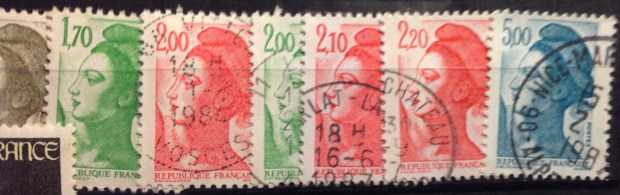
The Syracuse Stamp Club is really to blame for this digression. It was there that I “won” at auction a tasty selection of old French stamps. (I won’t tell you how little I paid for them — their catalogue value surely was a few dollars at least.) On examining them later at home, I realized I had acquired many values that were missing from sets in my limited collection. I started out by picking one set of definitives, from the 1930s, featuring a female allegorical figure representing Peace. I combined the new stamps from the  auction with those already in my stock book. (see right and below) The result was a pleasing display of many values in myriad hues, all bearing the classic design of “la France feminine” —
 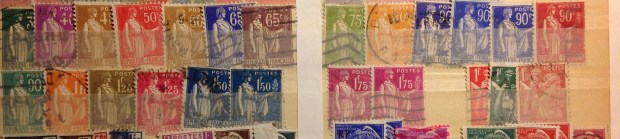 Peace bearing an olive branch. Good luck with that in the 1930s …
This fun little exercise gave me an idea. I noticed how all my early French stamps were bunched up in the front of my display in the stock book that mainly featured the gorgeous engraved landscapes, paintings and other multi-color stamp designs that make France so seductive to collectors. Some mint French stamps I swear are good enough to eat. Take a bite! Like an exotic leaf, a delicate fruit, or a sweetly etched wafer …
But these early French stamps aren’t beautiful, are they? What is it about them? They are just small rectangles, all featuring the same some allegorical figure. They seem to go on and on. Bo-r-r-ing …
Stop right there! That’s one of the pleasures of stamp collecting, after all — to assemble these related items in order, then display them in their various colors and ascending values, as a harmonious whole — that is, if you are lucky enough to have the set complete. These French stamps often came in long sets, which offer the advantage of a pleasing display, but also the challenge of trying for completeness. I’ve never tried that hard with the early French stamps, because it’s not really my main collecting interest.
However, now I am seized with a passing desire to assemble these sets from various places in my collection, and display them to advantage. I have a little stock book that is currently empty, so I’ll use it. Accordingly, I fill its pages with a special display of these early “French feminine” sets — not particularly valuable, but nevertheless historic, and colorful, elegant, inspirational …
I hope you enjoy looking at these sets, which I present toward the end of this essay. Let them soothe your eyes with their harmonious colors. Enjoy the orderly rows of stamps, all sharing the same design, marching across the page as they rise in numerical value. Consider how many of these stamps were used for letters mailed more than a century ago. Share the quiet pleasure of the stamp collector, taking in this colorful pageant.
 There is at least one other area I would like to explore sometime, involving French stamps. It’s about those wonderful landscape engravings that France has been issuing since the 1930s. The artists and engravers
 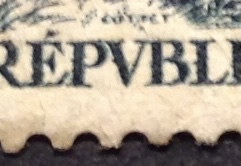 behind these small masterpieces of line, color and composition deserve attention, and no doubt there are stories to tell … (For example, I believe in every one of these landscape designs you will find the name of the artist/engraver in teeny-tiny letters along one side. In this example, it’s M. Cottet. See it in the enlargement at right?)
I gathered much of my French collection while I lived in Germany in my teen years. In the summer, my parents took us on driving tours of France, including Paris and environs, but mostly elsewhere. They charted circuitous routes through cities and towns and into the countryside — Joinville, Troyes, Avignon, Chateau-Neuf, Arbois, Mont St. Michel, Cahors, les Eyzees… Grenoble, Montpellier, Cognac, Vannes, Chartres, Reims … Cherbourg, Val de Saire, Angouleme, Libourne, La Rochelle …
One village and town was as pretty as the last, and I spent happy times sketching houses on winding streets, church spires and village angles and arbors of one sort or another. Now that I think of it, I may have been communing with the stamp artists whose beautiful landscape engravings of these same villages were on stamps I was 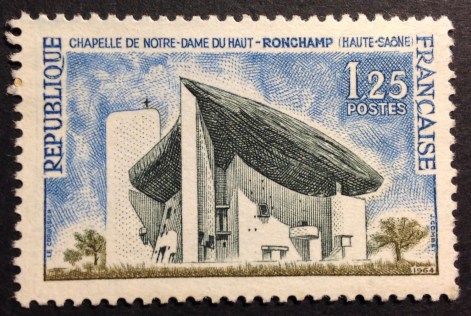 buying at the local post office. Indeed, I remember visiting Notre Dame du Haut, the church designed by Le Corbusier in Ronchamp, and buying the stamp, with the splendid engraving of the church, that had been issued months before. (right)
Q. Can you spot the artist’s name in the design abovet? Hint: It’s J. Combet.
NOTE: Believe it or not, there is much more detail available on all of this in the Fiske annals. One rich source is JMF’s travel notebooks, in the archive at the University of Iowa. Another is FMF’s diary, which continued into the 1960s, and which I am beginning to review for more details about these wonderful, meandering jaunts through France in the summers of 1960, 1962 and 1965 …
 DIARY EXCERPT: August 15, 1962 … Got to border at 2 p.m. without big incident. Looked for place to eat, but couldn’t get out of cities! Finally at 3:05 had picnic at Joinville. Are now in Troyes after big dinner. Bed 9:45. FRANCE IS WONDERFUL! … August 16, 1962 … Stopped at Cheateau-Neuf for stuff for lunch. Got going at 12:15. Stopped near Clery for lunch (picnic). Was fun. Stopped at
  Blois and saw chateau. Got to Tours at 4. Walked around and saw cathedral til 6. Then went to the Blairs’ house for supper. Was great fun, cause there were so many there. Bed 12. …
We stayed at picturesque inns, shopped for bread and cheese, then had picnics in the countryside, stopping by a stream, a shady spot or just a field, avoiding the cow paddies to spread a checkered cloth on the ground.

Could it really be that JMF (above) is actually checking for cow paddies while JRF looks on? 
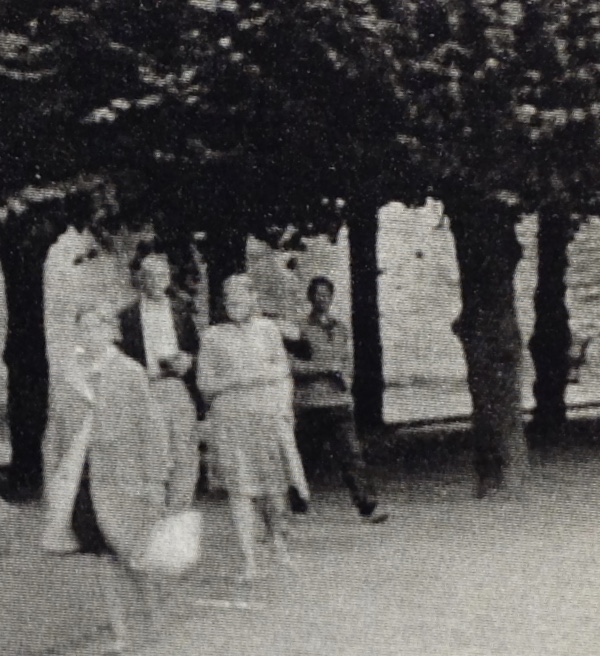
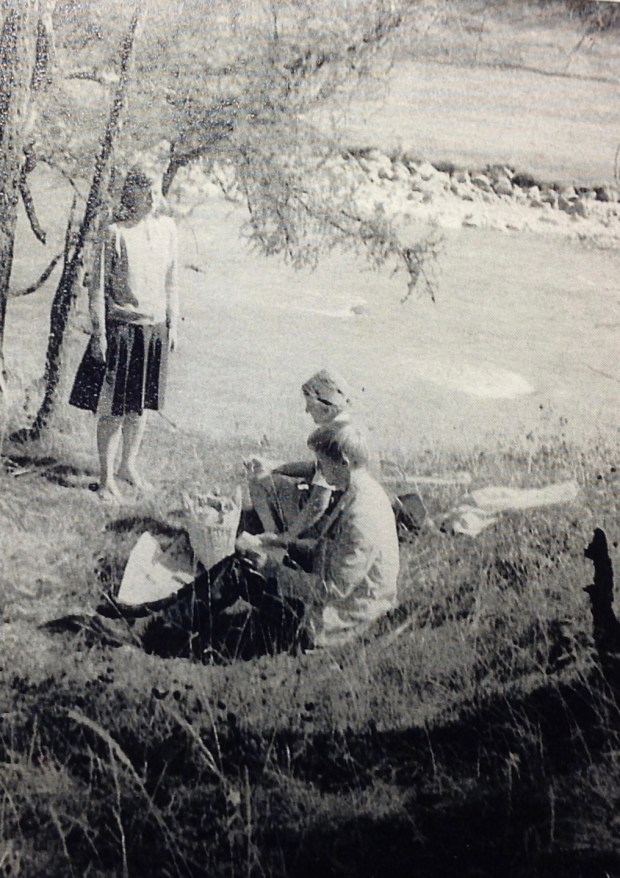
JMF served lunch — maybe pickles, always vienna sausage, cheese, bread, meats or other extras, limonade (or wine?), cookies … there was lounging on the tall grass, wading in the stream, a languorous ball game, perhaps a little accordion or guitar…
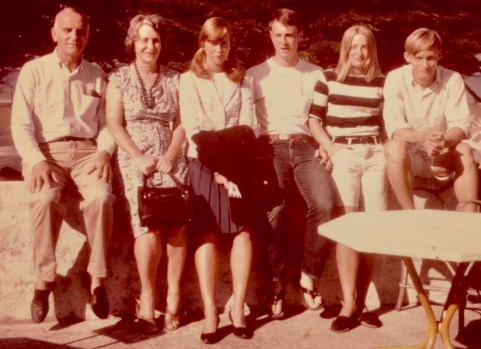 All three times we visited France, we made it to Ile d’Oleron, an island off the coast of Aquitaine that you could reach only by ferry in those days. Oleron was very French, but in a way Fellini would have enjoyed. We stayed for a week or more at a
pension, dining in a small central courtyard with a cast of characters out of a Tintin cartoon book. Every lunch and dinner included bottles of red and white local Clapotis wine in the middle of our table. My parents saved a copy of the Priere D’Oleron, which runs as follo
Mon Dieu! / Donnez-moi la santé pour longtemps … / De l’amour de temps en temps … / Du boulot pas trop souvent … / Mais du CLAPOTIS … tout le temps
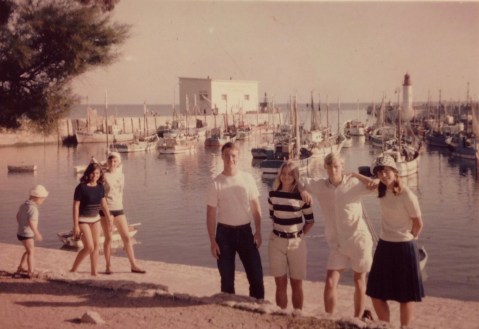 Oleron had it all — wild waves for body surfing at Vertbois (la cote sauvage), shopping in St. Denis, St. Pierre and Domino, and the quaint harbor of La Cotiniere, with fishing boats, the waffle maker (moule a gauffre!) and music and clowning around and oh! The aromas of sea and sugar and fried dough!
 DIARY EXCERPTS:
August 28, 1962 …then we hurried to Vertbois for an hour, then to la Cotiniere, where I painted a quick picture and ate a crepe, all in time to be back for supper. ….
August 22, 1960 … In the morning went down to the beach. It was at low tide. Then we saw the water zoom up over us. After lunch went swimming, and there were huge breakers. At night we all went to a circus!! What fun!!! August 23, 1960 … After lunch had a bad headache and went to sleep. Then others went to the lighthouse while mother read to me. Then my headache went away and went to beach. Got cotton-candy, and made an indestructible fort. Came home and had ARTICHOKES for supper!!! August 25, 1960 … In the morning went down to the beach and started an indestructible fort. Then came home and had lunch, and came back to the beach and finished my fort, then built protective wall and all that stuff. Then I watched the fort. Johnny made a pyramid that stayed, but mine was gone. August 26, 1960 … In the morning went to the beach, played in the sand, and then made a dam. Came home for lunch, then went around the island, then we went to Vertbois. It was damn fun with all the breakers. Came home, had dinner, and went to beach in dark. On second trip stopped at the “cassino” and had a high old time with the games. August 27, 1960 … In the morning went to the beach. I made a Cathedral, but somebody jumped on it. Went for swim, then helped Jonny with a dam (PARDON ME, LADIES). Had lunch, then went and played at the amusement house. On the way home got some cotton candy. Then went to Domino. At night went to amusement house. …
After Europe, I lived two years in francophone Congo, so I’m fairly well acclimated to the French language and outlook. As a teenaged philatelist visiting Paris in the 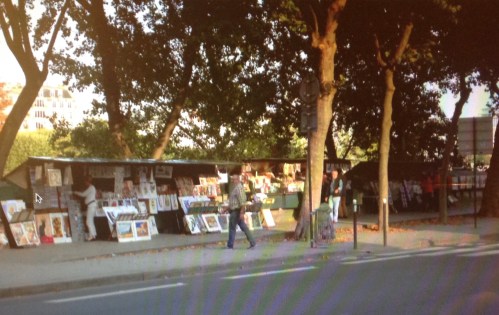 1960s, I managed to discover and revisit the open-air stalls along the Seine, les bouquinistes, who featured stamps along with books, posters, maps and other artworks and esoterica. The stamps were displayed on big boards under plastic sheeting gripped by clothespins in case of rain. The gypsies, brokers and sellers seemed ready to make a deal. There was a whiff in the air that anything could happen. Is that accordion music wafting through the elms? C’est magnifique! I don’t think I could afford to buy much, but I still had lots of fun looking.
My parents had strong connections to France. JMF wrote her masters thesis on Sasha Guitry, and lived in France after college, where she taught at a girls school just before WWII. When we returned to France in the 1960s, we had dinner with a M. Dupuy, who apparently had a crush on JMF back in the day. He went on to become a successful commercant of some kind — possibly a wine merchant — with a fine house and great family we had fun with on our visit. In the afternoon the teenage children took us to the piscine where we splashed about with cosmopolitan hilarity. Dinner was a grand affair, three hours long, with at least a half-dozen courses and accompanying wines, including one at the end our host said was 100 years old. I took a sip. Sweet.
My father’s great-grandmother, Anne MacMaster Codman, died in France and is buried in Pere LaChaise cemetery, in Paris. (LaFayette sent a condolence letter.) Pa first visited France in the 1930s, when he stayed with his cousin Ogden Codman, the decorator and builder and notorious queen, outside Paris. My father wrote a book-length manuscript about French language and culture, which I’m sure would have been well-received, had it been published. Seems another fellow came along with a similar ms. a little ahead of Pa … Anyway, let’s not get sidetracked by unpublished manuscripts …
What does any of this have to do with stamps? Let me get back to the subject of la belle France and its feminine symbol. Did this start with the women who marched on Versailles in 1789? Who was la Marsellaise? Who was Marianne? France always has depicted strong women on its stamps as aspirational emblems of the nation. As Goethe would say, das endlich Weibliche zieht uns hinan. (Notice how I use a learned quotation to get out of having to look up any of the answers to those questions. If you want answers, look them up yourselves!)
Here, then, are the sets depicting la Marseillaise, la Semeuse (the sower), la Liberte … The illustrated sets that follow are ones that I assembled from three sources: My original, limited collection; then, stamps added from the Syracuse Stamp Club auction lot; and finally, additions from my father’s collection, which I seem to have inherited. (lucky me!)
NOTE: Please carry on through the gallery that follows. At the end, there is more to the story!
GALLERY

 This set, which started in 1900, depicts various feminine allegories — for liberty, equality, fraternity the rights of man, more liberty, and peace. I have included a number of color varieties, which are noticeable. Note also the subtle bi-color designs on the higher-value, wider rectangles. A couple of them are a bit rare.
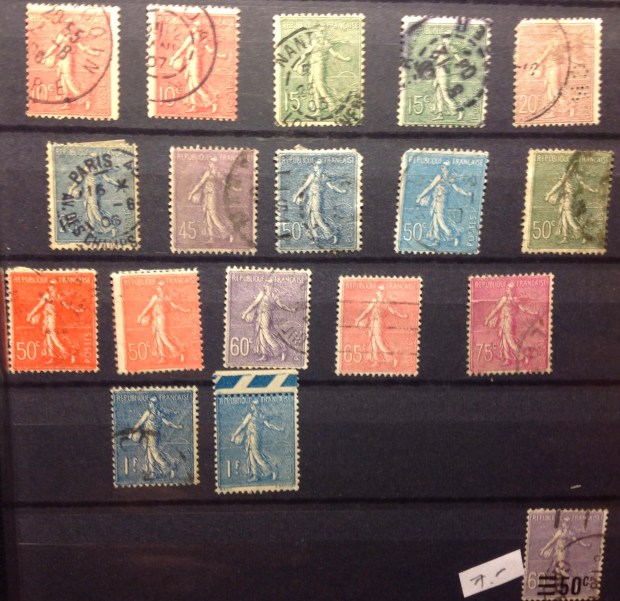 La semeuse, the sower, is the female allegory in this early design. The set started coming out in 1903, with new values released up to 1938. This classic design coexisted with another long set — of roughly the same design — which you will find
  on the next page. Why the two sets with the same design? Je ne sais pas, monsieurs-dames! I only ask that you agree with me that this allegory is an altogether pleasing figure. It is modeled after a medallion designed by Oscar Roty for the Department of Agriculture in the 1880s. The image appeared on French coins until 2001. An old Stampex pamphlet provides this “La Boheme”-worthy footnote: “The maiden who posed for the original of ‘The Sower’ on this stamp died in abject poverty in later years — a story with a tear drop at the end.”
 T
T his set (left) is an exception to the rule of the feminine — a depiction of Mercury on a definitive series. This one came out in 1938. After the Nazis invaded and occupied France in 1940, the collaborationist Vichy regime put out new stamps with a subtle change in the name — from “Republique Francaise” to “Postes Francaises.” (see enlargement below)

Suddenly Mercury
begins to look like Satan with a pitchfork, don’t you think?
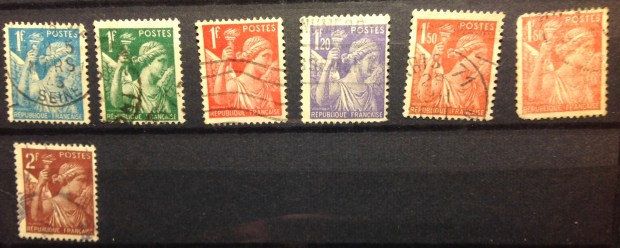 This set, depicting Iris, the Greek goddess of the rainbow and messenger of the gods, was issued in 1939. My catalogue says the stamps were in circulation until 1944, which means they were used during the German occupation. Hmm.
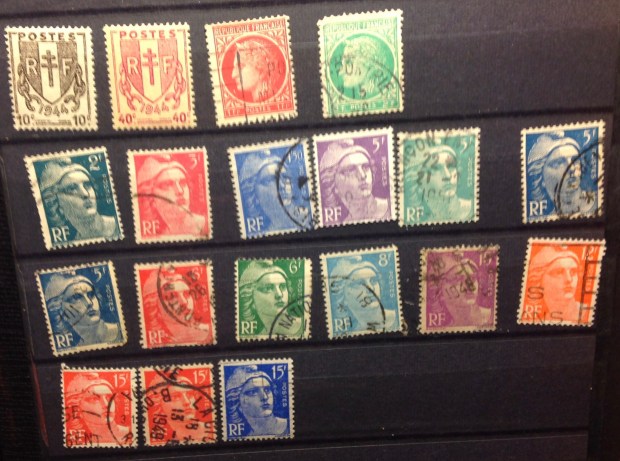
 These stamps, with the bust of a helmeted Marianne (or is it Joan of Arc?), were issued in London during World War II by direction of the Free French government. Apparently they were never used for postage. There seem to be wild fluctuations in value for these stamps — I suspect mine are at the low end, but some varieties are priced in the hundreds.
 H
H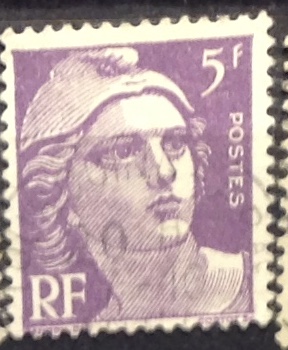 ere is the familiar postwar definitive set (1945-7), once again depicting Marianne. This beauty has a wholly Gallic expression — confident, alert, focused, slightly pouty lips, prominent nose, wary eyes on the future. Notice, too, the low-value designs (enlarged below) that incorporate the Ceres profile from the first French stamp of 1849 — about which more, shortly.


Without dwelling on them, I offer more examples of La Belle France on stamps over recent decades (see above and below)
 E
E
E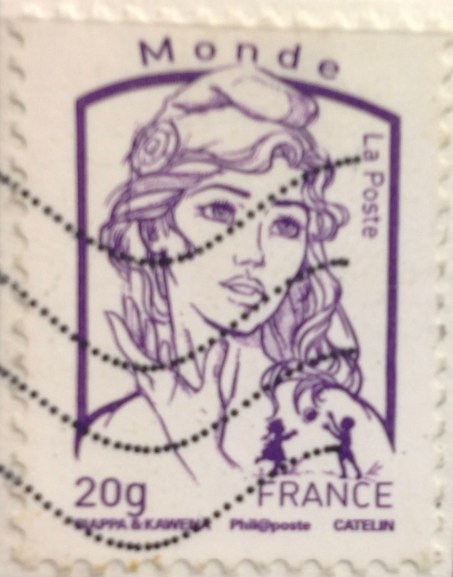 xcept now, qu’est que c’est? What is this? Is it really Marianne, the emblem of France? She looks like a cross between Bardot and Barbarella, a Victoria’s Secret model with tresses casually arranged and sculpted eyebrows under her chic Phrygian cap. Is she really going to lead the next revolution?
 I mentioned Ceres a little earlier — another feminine allegory, the goddess of Earth and fertility. I invite you now to the very beginning of French stamps. The first one had a profile of Ceres, and came out in 1849, a very awkward moment in French history. The Second Republic was in the second year of its short existence, having ousted Louis Philippe, France’s last king, after the confusing revolution of 1848. (I majored in French and German intellectual history at Harvard, and I still can’t explain it to you.) By 1852, the Second Republic had morphed into the French Empire under Napoleon III, who would soldier on until 1870 and the birth of the Third Republic, which endured until 1940.
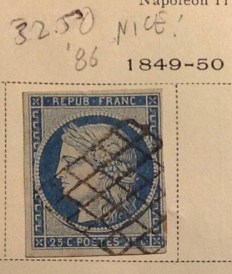
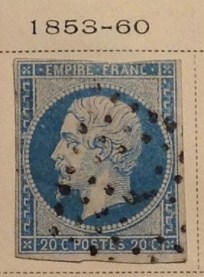 This explains why the first French stamps, in 1849, depicted Ceres, an allegory, rather than a king, and why the design changed to a profile of the “president” Louis Napoleon in 1852, and after that “emperor” Napoleon III (the same guy). After 1870, there was no more empire, so the Ceres design was used again. These stamps, seen at the bottom of the page below, are the so-called “Bordeaux issue,” named for the Republicans’ provisional capital as they laid siege to Paris and prepared to overthrow the tottering empire.

My father’s French collection was in his Scott album, printed in 1928. The first and second pages featured mint and used stamps from early France — including one from the first pair in 1849! As a reference point, Victor Hugo’s novel “Les Miserables,” was published in 1860. (By the way, the 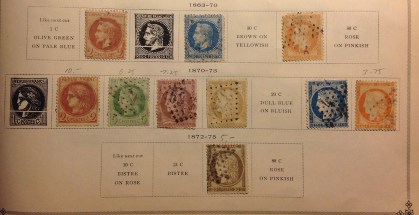 “uprising” referenced in that novel was a pretty minor skirmish in 1832.) 1860 was one year before the U.S. Civil War, the same year Abraham Lincoln was elected to his first term.
 This next design, launched in 1876 and lasting until the turn of the century, depicts two more allegories — in this case, one male, one female. On the left in the design is Peace, and to the right of the value tablet is Commerce. Pictured above is the set in
  my father’s collection, with enlargements to the right. Some of these stamps are quite valuable: The 5f mint stamp from the 1870s catalogues at $400! Wife Chris agrees with the suggestion to sell it.
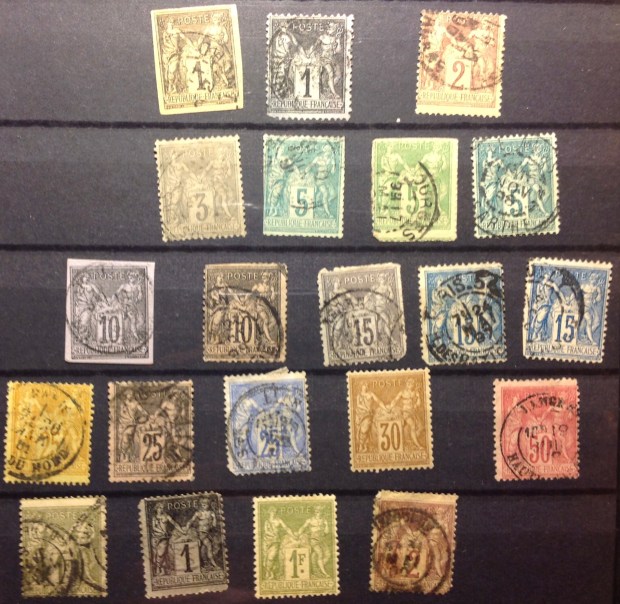
Above is the set I collected on my own, with recent additions from the Stamp Club auction. I was going to add the ones from my father, but decided to leave his precious stamps be for the time being. I like the way they look in the Scott album, which itself is nearly 100 years old. I expect I could sell some of the more valuable stamps on eBay, though I don’t really need extra cash …Maybe I’ll just keep enjoying them a while longer. TO BE CONTINUED


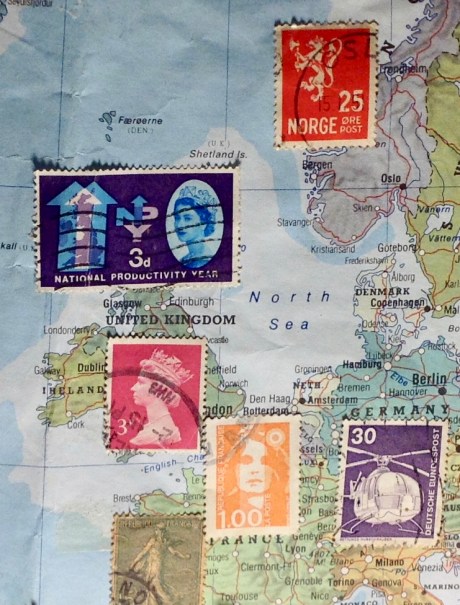 map is not in focus on the web page, but it seems the UK has a red Machin on England and if I am correct a 3d National Productivity stamp from 1962 above it which buries Scotland. Living in Wales, with the Celtic sensitivity that brings, I don’t think I can see an Irish stamp or any recognition that Wales, Scotland and Northern Ireland have their own definitive stamps. Please! This is by no means a criticism, just an observation, and I would be more than pleased (on receipt of postal address) to send you stamps to address this matter. I think Scotland is beyond help, but I can certainly offer you an Irish and Welsh stamp to enhance your wall map. …”

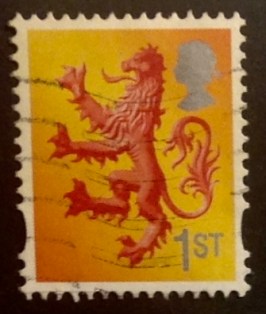
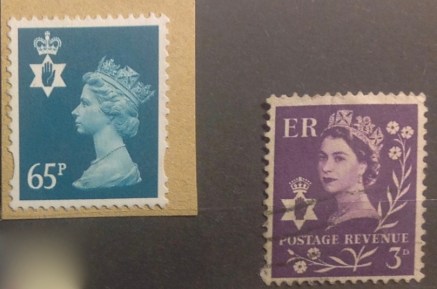


 of Paul’s stamps — for Scotland, England, Wales, Ulster, as well as the Channel Islands Guernsey and Jersey, also the Isle of Man. Since things were really getting crowded (crikey!), I substituted a small Irish stamp from my own supply instead of using one of Paul’s offerings. Yes, it’s surely a busy corner of my stamp map today. Anything wrong with that?
  Let me just add a word about the charming stamps Paul used on his mailing envelope, which are reproduced here. At right is another Welsh definitive, this one
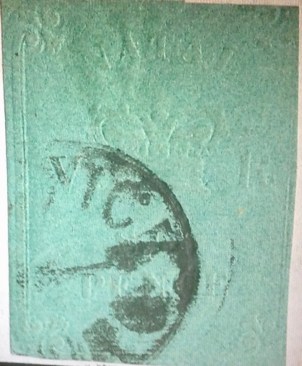
 What were the local overseers or the poobahs in the British colonial office thinking when they decided on the first postage stamps for Natal, in 1857? Designs and values embossed into cream, blue-, pink-, green-, rose- and buff-colored paper? What if you didn’t speak English, or did not read at all? If you could “read” these embossed images in the first place, would you know what to do with them? Did customers have
 impressions were
 Mecklenburg, Wurtemberg, Hamburg, Hanover, Oldenburg and Thurn&Taxis. Switzerland’s first cantonal stamps and Brazil’s “bulls-eyes” came out in 1843, four years ahead of the United States. The world’s rarest stamp — the sole surviving one cent black-and-magenta from British Guiana — was issued in 1856.
 savagely caricatured in the public press (abetted by stationers who saw their market encroached on and threatened by the Post Office letter). India tried a semi-embossed stamp in 1854 and promptly abandoned the practice. The Cape of Good Hope’s triangle stamps, issued between 1853 and 1863, were a novelty few copied. Argentina’s first stamps in 1858 were so crude they looked like children’s drawings.
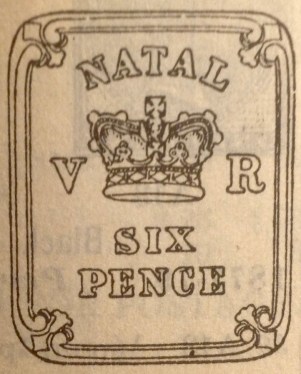
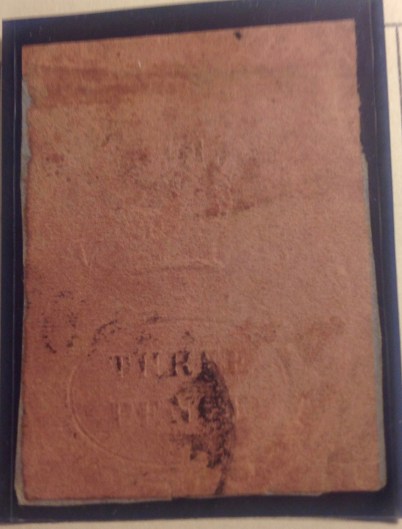 than actual size). The stamp has a catalog value of $500+, but that is for a copy with 4
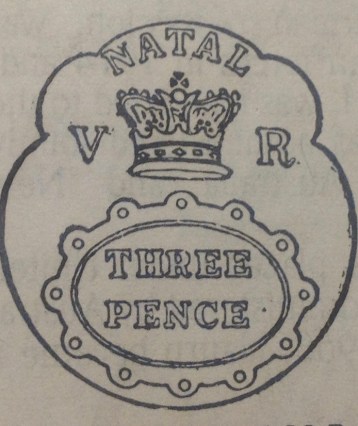 smudge of the cancellation. Actually, the margins are unusually large for this variety: just in at the bottom, clear the rest of the way around. Compare the faint embossing on the stamp with the design outline below it, as presented in the Scott catalogue, and see if you can discern these details on the original: 1) as stated, the number THREE PENCE is clear under the postal strike; 2) also visible are the circular border and the letter “A” from
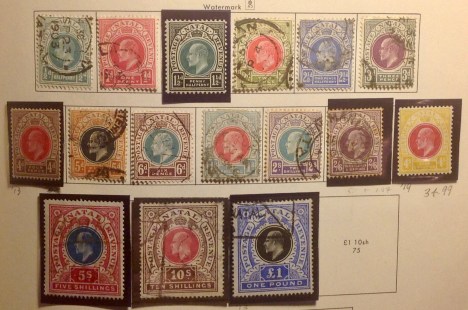
 Sets of early Natal stamps carried the elegant (and flattering!) Chalon portrait of the young Queen Victoria.
 in 1823. For years he lobbied the Cape Colony and Whitehall to make Natal a colony. After passive resistance from Capetown and London, the Boers took over and established the Natalia Republic, a regime so disorganized and incompetent — and oppressive of the indigenous people — that the British felt obliged to move in. By 1843, the Boers were out. After a final compromise on borders, many Boers trekked to neighboring Orange Free State or Transvaal. Over the years, Natal continued to play a role in regional affairs. In 1897 it annexed the Zululand protectorate, doubling its size. With gold and diamonds to be mined, the region thrived, and Natal’s port of Durban grew into an economic hub. In the 1890s, Natal won the right of “responsible government,” meaning local self-government. In contrast to the Cape Colony, where there was a historic commitment to universal suffrage, in Natal the voting laws were always skewed to exclude most black Africans and Indians. A 1904 census listed
 militants left Natal for good. (Unlike the Siege of Mafeking, in the Cape Colony, which was going on at the same time, no stamps were issued from besieged
 Mafeking; for that story see December’s blog post, “Mafeking Besieged!”)
 Transvaal/Zuikafrikaansche Republiek and the Orange Free State/Orange River Colony were contested
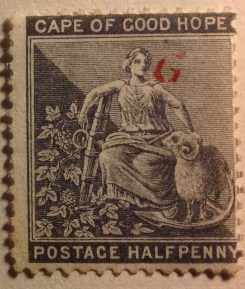 about a year, issued stamps. In the case of Griqualand, the stamps were simply Cape of Good Hope rectangles overprinted “G” in myriad ways. (See illustrations here from my collection). Stamp collectors beware: collecting all 102 Griqualand overprints could get expensive.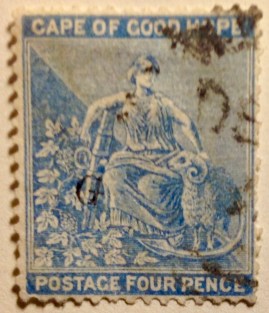
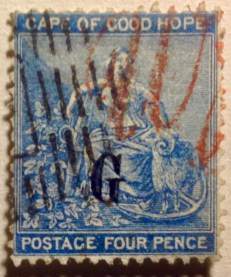

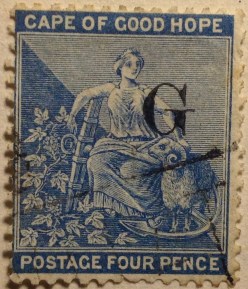

 an extremely rare Boer stamp overprinted
 primacy by cancelling the stamp y of their enemy with the overprint of their own] side. Who was really in charge here? Did it matter as far as the local black population was concerned? It certainly mattered as far as it resulted in black lives lost during the fighting between the white “tribes” — the Boers and the Brits!
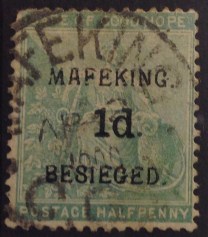
 Now take a look at this stamp (right). It is quite extraordinary. The overprint “Mafeking Besieged” on the Cape of Good Hope half-penny stamp identifies the desperate straits faced by the inhabitants of the Cape Colony’s inland city and strategic railway town. Stamps with this Mafeking overprint sell for a premium — I bought this average-quality one for L19.25. Other Mafeking stamps are much more valuable. My example has a somewhat rounded corner, upper left. But really, considering what a rarity it is, I’d expect you to be on my side on this.

 Behold! The Cape of Good Hope. Or should we use the name of the Portuguese who first rounded the point in the late 1400s, which they dubbed Cabo da Boa Esperanca? ….
 to found Cape Town (about 25 miles north of the cape on the map).
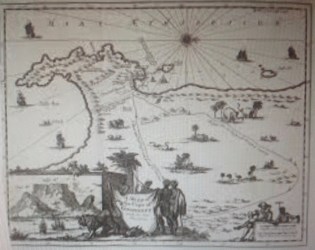 Here is an ancient map of the Cape of Good Hope, during a time when the Dutch and the Afrikaners and the Boers and the English lived as uneasy neighbors with each other — and the Xhosa and the Zulu. No one could have imagined what heartbreak and outrage would result from the transformational European incursion, starting at the Cape of Good Hope and spreading across southern Africa.
  Above is my example of the first stamp issued for the Cape of Good Hope: No. 1, on bluish paper. It came out in 1853, just six years after the first U.S. stamp. The somewhat crude but elegant engraving depicts a seated figure — “Hope” — with an anchor as an appropriate nautical emblem. Hope’s image would grace COGH stamps for the rest of the century. The triangular shape must have been a sensation at the time; and imagine! For a British territory at the southern tip of Africa! How exotic. The shape of the stamp itself suggests a geographical cape, don’t you think?
 I also got these two (left and below left) from my father. The 4d above, also from 1853,
 considerably off-center beat-up image. My Minkus album offers this notation: “Fine lines of background blurred or broken; printing less clear due to wear of plates …” This stamp is valued at $45, but mine is not a particularly well-cut example.
 Above are two examples from the first set of the “Hope” rectangles. If you look closely at the outside border of each of these two stamps, you will notice that there is a thin frame line that extends around the entire stamp. This is the only set that would have frame lines around the outside. What explains this change in later issues? Take a look at the stamps below, and you may decide, like me, that it’s probably a wise design decision — to eliminate the frame around the entire stamp; it’s slightly simpler, more coherent and elegant.
 Well before the first “Cape of Good Hope” set was issued, the British territory had expanded far beyond the cape itself. The map at left is from the early 1800s, and shows clearly how “civilization” is spreading east and north from the cape.
 By the time this map appeared after mid-century, the burgeoning Cape Colony was beginning to look like a map of New Jersey with its intricate territorial divisions.
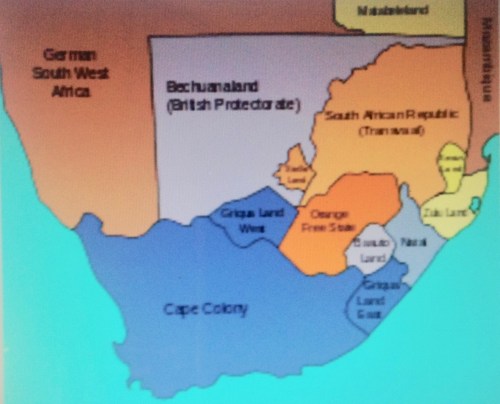 After 1872, the Cape Colony had the same rights within the British imperial system as Canada and Australia. It still issued stamps with the name “Cape of Good Hope,” but it was about to become the biggest baddest colony in Africa.
 Here is a map of Cape Colony at its apex, in 1898. In the 1904 census, the population of the Cape Colony was 2.4 million. That included 1.4 million blacks and almost 580,000 whites. The land mass covered 219,700 square miles — four times the size of the UK — yet the stamps still bore the name, “Cape of Good Hope.” Go figure. (You can still see the COGH sticking out like an inverted thumb-down near Africa’s southwestern tip.)
 Before we go any further, let me share what I’ve learned about how well the Cape Colony was governed in its early years. From the start there was lots of restless energy among the motivated groups of Dutch and English settlers, and considerable curiosity among the indigenous Xhosa, Zulu and other Bantu peoples. As the English, Boers and Afrikaners migrated along the coast and into the interior, they confronted each other and the native population with varying degrees of tolerance and respect. The Boers of the Orange Free State and Central African Republic established a racist hierarchy that subjugated the black African populations that surrounded and outnumbered them. The British, too, favored a racist hierarchy in Natal, Transvaal and the Cape Colony.
 John Molteno (right) was born in 1814 in London, part of a large English-Italian family of modest means. He shipped out to the Cape Colony as a teenager, working as a library assistant. He rose rapidly through the ranks because of his keen intelligence, outgoing manner and manifest competence. He won support from the Boers early on when he joined them in the Xhosa wars. Unlike the Boers, he espoused a lifelong commitment to equal rights for whites and blacks. When the British pressed for consolidation with the racist Boer republics in southern Africa in 1878, Molteno objected, on the grounds that the Boers would not tolerate the Cape Colony’s universal franchise. He lost his fight, and he was right. Molteno married three times. His first wife was “coloured” and died in childbirth. He went on to have 19 children; among his many descendants were anti-apartheid activists.
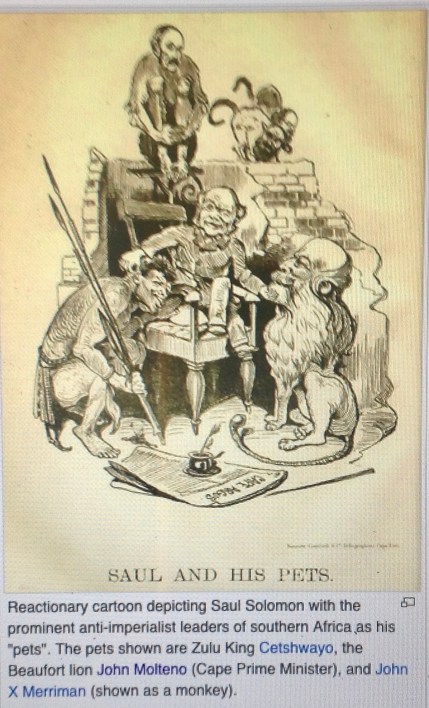 Molteno’s two key associates were John X. Merriman and Saul Solomon. Merriman’s extraordinary gift for administration helped build the Cape Colony into the economic engine that would power South Africa. Molteno persuaded Merriman of the importance of equal rights. At the end of the century, as the racist policies of Boer leader Paul Kruger became more dominant, Merriman presciently warned: “The greatest danger to the future lies in the attitude of President Kruger, and his vain hope of building up a state in a narrow, unenlightened minority.”
 Above is the last set issued by the Cape Colony, starting in 1902 with the death of Queen Victoria and the start of the relatively short reign of her aging son, Edward VII. There’s nothing special about the set, except that I want to show it off because I have it complete, from the 1/2d to the 5 shilling. You may find the set online for under $20.
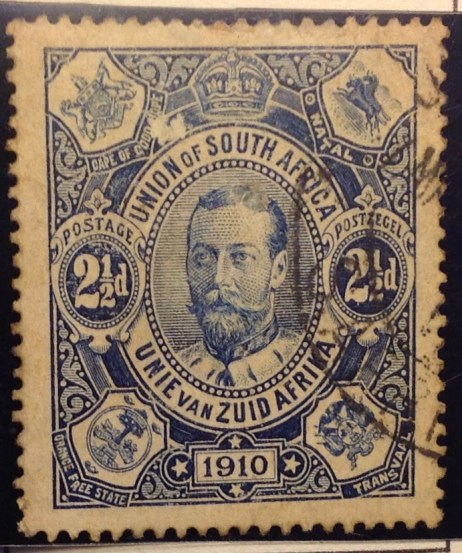 To the right is the first stamp of the Union of South Africa in 1910, the same year as the death of Edward VII and the ascent of his son, George V, to the throne. The union comprised the Cape Colony, Orange Free State, Transvaal and Natal (see coats of arms in the corners). As you can see from the map below, the union encompassed the whole of southern Africa with the exception of Swaziland and Basutoland.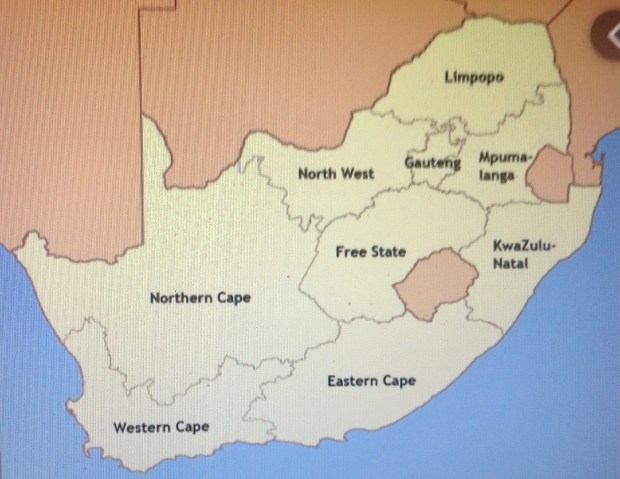
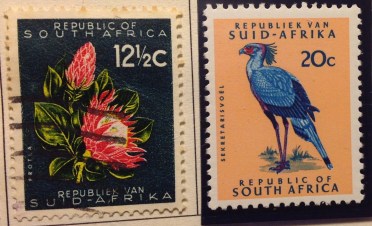 In 1961, the Union of South Africa became the Republic of South Africa (RSA). This name change did not alter the repugnant system of apartheid or improve the lives of black South Africans in any significant way. The RSA would not abandon apartheid until the 1990s.
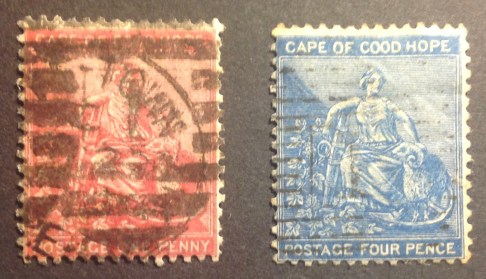 To start off, look at these two dandy examples of the first “rectangle” set (right). Notice the frame going all the way around the outside of each stamp. Do you see it? Do you? Do you? Look hard! See it? (Here’s a helpful note from The New World-Wide Postage Stamp Catalogue: “Worn plates of 1p, 4p show no top or outer frame lines.” I can hardly see them here either.)
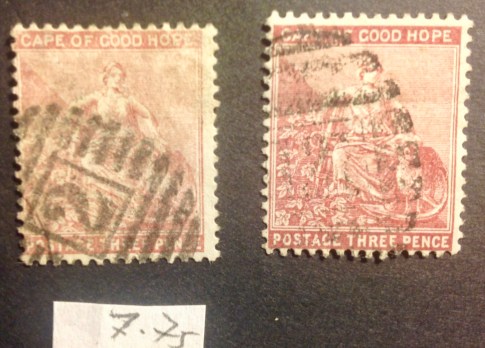 Now as a contrast, look at this pair (right). See the frame stop at the upper and lower border of the image? You might or might not be interested to know why one of these 3d stamps cost me $7.75 and the other didn’t. The reason is that the expensive one is listed in the catalogue as No. 25, ‘lilac rose (’80),” while the one on the right is listed as No. 26, “claret (’81)”
 This stamp is not distinguished or valuable, but I include it because it is the only mint (uncancelled) variety I have from these Cape of Good Hope sets. I puzzled for some time over what are described as “emblems of the colony.” What at first looks like a wheel is the anchor, of course. That’s a ram standing inside the anchor’s curved heel, right? In the background are grapes, I’ll bet. And Hope is leaning on … well, that took me more time to figure out. Is it a lute or some other stringed instrument? Something to press grapes into wine? Something to poke or slaughter a ram with? Is she holding something, like a mug or flagon? Is she drunk on grape wine?
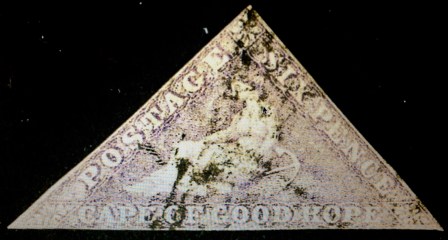 Here’s one that got away. The image is from online. It’s a half-decent example of No. 5, the 1 shilling yellow green (yellow green?). It catalogues at $175, and is a pretty example. I could have bought it for $35, but I let it slip away. (Sigh …)
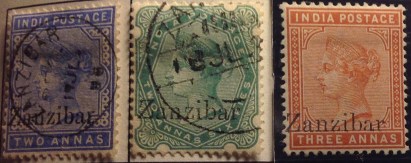
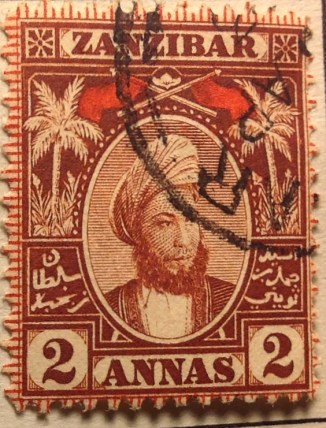

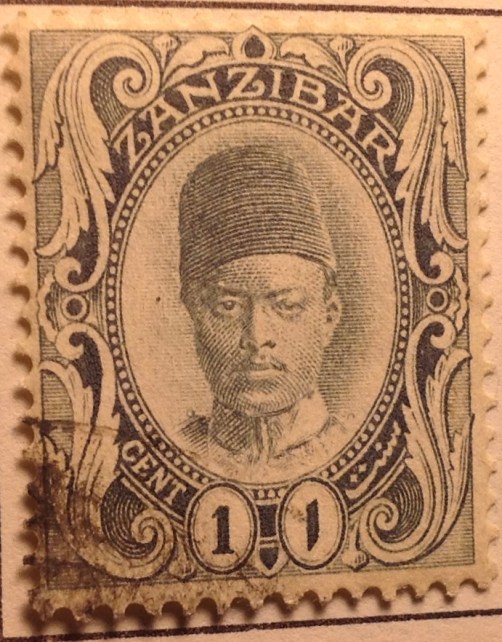

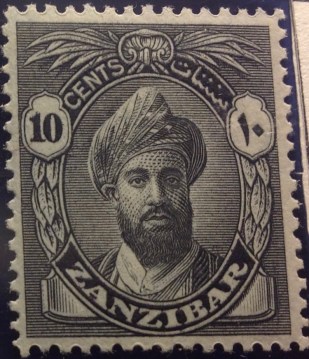
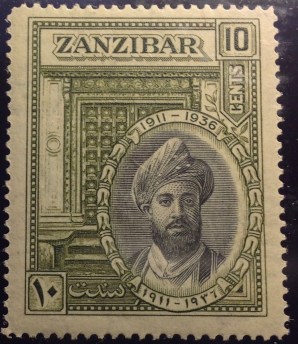 built, the port was developed, sanitation and living standards improved. It’s not as though the people had anything to say about it, though. The British overlords deserve at least as much credit as the sultan for any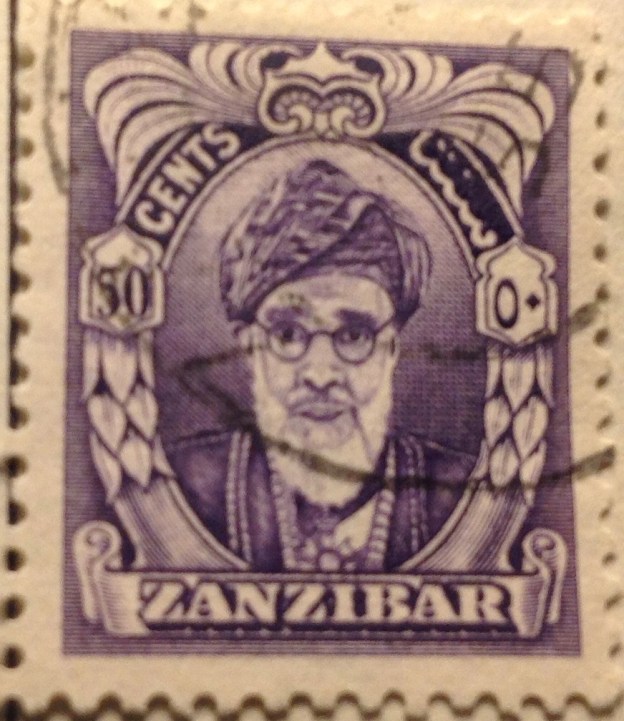
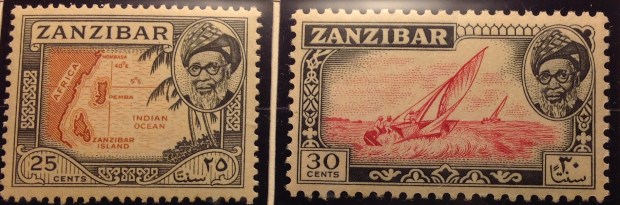

 The sultans and their British masters had been in cahoots for more than a century, lording it over the people. It’s sadly predictable that a month after Zanzibar gained its independence (“uhuru”) in December, 1963, a bloody insurrection overthrew Sultan Jamshid bin Abdullah (pictured at left). The last sultan was able to escape into exile. At this writing, he is 90 years old and living in Portsmouth, England, where he settled with his wife and seven children.
 last sultan, Jamshid, didn’t have time to put out an updated definitive set using his own portrait. The
  stamp at right is a record of unfolding history — “uhuru” in 1963 and “jamhuri” in 1964. How Is a republic an improvement over a constitutional monarchy? Discuss.




 Later in 1965, revolutionary postal officials finally acknowledged Zanzibar’s official merger with Tanzania, though they brashly stuck their islands’ name ahead of the mainland in the ungainly title
 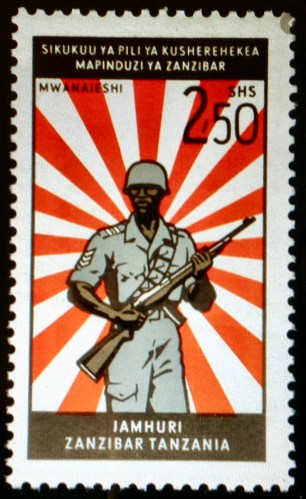 At right is a stamp from a short set of 1966, celebrating the second anniversary of the Zanzibar Revolution. Notice the rifle. Notice at the bottom of the stamp is the name “Zanzibar Tanzania.” Is Tanzania implicated in the Zanzibar Revolution, or what? Would the merger have happened without the revolution? Discuss.
 **Note:

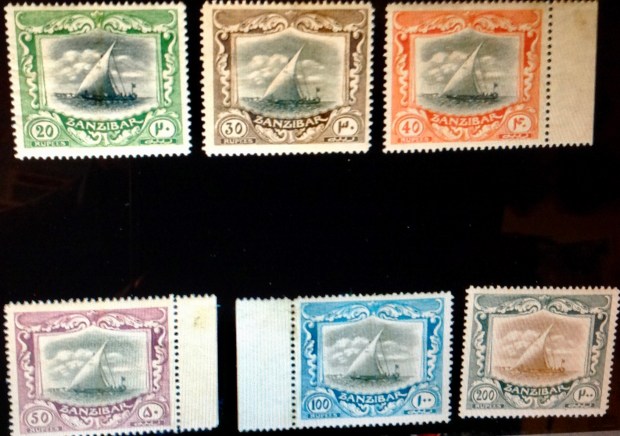
 Here is an example of why stamp collectors get a reputation for being kind of … kooky. Look at this envelope (right). The colored labels are postage-due stamps from 1931, carrying nothing more than the value and the message, “Insufficiently prepaid postage due.” They don’t even say “Zanzibar.’ The cover is selling online for $3,674. OK, it’s rare. But hardly in demand. And they sure aren’t very pretty.
 How to summarize the 50-plus years of Zanzibar history after 1964? I’ll just say a few words. The stamp at left shows an inverted “Jamhuri” hand overprint from 1964. Looks like someone acted carelessly, perhaps in haste. You can buy these inverts online for $10 and up. The errors seem fitting, considering the upside-down story


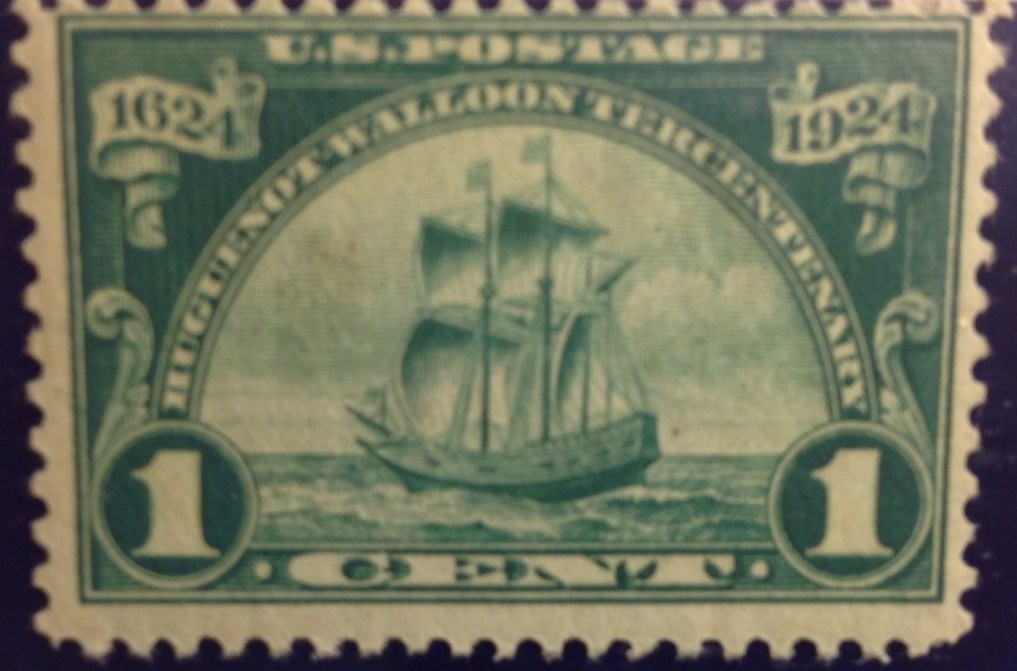
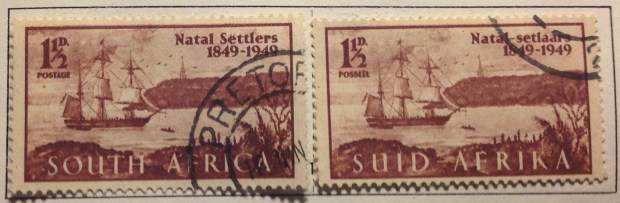
 from religious persecution at home. Likewise, among the Dutch and German adventurers who landed near the tip of southern Africa in the same century were French Huguenots, fleeing persecution for their faith. Dutch navigators Jan van Riebeeck sailed to the Cape of Good Hope, found safe harbor for his ships in Table Bay in 1652 and went on to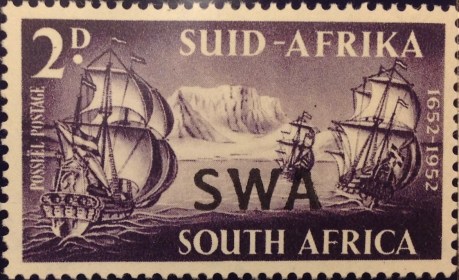







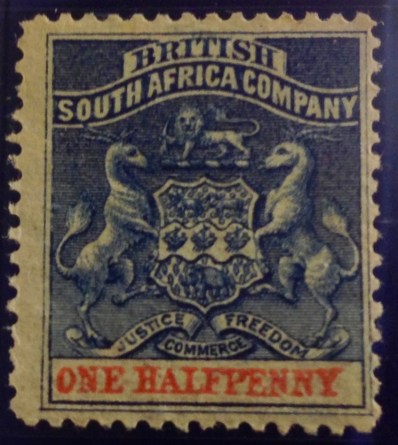 In the end, I would simply offer this rationale for my leap into these deep waters with the FMF Stamp Project; it is the justification for all historical study: to know how we got here. How did the “British South Africa Company” become Zimbabwe? How did the Cape of Good Hope turn into the Republic of South Africa? What happened to Transvaal, Natal, Zululand, the Orange Free State, the New Republic, Stellaland, Griqualand West? (Not to mention Griqualand East?) Why did Bechuanaland split apart? Answering these
 colonialism combine much of today’s conventional wisdom with another possibility. I agree the colonial enterprise in Africa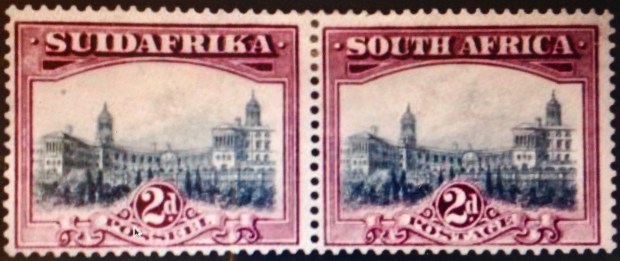
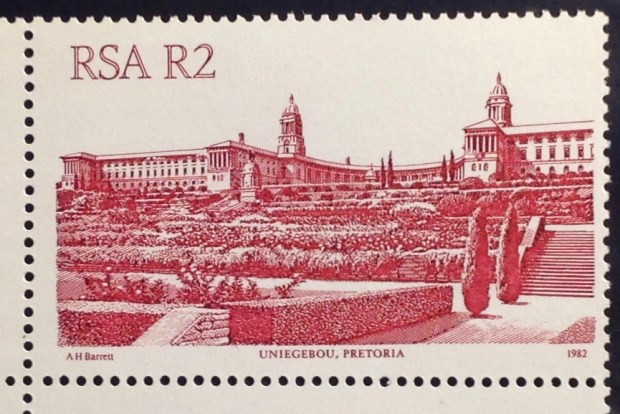
 from the 1850s, and a hand-stamped emergency issue of 1900 from the Cape of Good Hope, overprinted “Mafeking Besieged.” So please —
  read on!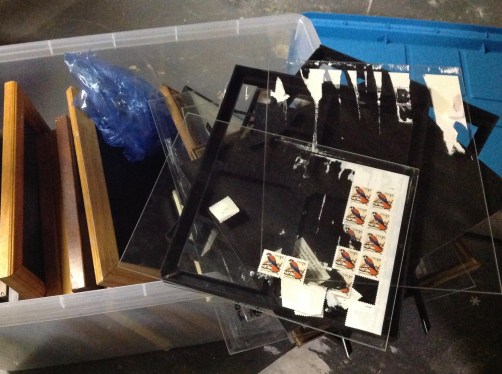
 nothing can ruin the value of a mint stamp quicker than a drop of water.
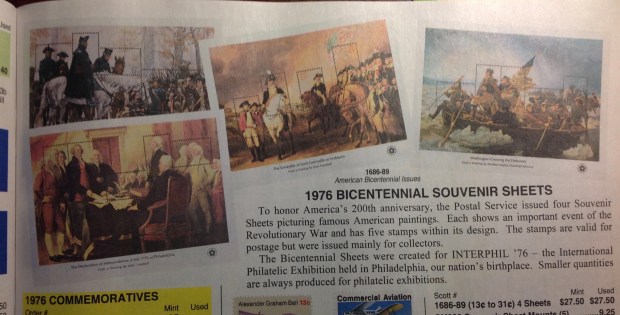
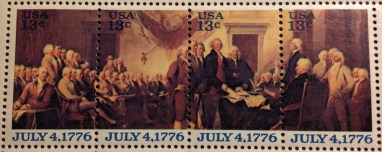 its wisdom to issue a four-stamp set July 4, displaying a wider view of the same painting that appeared on one of the souvenir sheets — signing of the Declaration — with the inscription, “July 4, 1776.” (see right). I took advantage of the situation by affixing that set, along with the souvenir sheet containing a detail of the same design, to an oversize envelope bearing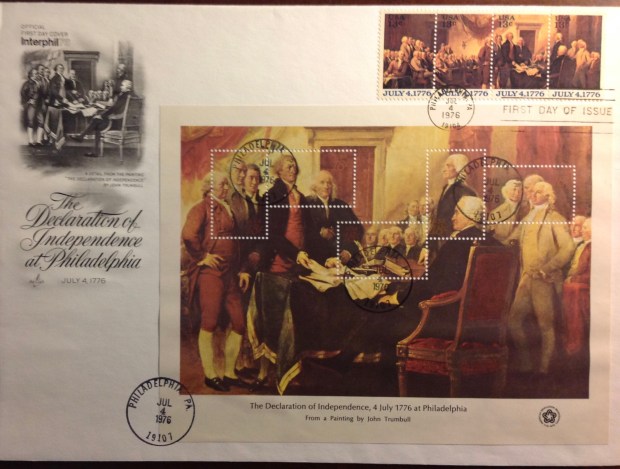
 I concocted back in May 1976, when the Bicentennial souvenir sheets were issued (see right). First I broke up one of the “Yorktown” sheets, and must have used three of the five embedded stamps for postage on letters. The other two stamps, still intact with the sheet remnant, I stuck to a commemorative envelope, put my address on it and had it sent to me across town through the mail, complete with the first-day cancel. Any idea what a partial first-day cover is worth?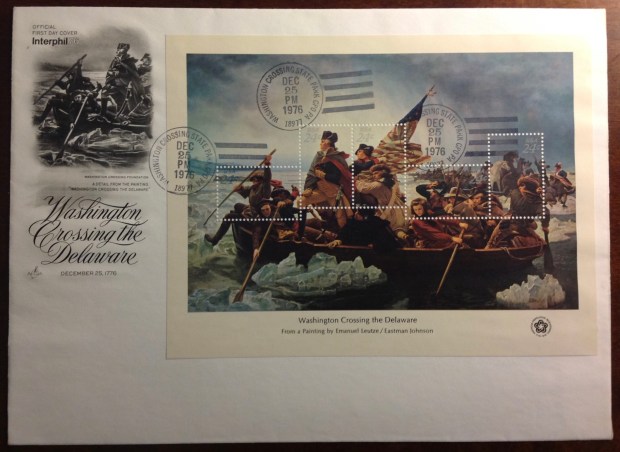
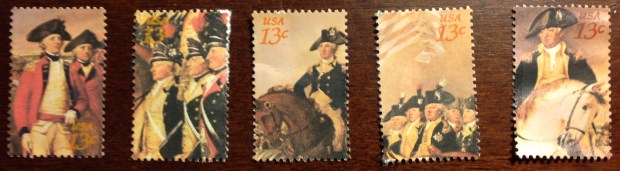
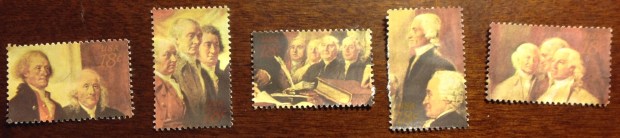
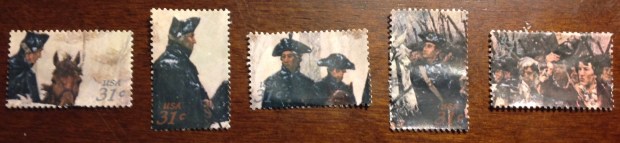
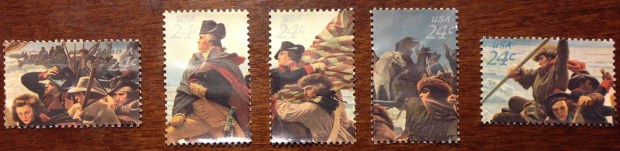 Now consider: I have recovered each of the five stamps on the bicentennial sheets (pictured above). Removed from their surroundings in the damaged sheets, they take on a whole different aspect. If you examine them one by one, you may conclude, as I do,
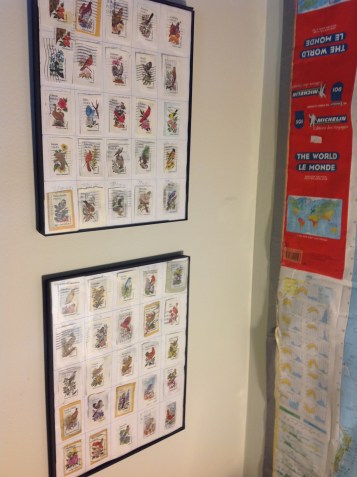
 The last two frames I offer for your inspection, at right, represent a considerable labor of love on my part. I patiently accumulated cancelled copies of each one of the 50 values in the 20-cent state-birds-and-flowers series of 1982. (Back then I was a newspaperman and had access to tons of mail.) Then I mounted the set, in alphabetical order of the states, on two grids and framed them. Cute, eh? At first the frames didn’t appear to have suffered damage, but when I started to lift the glass out of one frame, some of the stamps stuck and
 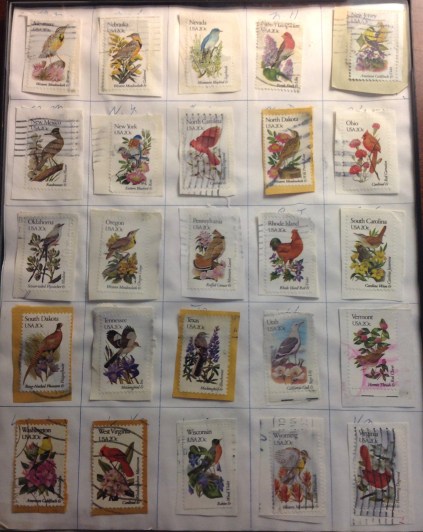 started to come apart. I stopped immediately, returned the glass to the frame and let it be. What to do now? Since these are used stamps, I suppose I could soak them off in water (!) and even assemble another two-frame display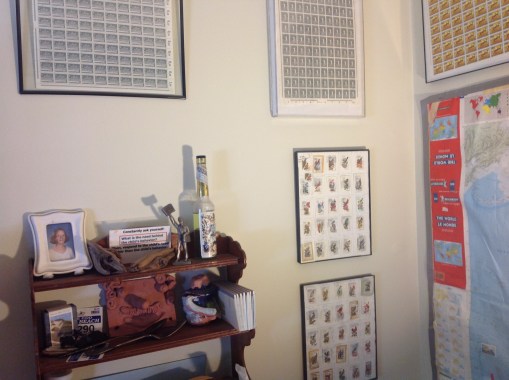
 My first memorable encounter with philately came when I was about six, in 1954, at The Pigeon House, a drafty converted coop-barn that my family stayed in for several summers near the south shore in Marshfield, Mass. It was part of the “farm” on Pudding Hill Lane that
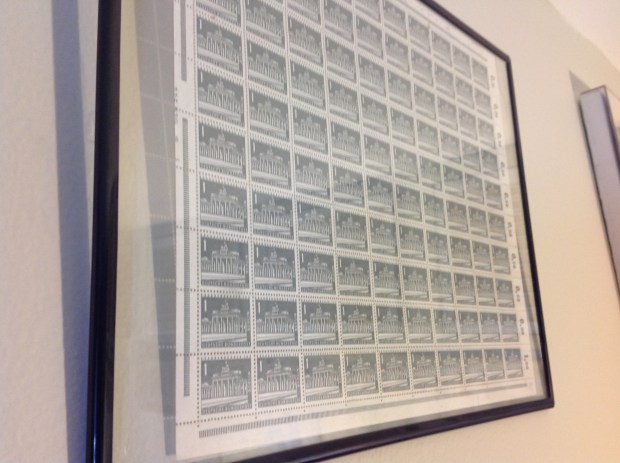
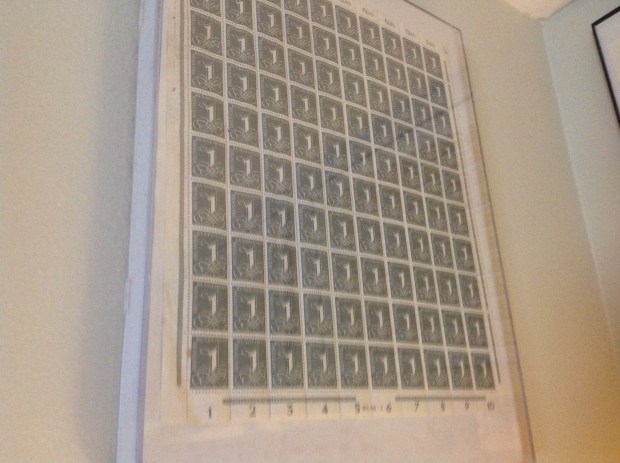
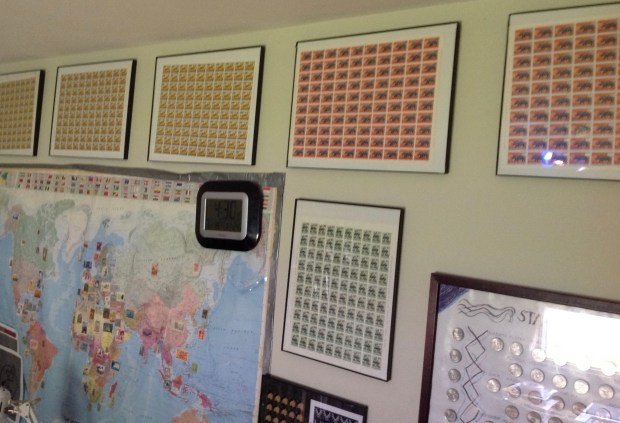
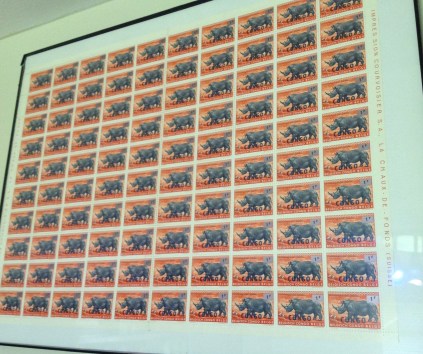
 The image at right is from the line-up of framed stamp sheets from Congo on the wall of my study (see above). The stamps originally were issued for the Belgian Congo, overprinted at independence — then overprinted again in subsequent years. This stamp started out as the 1f50 value from the flowers series of 1953, which was overprinted “CONGO” and became the first definitive set of independent Congo in 1960. In 1964 it was surcharged in black on silver, as Congo lurched toward ruin in the hands of Mobutu Sese Seko.
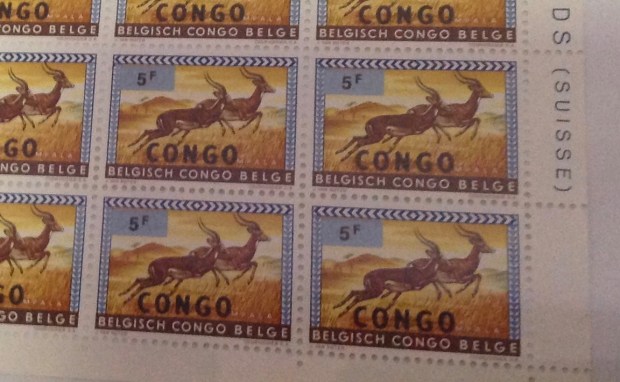
 In this pair of images and the next pair you will find two examples of what was once the 20 centime stamp from the Belgian Congo 1959 animal series, overprinted “Congo” in the second definitive set after independence in 1960. Here the original 1959 stamp carries a silver overlay
 This
This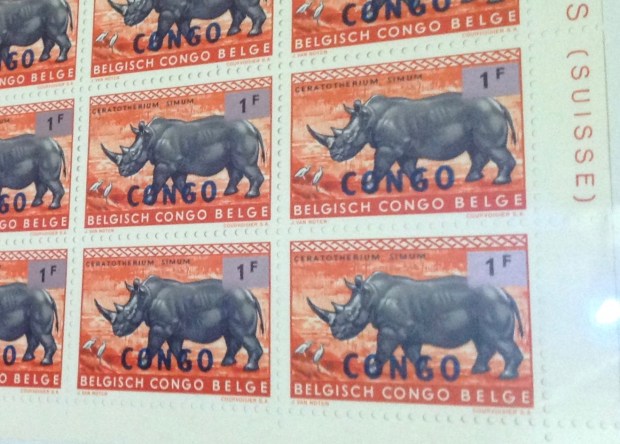
 OK, let’s really get into it. If you like, run quickly through this pair of images and the next two pairs., then come back…. On first glance, all the stamps look alike, right? Well, they started out being the same — the 6f50



 Above my desk you will find a Stamp Map (above) — the world laid out before me, with stamps from many nations attached to their country of origin. Seems like it’s always been there on the wall … a bit like that bathroom at The Pigeon House, eh?


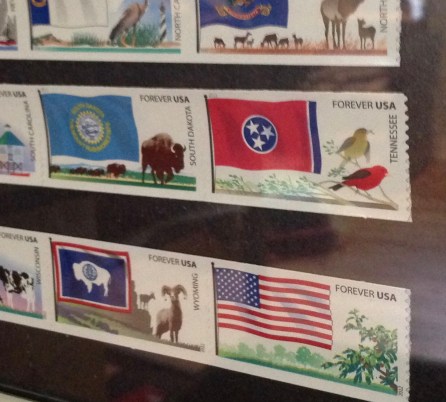 This series (above and rifght) confirms the wisdom of my decision to frame and display my stamps. There’s just no other good way to handle these stamps! It’s from just a few years ago, an issue with 60 values, one for each state and a number of “generic” USA stamps.
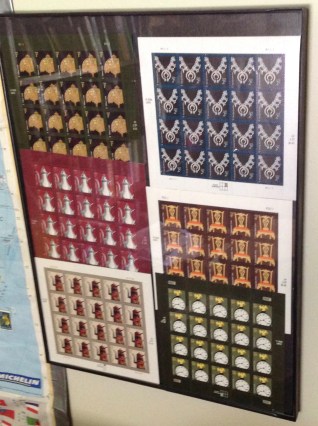 Here is another enchanting exhibit. A few years ago, the USPS issued a series of low-value definitive stamps featuring vintage designs — jewelry and household furnishings. The charming, full-color vignettes had colorful backgrounds and common design features for each value — 1c, 2c, 3c, 4c, 5c and 10c.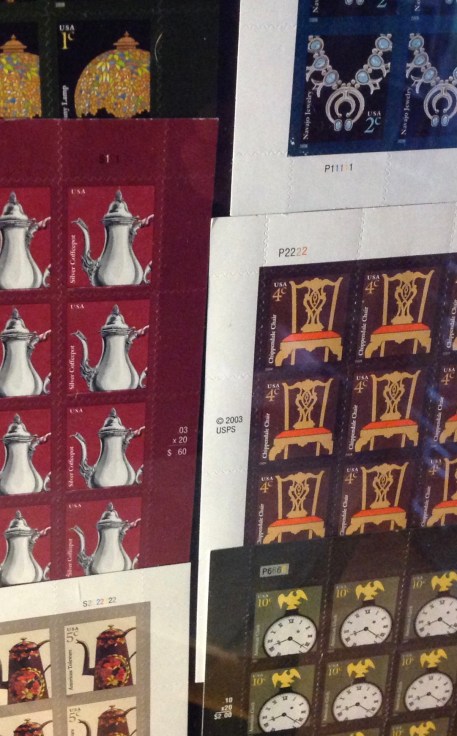
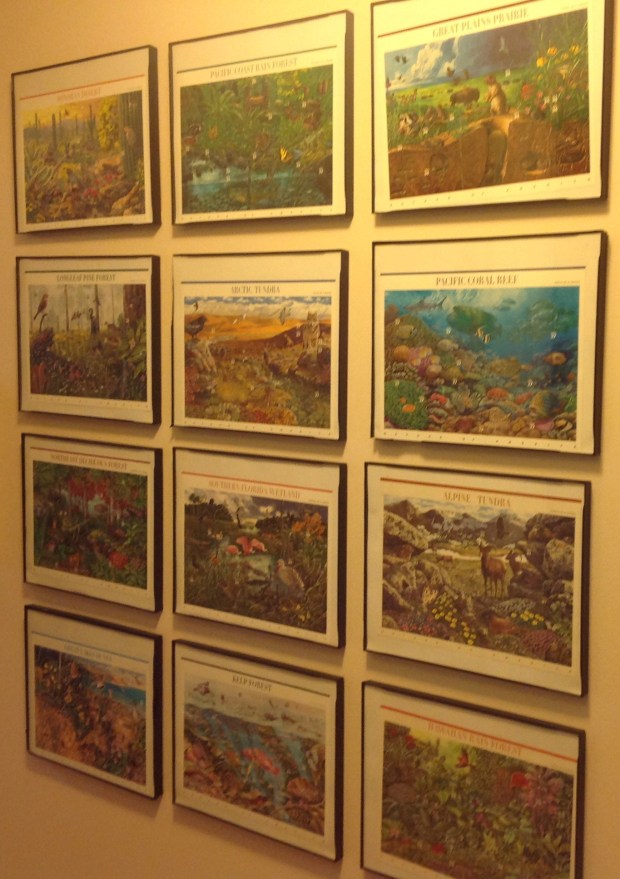 These beautiful landscape paintings appeared in a series of 12 sheets under the heading, “Nature of America.” The sheets were designed and executed so that you could identify easily the essential information — “USA 33” — to locate the stamps within the sheet. You’d just peel off stamps as you needed them. If you look closely, each stamp has a design that stands on its own. Clever. Sort of like a loopy version of an advent calendar. Or a sticker book in reverse.
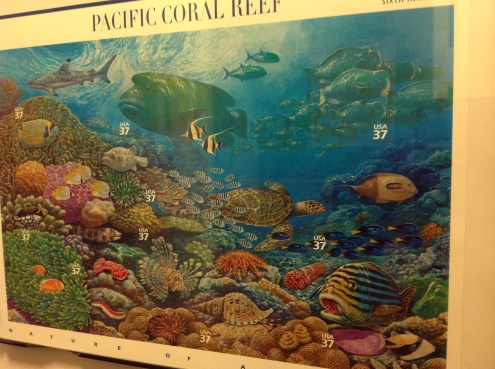 At left are enlarged versions of a couple of the sheets, one featuring a Pacific Coral Reef, the other the Sonoran Desert. All the sheets are worth a look, and they are not expensive — about 60 bucks for all 12. Other scenes depict the
  Pacific Rain Forest, the Great Plains Prairie, Southern Florida Wetland, Northeast Deciduous Forest, Alpine Tundra, Great Lakes Dunes, Kelp Forest, Hawaiian Rain Forest, Longleaf Pine Forest and Arctic Tundra.
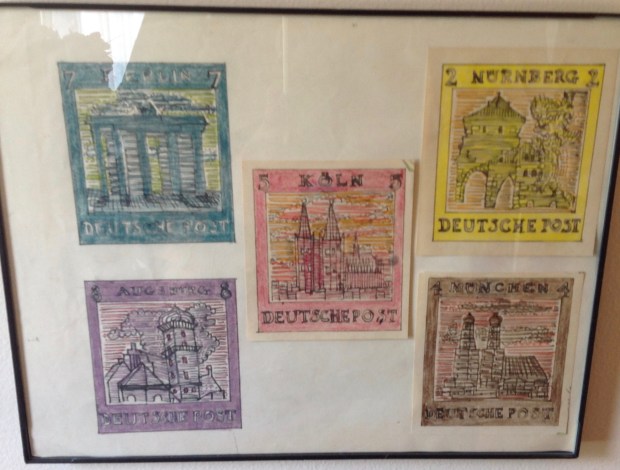
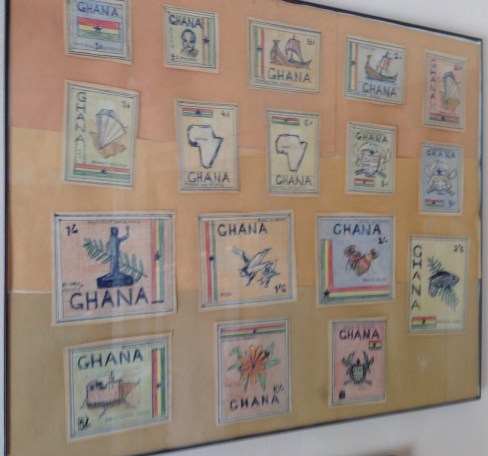 These final “stamps” on display aren’t really stamps at all, but rather my own fanciful designs for imaginary sets from exotic lands, concocted during my teenage years when I actually lived in exotic lands like Congo and Germany (but not Ghana or Australia).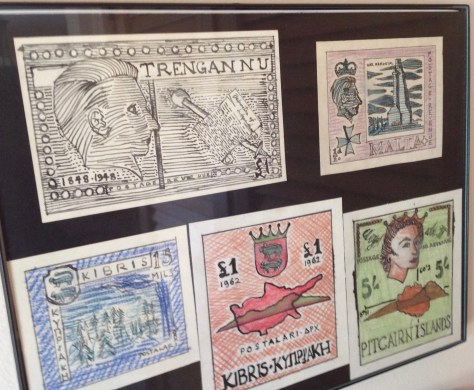


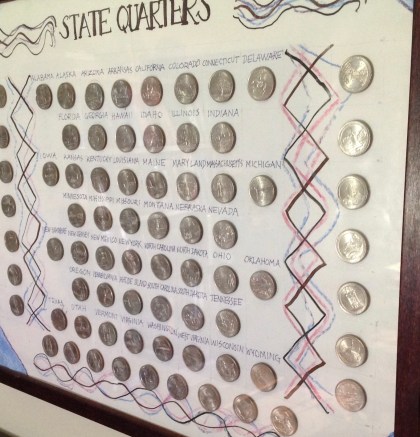 Finally, here is my display (right and below) of the “state quarters” that started appearing over the past decade. I had no idea, when daughter Tanika and I crafted this display, that the US Mint would keep issuing quarters for all sorts of monuments and moments. I have more than a dozen waiting to be added to my collection — but how will I fit them in? And will the practice of churning out new quarters never end?
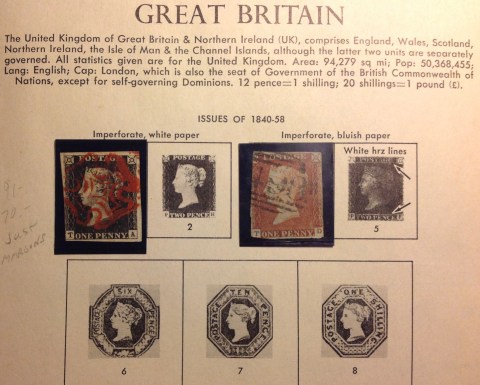 If you have paid close attention to my stamp blog, you know I have a nice copy of Great Britain No. 1 — the world’s first postage stamp, also known as the Penny Black. (see right)
 Take, for example, this early two-color British India stamp of 1854, featuring an imperforate octagonal frame with a portrait of Queen Victoria (right, from the Internet). A nice copy like this pretty stamp (grabbed from the Internet) will sell for up to $450.
 Here is an example, from the Internet, of the 4-anna stamp, cut to shape. It’s not cheap, but much below the cost of a rectangle. Get my point?
 For starters, take a look at this beauty (right). It’s the famous British Guiana one-cent black-on-magenta, a fabled one-of-a-kind variety. And as you’ll notice, it’s cut to shape. That doesn’t prevent it being sold and re-sold, every now and then, for millions.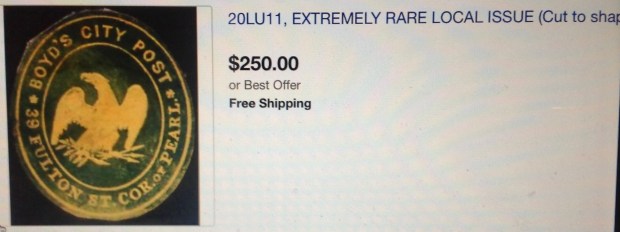
 More common are examples like these, also from the Internet. Notice the relatively low price for these ancient embossed beauties. They’d be worth a lot
  more if they were not cut to shape.
 Whatever value the medallion-shaped oddment here had was decimated by the lame-brained stamp fiend who cut it to shape. (Was it a younger me?)
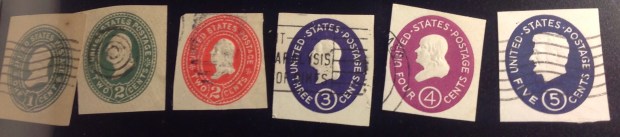 This is a cute enough collection, and they’re all nice rectangles. Not worth much, though.
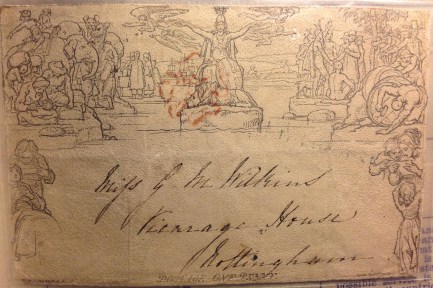 As I segue back to my quest for those early GB embossed stamps, I offer this: the world’s first “envelope stamp.” It’s from 1840 in Great Britain, and it’s known as the Mulready Cover — a one-penny foldable sheet you could write on, seal up and send through the mail. The idea never caught on. (This nice example is from my collection; I expect it’s worth at least the
  $40 I paid for it.)
 some kind of holographic horror representing the space program or something like that.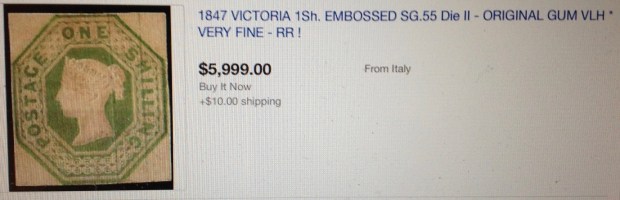
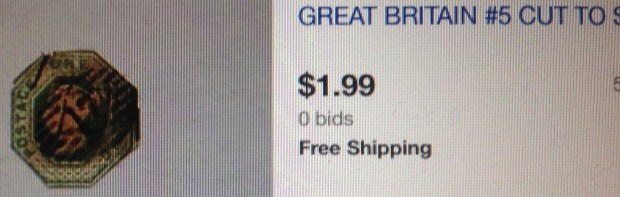
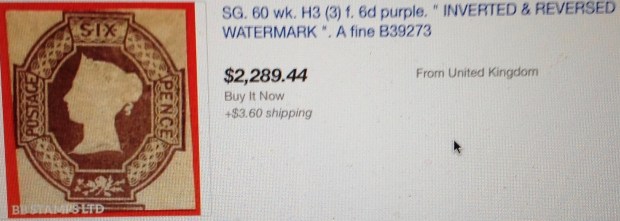


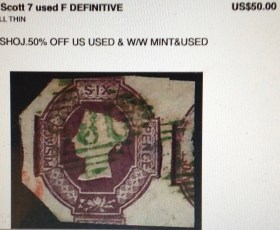 It was growing clear to me that if I ever wanted to fill those empty spaces in my album, I would have to settle for cut-to-shape. But I didn’t just want a “space-filler,” a crudely mangled example that is essentially worthless. Over the years, the Scott catalogue has upgraded its price for Nos. 5-7, cut to
  shape, from $1.50 to $10 or so. I searched the Internet and began finding cut-to-shape offerings that were well within my price range. There were flaws, though.
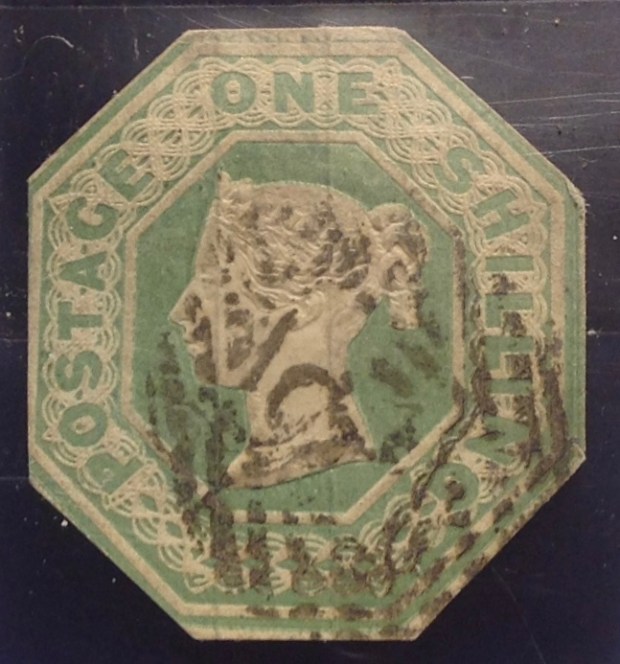 Finally I came across this cute little item: No. 5, carefully cut to shape, including nearly the entire design; no thins, tears or creases; offered for sale at $14.99.

 FMF STAMP PROJECT