
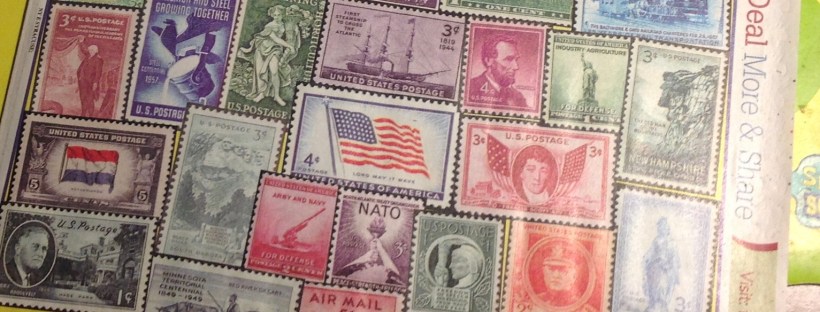
This “world stamp map” is on the wall of my study, in front of my desk. I recovered it the other day from a box where it had been in storage after our recent move. I made it years ago by assembling a group of stamps that were damaged or very cheap, and pasting them over the appropriate country on the map. You can buy these ready-made, perhaps find a “kit” somewhere to build your own. But you also can just use a standard world map, gather some cheap stamps and glue (or stamp hinges, if you can’t bear to mar a stamp), and make one from scratch. A map like this brings into perspective some of the distinctive qualities of the hobby, in that it displays the diversity and variety of stamps, and provides a humanistic overlay on geography, politics, sociology, anthropology, culture … you name it, philately’s got it!
Why collect stamps? Others have answered this question as well as or better than I could, so let’s hear from some of them, speaking from the heart.
“Stamp collecting is a ‘mature’ hobby,” writes Gary Eggleston,”not because its enjoyment is limited to older adults – the shut ins as we like to call them – who derive much pleasure from gazing at the flowers and the trees, the fish in the sea, the airplanes and the towers – not only in their territory but in places as remote as Papua New Guinea and American Samoa.
“Stamp collecting is a mature hobby because of its colorful role in history,” Eggleston continues, “because of how it has evolved into a pastime that has brought joy to millions of people around the world.
“Yet stamp collecting has an innocence all its own. It’s a hobby that stirs something in each collector – a longing to visit foreign lands, a keen investigative sense for print and color … , a yearning for friendship, and an intellectual curiosity about what other collectors are up to or have discovered.
“Photographs in an album preserve those Kodak moments that cannot be re-lived again. … But stamps in an album? How about history, geography, and culture, for starters? How about friendships that know no barriers or frontiers? How about an all-consuming passion that never ebbs or flickers?
“This is the beauty of stamp collecting. It opens doors, it’s the bottomless well of knowledge, and it’s the pictorial story of a country and its heritage. It’s also about the story of the men and women who work five days a week to deliver our mail. It’s about stamp dealers who wheel and deal and know all about value and price and rarity,” Eggleston concludes unerringly: “It is — or was, once a upon a time — about you and me.”
Another eloquent online author wrote this: “The world of stamps is a common denominator that brings together the old and the young, the experienced collector and the novice hobbyist, the boardroom CEO and the long-haul trucker. Stamp collecting cuts across socio-economic, racial and cultural boundaries. The joy of collecting, the sharing of knowledge and technique, the opportunity to learn may make for some strange bedfellows, but it forms the common bond that binds collectors. … All that is required of the stamp collector is that he find pleasure in collecting the particular type or category of stamp he chooses. … There are no requirements. Collect what moves you, what you are passionate about. Stamp collecting is an exercise in love.”
I will leave the last word on the subject to our friends from the Sunnyvale Stamp Society. “Stamp collecting is the most popular hobby in the world,” writes the unabashed and unbowed phil-anthropist from Sunnyvale. “However, if you are not a collector you may be asking, ‘Why stamps? Aren’t stamps just pictures on little pieces of paper?’ Scientifically speaking, yes that’s correct. However, there is so much more to stamps that people of any age, any income and any interest can find some aspect of stamp collecting appealing and very satisfying.”
Stamp bonus: A small photo gallery to whet your philatelic appetite
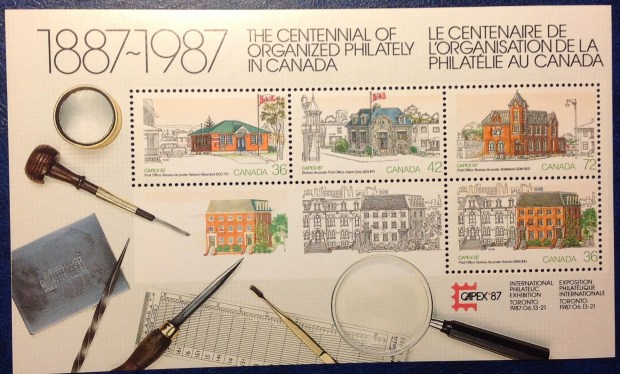
This souvenir sheet from Canada is a beautiful example of engravers revealing their art. Notice how each stamp is in a partial stage of completion, from line engraving to coloring. Notice the tools. (But where’s the paint brush?). In the blowup, below, you can see the exquisitely color-only rendering, poised just to the left of the engraved stamp where it belongs. It’s easy to imagine how it would fit on. But wait! You don’t have to imagine! The partially colored engraving appears in the next stamp over.

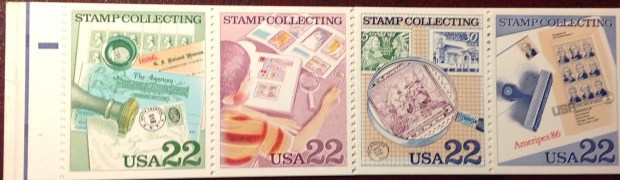
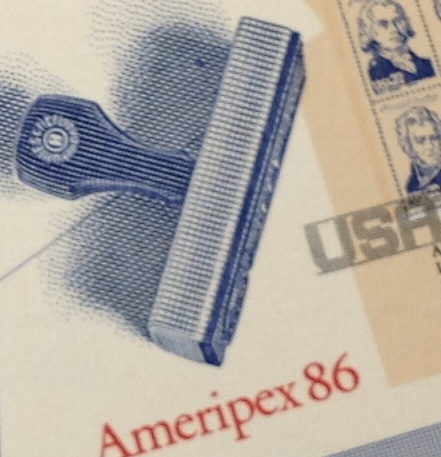
Speaking of technique, notice these fine examples of the engraver’s art, from a 1986 strip set to promote stamp collecting. The two blow-ups below display a tromp-l’oeuil effect, with the postal tools appearing to be lying on their sides, while in the next enlargement, the boy’s engraved profile and shirt become a study in abstract patterns, intricate textures and bold coloring.

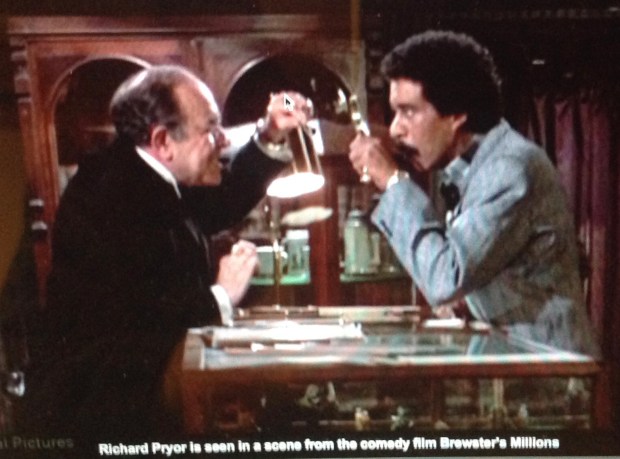
Above is a still from the movie “Brewster’s Millions,” starring Richard Pryor (at right). For some reason he has to spend $20 million in a hurry, so he buys an inverted Jenny (you know, one of the most valuable stamp errors in the world — see below), and uses it on a post card. I think that is what this scene is about. Below, Homer Simpson discovers a sheet of inverted Jennys at a flea market, but dismisses it as faulty.


It’s always fun to get a good look at the costliest stamp in the world . It’s the 1856, one-cent, black on magenta from British Guiana, which sold at Sotheby’s in 2014 for the tidy sum of $12 million. Here it is, folks! (My recollection is that one reason this may be the only copy of the stamp is that the rest, or most of the rest, were destroyed in a shipwreck. A little research should confirm or dispel this story, and I may get around to it some day …)
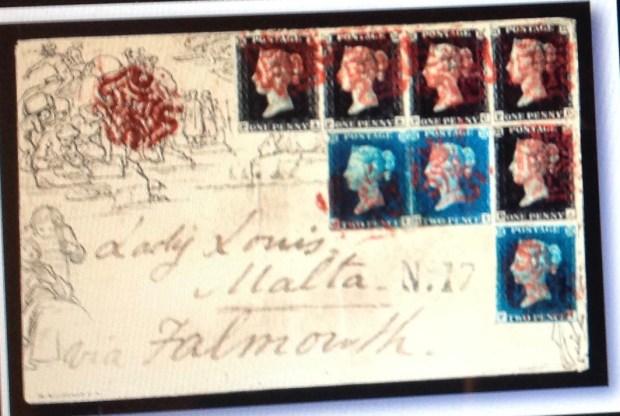
I include this cover as part treat, part tease. It’s an insanely valuable philatelic item. The envelope incorporates five copies of the first-ever postage stamp (the British Penny Black), each on worth more than $100, with three copies of the even more valuable 2 penny blue, all tied with bright red Maltese Cross cancels to a one-penny Mulready cover, also worth lots! This cover reportedly sold for $10 million. Fabulous! And to think you or I might find something like this in an attic one of these days …
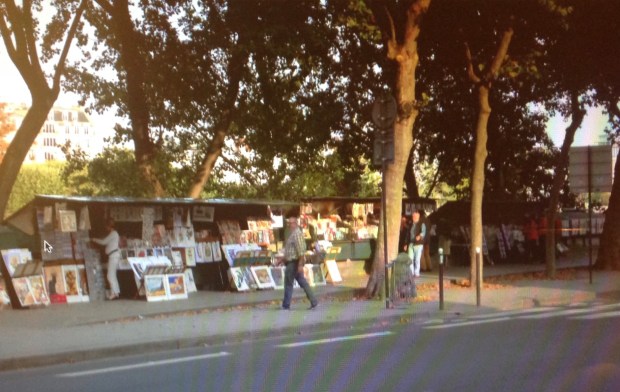
Some lucky stamp collectors (me included, at least twice!) get a chance to explore their hobby amid the “bouquinistes” who set up stalls along the Seine River in Paris to hawk books, posters, artwork as well as — les timbres postes. Stamps!. It feels like you might find anything in these outdoor ateliers of gypsies and dealers, their wares arrayed on boards under plastic gripped by clothespins in case of a shower. Is that accordion music I hear, wafting down the boulevard by the flowing river? The thrill of infinite possibility is in the air …
TO BE CONTINUED
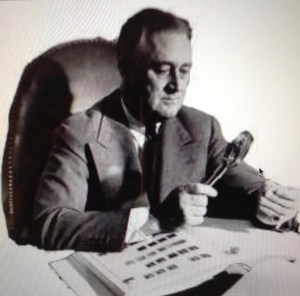

 stamps (see photo, top right). But there seems to be a design error: The president’s right hand holds a magnifying glass and is just fine; however, he clasps a stamp in a left hand that contains five fingers — and a thumb! (You’d think this stamp would be valuable, but you can buy it for a quarter.) One further note on this bit of arcana — the photograph the engraver used actually does seem to show “six finger
 s,” though closer perusal reveals the extra “pinkie” as distorted image of FDR’s shirt cuff. It must be!
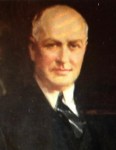 , James A. Farley (seen here in a very flattering formal oil portrait), was an old friend and mentor in
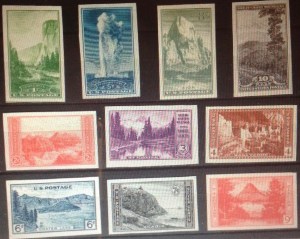 the sheets, and
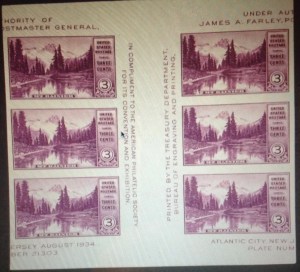 How to collect these items? None of the stamps are particularly valuable by themselves. (The original national parks set of 10 sells online for well under $10.) Should you try and get a full sheet, unperforated and ungummed, as an unusual but somewhat spurious collector’s item? What about all the other souvenir sheets, vertical and horizontal “gutter pairs,” “arrow” blocks of six and other Farley shenanigans? Cut out from their sheets or other special settings, aren’t the stamps the same? And get a load of this odd note, from the fine print of my Scott catalogue: “In 1940, the P.O. Department offered to and did gum full sheets of Nos. 754 to 771 sent in by owners” — thus creating new philatelic varieties, it would seem.
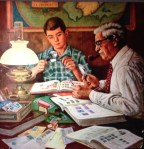 to erase the stereotype of the geeky stamp collector, dusty, bespectacled, aging, beetling about his business (like me). I have little confidence left in the tradition of fathers passing along their interest in stamps to sons — as my father somehow did with me. As far as I can tell, my older brother Jonathan and I are the only ones in my extended, intergenerational family circle who give a hoot about stamps. Too bad, because stamps are worth paying attention to.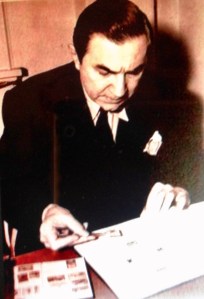
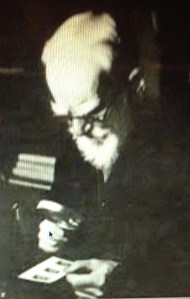
 shot of
 Britain’s Queen Elizabeth was a real enabler of Sarkozy, handing him one philatelic trophy after another. To be sure, she had plenty to give — the queen was heir to a stunning collection begun by her grandfather, and expanded by her father.
 George V’s original collection filled 328 60-page red albums; his son George VI’s albums are blue; Elizabeth’s are green. It seems George V got started long before he became king, aided by Prince Alfred, his uncle and Duke of Edinburgh. The king’s philatelic ambitions soared. He once wrote an adviser, “I wish to have the best & not one of the best collections in England.” He certainly tried to achieve his goal. In addition to accumulating special items by dint of his royal access, the king made astute purchases, acquiring such rarities as the Post Office Mauritius and the Great Britain Two Pence Tyrian Plum. (Don’t you just love the name of that color?)
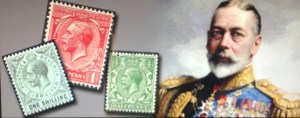 raightforward monarch, quite popular during his reign and well-suited to his times — though it’s hard to see how collecting all those stamps bearing his profile could not have swelled his royal head. He is credited with helping to revive a hobby that had grown a bit moribund. (Where is the next George when we need him?!) A popular story has one of his retainers reporting that “Some damned fool had paid as much as L1,400 (about $3,600) for one stamp,” and the king mildly replying, “Yes, I was that damned fool.” His investment paid off: The rarity in question later sold at auction for $3.9 million.
 ** In addition to collecting stamps, little Freddy began a daily diary in Dacca, when he was eight, and kept it up until high school and sporadically, beyond. When I get around to reviewing its generally hum-drum contents in coming years, no doubt I will find specifics about the years-long set-to with the Kenmore Stamp Company. Accordingly, I shall endeavor to keep this record updated with my findings.
 ar newspaper career in 2013. He has degrees from Harvard and Columbia, and was president of the National Conference of Editorial Writers in 2001. He lives in retirement near Syracuse, NY.
 FMF STAMP PROJECT