-
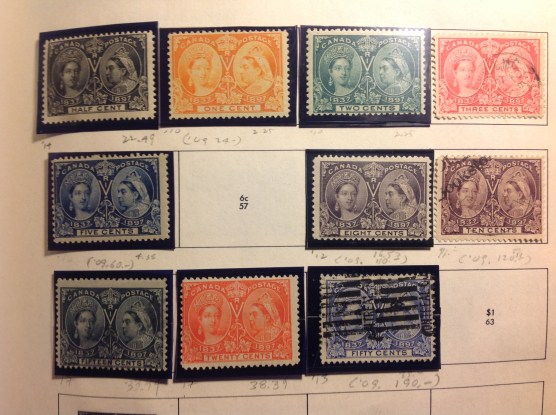
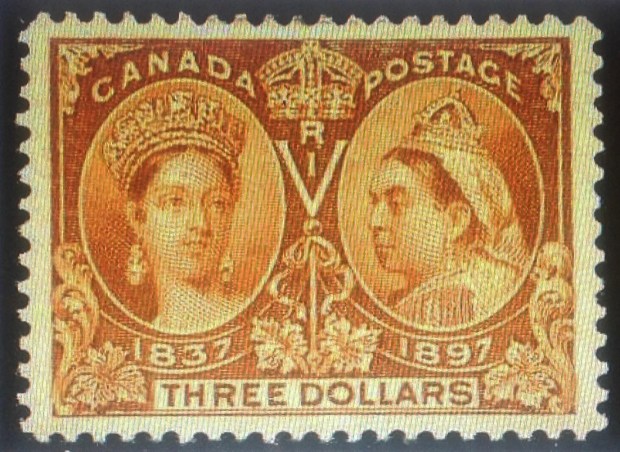
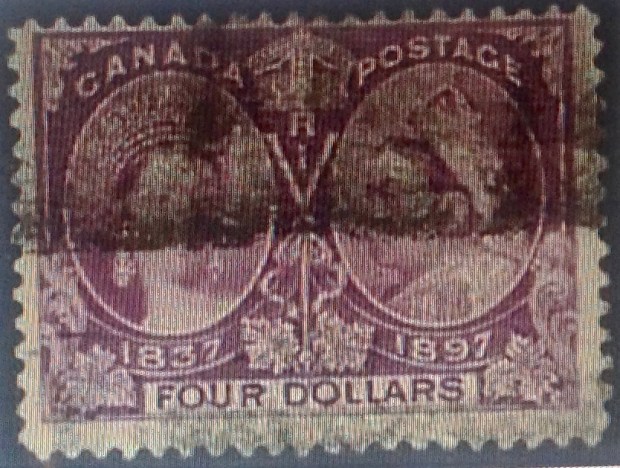
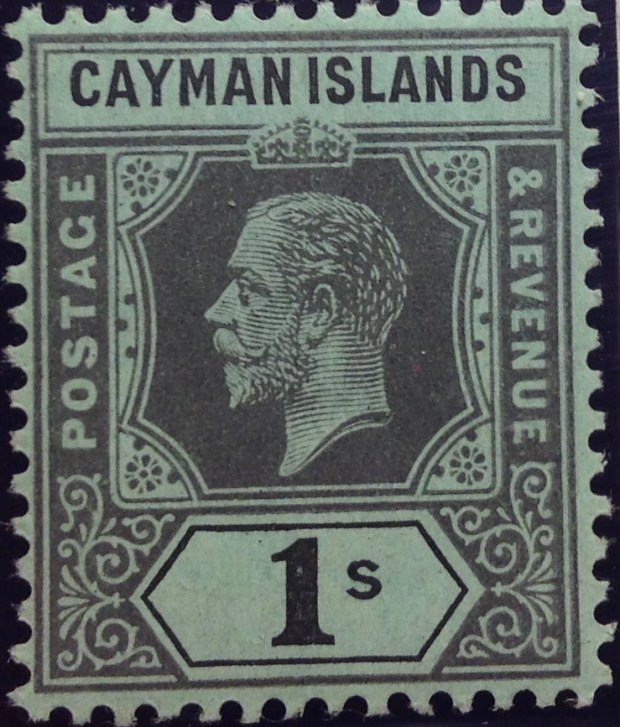
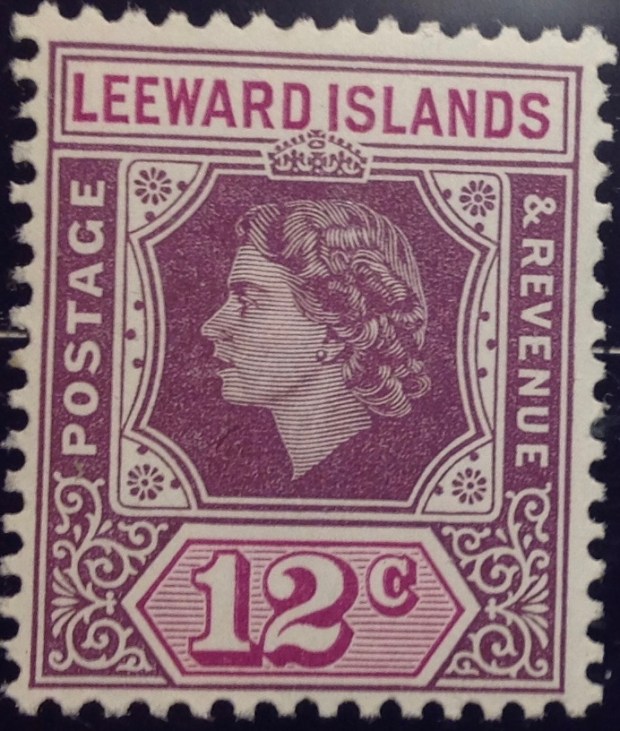
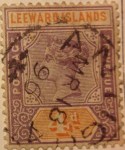
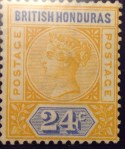
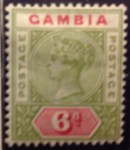
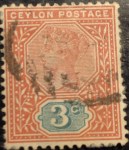
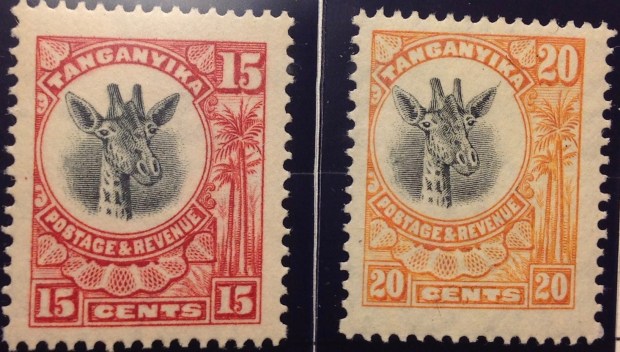
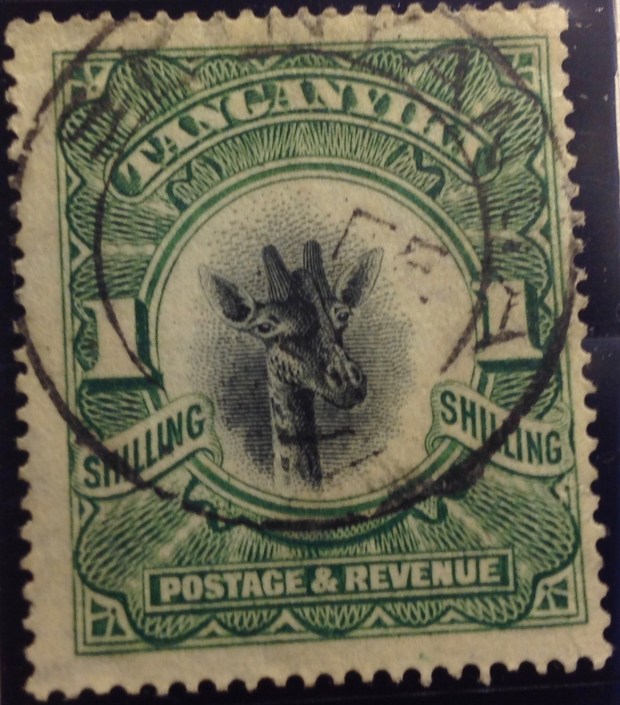
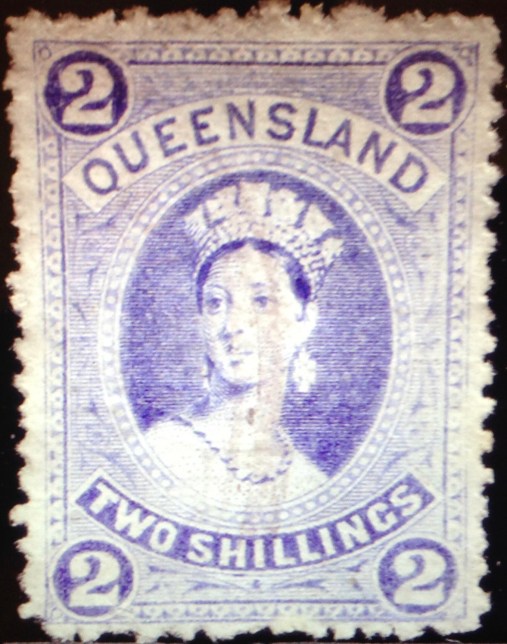
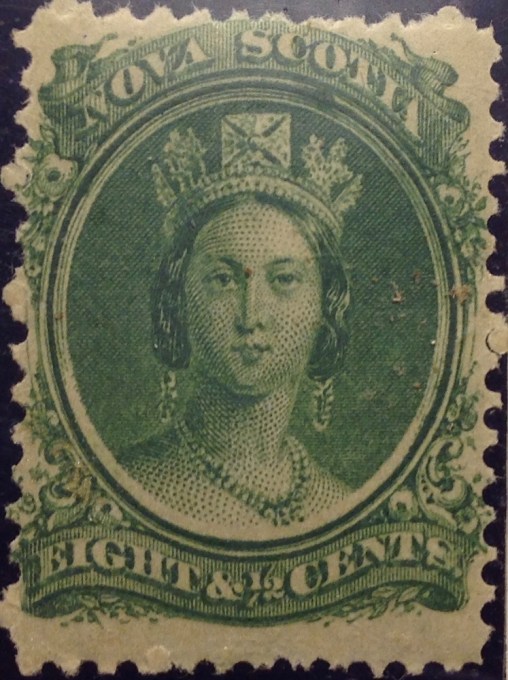
- The stamps pictured below, from around the British Empire, were issued between the 1890s and the 1950s. They span five reigns, from Victoria to Elizabeth, that amount to 179 years — and counting. Across this vast expanse of time and territory, these stamps have held to the same design standard set by the first Victoria Jubilee series. These remarkable threads of continuity — from monarch to monarch, century to century, continent to continent —weave a mesmerizing tapestry of empire, don’t you think?
- Same design through five reigns: (from top) Victoria, 1837-1901; Edward VII, 1901-1910; George V, 1910-1935; George VI, 1936-1952; Elizabeth II, 1952 —
-
The British Empire’s Fourth Dimension
-
- The stamps pictured below, from around the British Empire, were issued between the 1890s and the 1950s. They span five reigns, from Victoria to Elizabeth, that amount to 179 years — and counting. Across this vast expanse of time and territory, these stamps have held to the same design standard set by the first Victoria Jubilee series. These remarkable threads of continuity — from monarch to monarch, century to century, continent to continent —weave a mesmerizing tapestry of empire, don’t you think?
- Same design through five reigns: (from top) Victoria, 1837-1901; Edward VII, 1901-1910; George V, 1910-1935; George VI, 1936-1952; Elizabeth II, 1952 —
-
A Top-60 Blog!
The other day I got what seemed to be a piece of unsolicited good news: My FMF Stamp Project had been selected as one of the “Top 60 Stamp Collecting Blogs” on the Internet. Cool!
What exactly does this mean? Well, first take a look at the message the popped up on my email server:
“Hi Frederick,
My name is Anuj Agarwal. I’m Founder of Feedspot.
I would like to personally congratulate you as your blog FMF STAMP PROJECT has been selected by our panelist as one of the Top 60 Stamp Collecting Blogs on the web. (Ed: Anuj supplied a link further into his Feedspot site: http://blog.feedspot.com/stamp_collecting_blogs/ )
I personally give you a high-five and want to thank you for your contribution to this world. This is the most comprehensive list of Top 60 Stamp Collecting Blogs on the internet and I’m honored to have you as part of this!
Also, you have the honor of displaying the following badge on your blog. Use the below code to display this badge proudly on your blog.”
Opening the link, I found a listing of the other 59 stamp-collecting blogs that have received this special recognitions. And more text, starting with a sentence fragment:
“The Best Stamp Collecting blogs from thousands of top Stamp Collecting blogs in our index using search and social metrics. Data will be refreshed once a week.
These blogs are ranked based on following criteria
•Google reputation and Google search ranking
•Influence and popularity on Facebook, twitter and other social media sites
•Quality and consistency of posts.
•Feedspot’s editorial team and expert review
CONGRATULATIONS to every blogger that has made this Top Stamp Collecting Blogs list! This is the most comprehensive list of best Stamp Collecting blogs on the internet and I’m honoured to have you as part of this! … If your blog is one of the Top 60 Stamp Collecting blogs, you have the honour of displaying the following badge on your site. Use the below code to display this badge proudly on your blog. You deserve it!”
It doesn’t seem to me that my FMF Stamp Project has attracted much attention — yet anyway. But the “medal” looks totally cool, so I figured out a way to display it as a logo at the top of my home page and FMF Stamp Project blog posts. I also did a little research on feedspot.com and Anuj Agarwal. According to social media, he already has had a successful career in international insurance, both in India and Great Britain and probably beyond. I imagined him being an enthusiastic stamp collector with considerable resources and free time on his hands (or else building a new fortune with this feedspot.com site, which seems to be an info aggregation service for its subscribers).

Anuj
All this, notwithstanding that the photo he included with his email message makes Anuj Agarwal look, according to my friend George whom I shared the message with, like he’s still in junior high. (Sorry Anuj — that was George talking, not me.)
Inspired by the sheer serendipity of the whole thing — after all, the FMF Stamp Project is just a lark, and I have only just managed to clamber aboard this wordpress.com Internet platform — I sent Anuj (I hope I may call you Anuj) a cheery email in reply:
“It was a pleasure to get your message and notification today. I don’t know exactly what it means yet, but it sure seems like it can’t be bad. (I’m already displaying my “medal” as logo on my blog!) It is a thrill to have my FMF Stamp Project noticed in any way. This labor of love has been going on for a year or more. I am putting up more blog posts all the time, because I have a story to tell on just about every page of my large stamp collection. I looked you up via social media and see you have had a successful career already. And your Web site looks intriguing — something that could be very useful for curious and discriminating readers. Perhaps I will learn to use it one day.
“I am a retired journalist and editor in Syracuse, NY, age 68. Now I continue to pursue my lifelong interests in music composition** and performance, as well as writing projects like the FMF Stamp Project. My stamp commentaries began as essays shared with family and loved ones. I was encouraged to put them on a blog, and with help from my stepson was able to scramble onto the platform, where I am hanging on for dear life. Having lots of fun, though!
“FYI, I lived on the subcontinent in the 1950s — in Dhaka, where my father was a diplomat. We traveled several times by train from Calcutta (Kolkata?) to Delhi and beyond, to visit my brother and sister who were studying in Woodstock. What memories …
“It is also a pleasure to make your acquaintance via the Internet— which Dan Rather calls the most significant innovation since the steam engine. I wish you every success. — Fred M. Fiske, Minoa (Syracuse), NY
** p.s. I also have a site where I have posted a half-dozen of my songs so far. Go to soundcloud.com and search for fred fiske.”
It wasn’t long before Anuj sent me a reply:
“Hi Fred,
Thanks for adding the Badge on your Blog.
If you can add a link back to the post, we’d greatly appreciate it.
http://blog.feedspot.com/stamp_collecting_blogs/
Best, Anuj
So now I need to figure out how to embed a link in the logo? Or elsewhere on my blog? Why a link to feedspot.com? Am I opening myself up to some kind of scam? I hope not! Will this end up with my bank accounts drained, all my assets confiscated, leaving me a homeless panhandler in the snow on a street corner? Heaven forbid!
Get a grip. Don’t be so morbid. Maybe it’s just a chance to expand your audience. Enjoy the (limited) celebrity. And limited is right. When I told my wife about my new “medal,” she snickered. That’s how much of the world thinks about stamp collecting in general. And with some reason. We tend to attract geeks and nerds, like me — and not the high-tech kind. I may be a celebrity in Syracuse Stamp Club circles, but I still need $1.50 to buy a cup of coffee.
And yet … my starry eyes are starting to focus on future prizes in the sky: more readers for the FMF Stamp Project; more open-minded folks taking an interest in stamps; renewed interest in the hobby in general — and improved prospects that my collection won’t lose value as fast as I build it up.
My daughter Molly, who is Mideast bureau chief for the Los Angeles Times, heard the news (from me, via email) and responded with words of encouragement:
“Way to go YOD (Ye Olde Dad)! I KNEW you needed an online presence, and would get a kick out of it. Look at all you’ve been doing, between the stamp blog and your music. Am really excited for you. What a great outlet, and — as I predicted — you have an audience. Now, if you could only monetize it… love from Cairo, where the weather is fantastically cool.”
Encouraging words, indeed. But forget about the push to monetize. We stamp collectors generally have a pretty modest and realistic assessment of our beloved pastime. While we can’t get enough of it ourselves, we all too readily accept that most of the world doesn’t care a hoot about stamps.
Nevertheless, through the FMF Stamp Project, I think I have managed to open a conversation about stamps aimed at a general audience, using the resources of the Internet to enrich my commentaries with glorious illustrations of enlarged stamps from my collection and elsewhere. Now, being selected as one of the 60 best stamp blogs — “from thousands” (really?) — I am (modestly) thrilled. Perhaps it is slightly ridiculous. And so, I offer a bit of silliness to celebrate this new distinction: **
Let me collect my thoughts before I become unhinged by the thrill of having my FMF Stamp Project selected as one of the 60 best stamp blogs on the Internet. I know skeptics may suspect an ulterior motive behind this “medal,” and wouldn’t touch it with 10-foot tongs. They’d demand that the whole thing be canceled. Nevertheless, I am inclined to commemorate this happy event as a definitive comment on the good quality my work, and hope my commentaries will be engraved in the minds and hearts of a growing audience. My aim, of course, is to promote stamp collecting, a hobby whose popularity seems to have worn thin. Yielding to despair and admitting I am licked would mean being stuck in a declining market that could only mean damage for my own collection. My focus is on encouraging more and more people to consider stamp collecting, in hopes that committing philately together will improve the condition of my beloved hobby.
** The italicized words all refer to stamp-collecting; if you can’t figure out how, ask a stamp collector!
Congo stamps: The slide show
This is the gist of a talk I just gave at the Syracuse Stamp Club. Vice President Dan invited me to focus on Congo stamps. I already had presented once on this subject, but Dan said he was still confused about the “different Congos” and which stamps went with which. I readily agreed to take on this intriguing topic. I assembled a group of digital images of stamp “signposts,” mostly from my collection, to help navigate the turbulent currents and tributaries of Congo-related philately. My presentation took the form of a quiz: Look at the stamp projected on the screen and identify or guess which “Congo” it came from. Also: see if you can stump the presenter with your questions. (I don’t know everything about Congo stamps!) Comments afterwards from the audience of 20-plus indicated they liked the program, so it seemed worthwhile to recapture some of it for the blog. On with the show — a quick narrative guide through 42 slides.
1. Here is the first set of stamps issued in what would become the Belgian Congo. They picture King Leopold II of Belgium, and look a lot like Belgian stamps of the period. You can just make out the tiny writing, “Etat Ind du Congo.” That means “independent state of the Congo” — though it was anything but! What it really meant was that King Leopold was “independent” of accountability to his own government or anyone else but God. He ran this vast colony as his private fiefdom. Though he never set foot in the Congo, he micromanaged the place from his palace in Brussels, built a vast and exotic Congo museum complex in his royal gardens. While he mouthed platitudes about Christianity, civic progress, development and moral uplift, he ruthlessly suppressed indigenous populations. He exploited the country’s ivory, rubber and other resources for his own profit. He also issued stamps for his “independent” state. This set of five stamps catalogues at several hundred dollars, largely due to the rare 5 franc value.
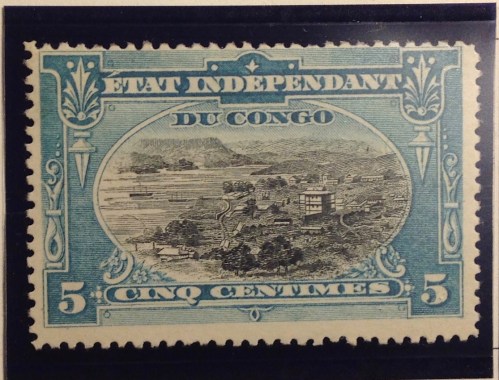
2. The Congo may have been a vassal state of a callous ruler — Joseph Conrad used it as the locus of his haunting novel, “Heart of Darkness” — but King Leopold did manage to put out some pretty stamps. Look at this lovely two-color engraving from the 1890s of the growing town that was to become Leopoldville.
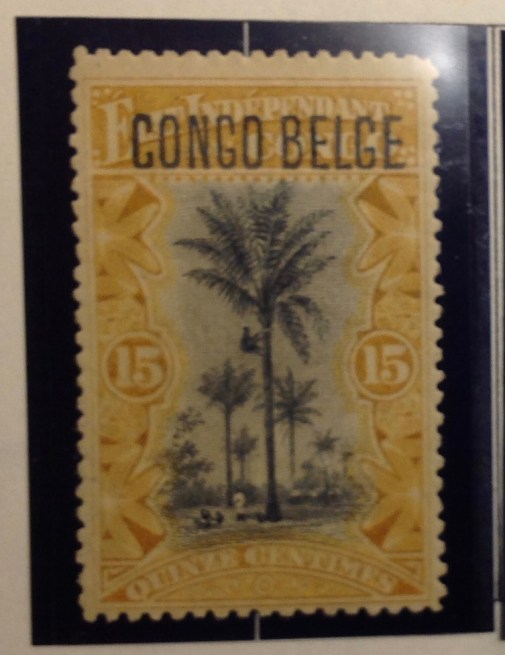
3. By 1906, King Leopold’s Congo was such an embarrassment to the “civilized world,” thanks to the investigations and reports of reformers like Roger Casement and Edmond Morel, that the Belgian government had to step in and taking control. The “independent” Congo henceforth became the “Belgian Congo.” By the time the old king died in 1909, the regime in Brussels had issued a set of stamps obliterating the old title with the new name: “Congo Belge.” There are two sets: In one, the stamps are hand-cancelled; the others, as in this illustration, were machine-cancelled, worth considerably less.
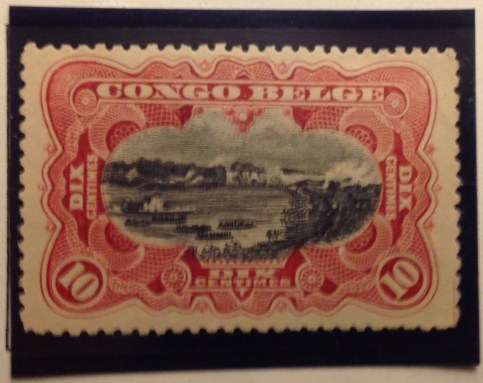
4. The powers-that-be quickly followed up with another short set, using the same designs
as the earlier series, but with the new name. This engraving shows the busy port of Matadi. But there was a festering problem: Since Belgium is a bilingual nation — French and Flemish — the French-only stamps were a political irritant.
5. Belgian stamps were bilingual by the 1890s, so the
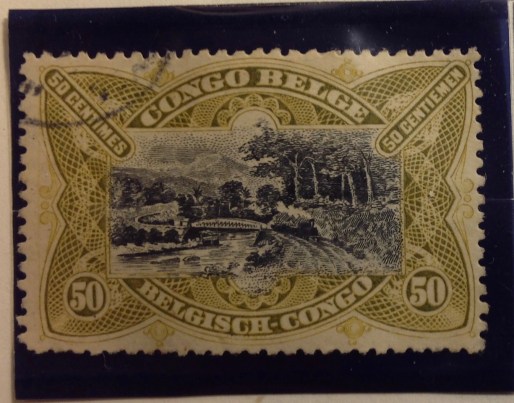
Belgian Congo had to accommodate the proud and vocal — and touchy — Flemish constituency as well. Here is the result. It turned out to be relatively easy to keep the central images of the original set and redesign the borders to make room for “Belgisch Congo” as well as the French name. This charming two-color engraving depicts the railroad from Leo to Matadi, at the time a considerable engineering feat. Alas, the mammoth construction project took its toll in lives, most of them Congolese.
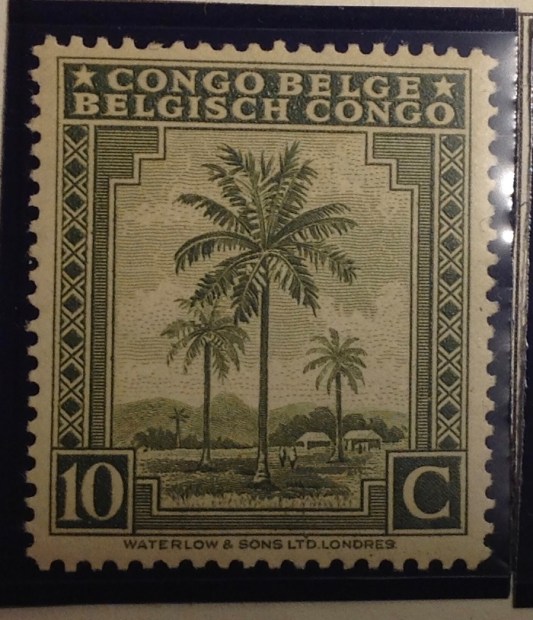
6. The “bilingual imperative” now in place for Belgian Congo stamps did have some awkward moments. Take this set from the 1940s — or rather, two sets from the 1940s. The nicely engraved stamps were identical in every way — except that in one set, the country’s name was printed first in French, then in Flemish; in the other set, the names were reversed.

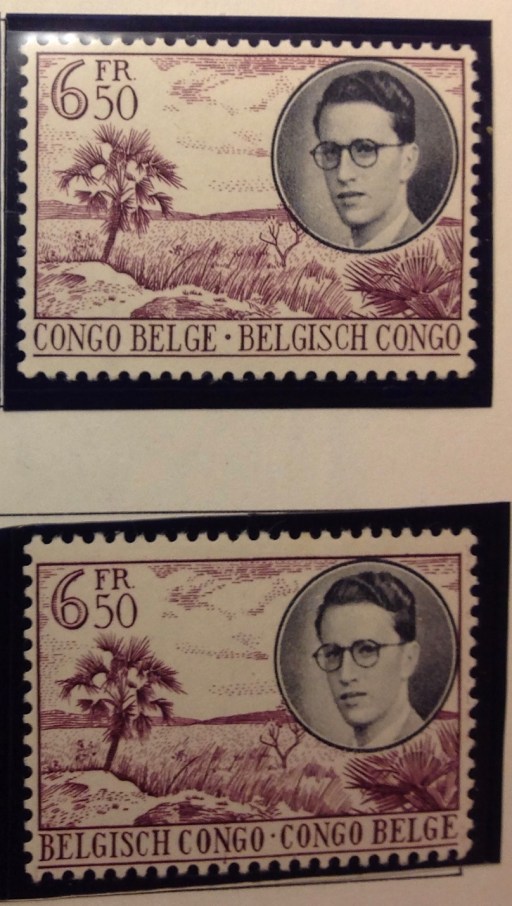
7. This awkward practice continued, off and on, into the 1950s. This double set featuring Belgian King Baudouin was issued five years before independence.
8. What’s this? A set from 1930s Belgian Congo, overprinted “USA Airmail”? With denominations in U.S. cents? What gives? I wish I had a satisfactory answer for you, but I don’t. Were Americans really a presence in the Belgian Congo? Was this overprint used at the U.S. embassy, or by troops passing through? So far, it remains a mystery to me. Whatever its provenance, the set isn’t expensive to buy.

9. Right about now would be a good time to introduce a map of the Congo, so you can get geographical idea of the stamp-issuing areas represented in coming slides. I lived in the Congo from 1962 to 1964, when I was 14-16 years old. My father was a diplomat, and we lived in Leopoldville, the capital city in western Congo, not far from the Atlantic Ocean — or the Equator. The areas I will be discussing up to 1,000 miles from Leopoldville, in central and eastern Congo — Katanga in the southeast, Kasai in the center, Stanleyville in the northeast. Then there is Ruanda-Urundi, a separate Belgian territory bordering on the Congo’s eastern frontier. I also will have things to say about the territory around Leopoldville — both south and north. This map highlights the divisions of the “crisis years” between 1960 and 1964. This refers to the breakaway republics of Katanga and South Kasai, as well as so-called Simba uprisings around Albertville (northern Katanga) and Stanleyville (center-north), all of which produced postage stamps.
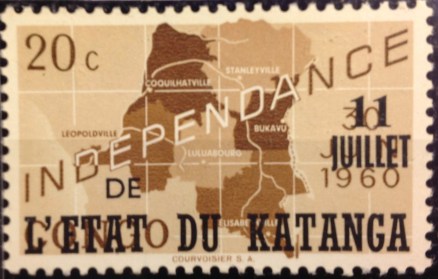
10. This stamp marking the secession of Katanga shows a lot of gall. Not only does it co-opt a stamp from the “mother nation” of the Congo, it blots out that nation’s independence day with its own date, cleverly leaving “1960” uncovered. It also leaves alone the banner “Independance” (inedependence), but obliterates “Congo” with the audacious overprint “de L’Etat du Katanga” (of the state of Katanga). The essential illogic of this stamp, however, is that it depicts the whole nation of Congo and doesn’t even identify the rebel province that is declaring its independence.
11. Here’s a semi-postal stamp from Katanga picturing the renegade leader, Moise Tshombe (who I once met, by the way, but that’s another story). It features the copper crosses that are emblems Katanga, literal currency at one time, and a key source of the region’s economic well-being, such as it was.
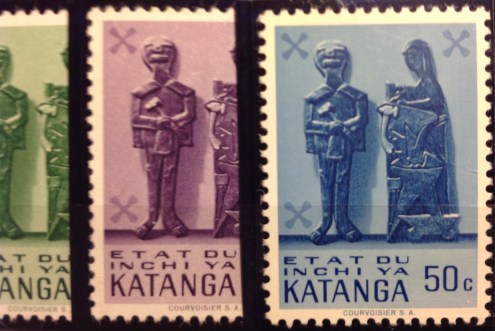
12. This Katanga set seemed quite modern for 1961. The indigenous bas-relief sculpture has primitive charm, though the characters do bear some resemblance to “Mr. Bill,” the hapless, creepy clay figure from early “Saturday Night Live.”
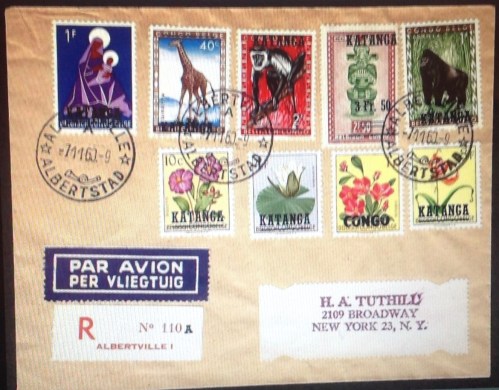
13. I include this cover of Katanga stamps, all of them overprinted Belgian Congo stamps, because I am quite proud to display such a rich sample of postally used examples from a country that only existed for a couple of years. I expect it is worth as much as $20 or more — if you can find a buyer for this obscure stuff.
14. These 1950s-era definitive stamps from India are familiar enough. But what’s with the “Congo” overprint? Here’s what: During the troubles in Katanga, the United Nations stepped up with peacekeeping troops to try to straighten things out. There also were troops from Sweden, Canada and Ireland, but the Indians seem to be the only ones who issued their own stamps — or rather, their own stamps overprinted “U.N. Force (India) Congo.” Was it national pride? Was there a practical purpose, i.e., to provide the troops with stamps to use on letters home? If so, where are the covers with cancelled copies of these stamps? I’ve never seen one. If they exist, such philatelic oddities must be quite rare and valuable. India also overprinted this set for troops serving the United Nations in Korea (1953), Cambodia, Laos and Vietnam (1950s) and Gaza (1965).
15. Here is another overprinted set, this one involving the Belgian Congo flowers set of 1952-3. The set became the first issued by the independent nation, which was overprinted “Congo.” Here the same colonial flowers set was used for the breakaway republic of South Kasai, a renegade central province. This was only a half-hearted rebellion — South Kasai never broke relations completely with the central government, and President Albert Kalonji retained his seat in the Congolese parliament.
16. Here are the rest of the stamps issued by South Kasai, including original designs, i.e., not overprinted Congo stamps. The rebellion petered out in a few months, and Albert Kalonji, (pictured here) the president of the short-lived state, ended up in exile — but alive.
17. The transition from colony to independence was haphazard in the Congo — socially, politically, economically — and philatelically. There were missing or misplaced overprints and surcharges, upside-down printings (“inverts”) and other varieties. As a 15-year-old stamp collector In 1964, I was able to buy stamps at the downtown Bureau de Poste to create a cover using six different versions of the original 6.50-frank stamp of the animal series depicting two leaping impala. 
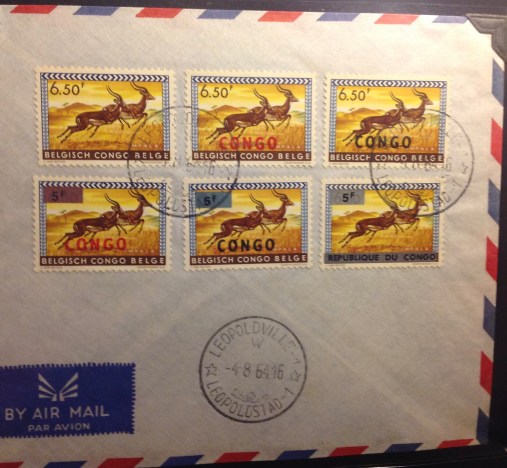
Top row, left to right: 1. the original stamp, issued in 1959; 2. the same stamp, overprinted “CONGO” in red, issued 1960; 3. ditto, overprinted in black.
Lower row, left to right: 1. ditto, with a silver surcharge “5F” and red overprint, 1964; 2. ditto, with silver surcharge and black overprint; 3. finally, with a silver surcharge as well as a silver bar behind the black inscription “Republique du Congo.”
I created another cov
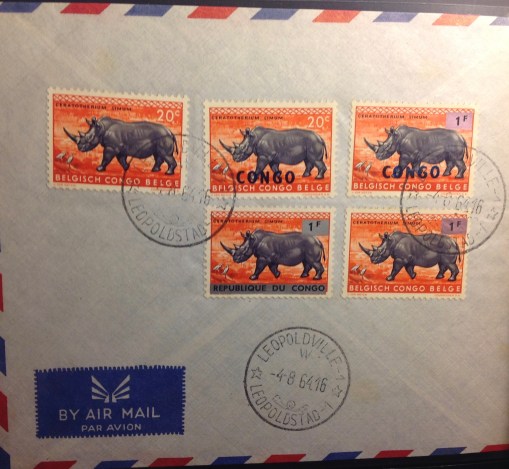
er with five different varieties of the 20-centime stamps from the same animal series, featuring a rhinoceros. Can you pick out the differences. The last item, lower right, is a most peculiar error. Let me explain:
While the original Belgian Congo stamp was successfully surcharged “1F” on a silver rectangle, the “REPUBLIQUE DU CONGO” overprint is missing. This means the stamp looks for all the world like a new “Belgian Congo” stamp — issued in 1964, four years after independence! (This stamp is not listed in my Scott catalogue.)
18. Here is a Congo stamp featuring Patrice Lumumba, the controversial first prime minister of the Democratic Republic of the Congo in 1960. Only the stamp is not from that Congo, but from the “other” Congo — the former French Congo, now the “Popular Republic of the Congo.” Lumumba has never appeared on a stamp from his own country — not a big surprise, since he was assassinated with the acquiescence or connivance of Congolese leaders Joseph Mobutu, Joseph Kasavubu and Moise Tshombe. It was up to other African nations like the neighboring Congo, ruled by Marxists and self-styled Marxists over the years since its own independence, to memorialize the mercurial Lumumba.

19. Here are stamps from early in the former Belgian Congo’s independence years. They honor Dag Hammerskjold, the UN leader killed in a plane crash in September, 1960 while trying to mediate the standoff between Katanga and the mother Congo. The overprint reproduces a slogan from the short-lived administration of Congolese Prime Minister Cyrille Adoula — “paix, travail, austerite” (peace, work, thrift).In 1962, the earnest, honest Adoula seemed to hold out hope for a better future — but his tenure was cut short by events and plots.

Kasavubu
20. Congo’s president from 1960 to 1965 was Joseph Kasavubu, a wily politician from an important tribal family. He managed to hang on through the Congo’s most turbulent years, only to be dismissed into retirement after a young colonel named Joseph Mobutu took over in 1965.

A young Mobutu
21. After Kasavubu fired Adoula as prime minister in 1964, he called on Moise Tshombe, the exiled former leader of the Katanga breakaway province, to try and bring order to the Congo itself. This was not quite like Jefferson Davis being invited to take over after Abraham Lincoln, but you get the idea. Tshombe lasted about a year, whereupon Mobutu and the army stepped in. He rapidly consolidated his power and proceeded to rule the Congo for the next 30 years with a combination of harshness, violence, cruelty, indifference toward his people, hypocrisy and narcissism, monumental greed and selfishness. Would you like to know how I really feel about him?
22. Mobutu’s most cynical act was his claim of “authenticity” — that he somehow embodied African values and aspirations. He renamed his country “Zaire,” in ancient tribal tradition, gave himself fancy new titles, and began to sport a walking stick and leopard-skin hat. This Zaire stamp says more than its designers may have intended. It pictures Mobutu contemplating the big diamond — loot! And what kind of guy has himself depicted on a postage stamp wearing sunglasses? Shifty!
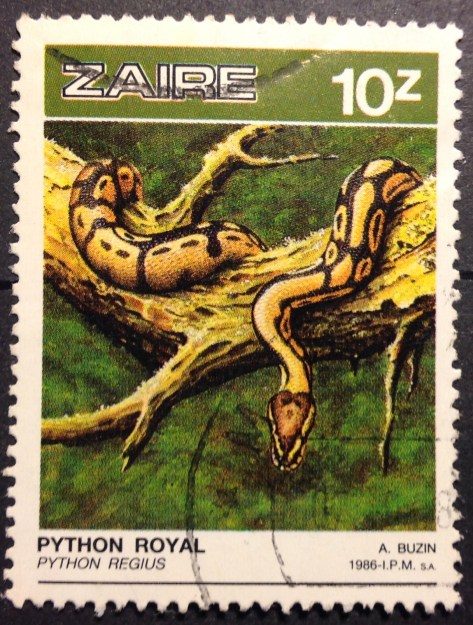
23. Here’s an even better likeness of Mobutu — again, probably not intended by the stamp’s designers …
24. Now for a U-turn back to 1915, folks! Back to World War I, which was being fought in Africa as well as Eurasia. Germany had maintained a colony in east Africa since the 1880s. After hostilities broke out in 1914, it didn’t take long for the English to the north and east, and the Belgians in the west, to overwhelm German East Africa’s forces. They divided the spoils: Britain “took” Tanganyika, and the Belgians moved into what is today Rwanda and Burundi (see maps, above and below). The first stamps from these countries were hand-overprints on the current Belgian Congo pictorial set, like this one. These stamps are quite rare. Mine cost $29.85. It catalogues for much more than that. My scribbled note “authenticated” means the stamp carries the desired mark on the back. (I guess there are counterfeits of this rare set.)

25. Here is the image of a stamp from the first set of “Ruanda,” also in 1916. It’s captured from an Internet screen, and is on sale for “just” $400! That’s a rare stamp!

26. The reason the Ruanda and Urundi stamps are so valuable is that so few were issued. They were soon replaced by a set with this busy overprint — in two languages. The inscription in French and Flemish reads “German East Africa: Belgian Occupation.” The lettering partially obscures the delicate engraved designs. Aesthetically, overprints are ugly, marring the appearance of a stamp. In this case, postal authorities might as well have printed the names on blank paper!
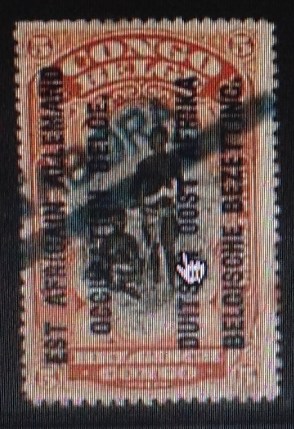
27. How about this one — an overprint on top of an overprint? You should be able to make out a faint hand-stamp “Tabora,” above the black line rising from left to right. The Scott catalogue says these local overprints were not authorized, and assigns them no value. This item from an Internet image was on sale for a cool $99 — too rich for my wallet.
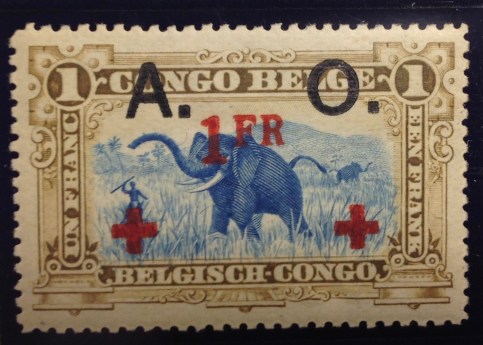
28. How about this item? It’s really not fair for the stamp designers to be so cagey. You can make out that it’s a Belgian Congo stamp, or at least was one originally. Then there’s a red cross and a printed number, presumably designating a charitable contribution of one franc on top of the stamp’s one-franc value. That’s decipherable. So is this a Congo stamp, or what? And what the heck is “A.O.”? For answers, you need a philatelist, or historian, or at least someone with a Scott catalogue who knows where to look. Then you would learn that “A.O.” stands for Afrique Orientale — East Africa. This is in fact another stamp from the Belgian occupation of Ruanda and Burundi — which in 1922 became the Belgian mandated territory of Ruanda-Urundi. One wonders how a stamp like this would be received by the indigenous population. Would they pay the extra franc for the Red Cross? Or as some philatelists suggest, did most stamps like this one (which aren’t that pricey today) never even reach post offices, but rather go right to collectors?
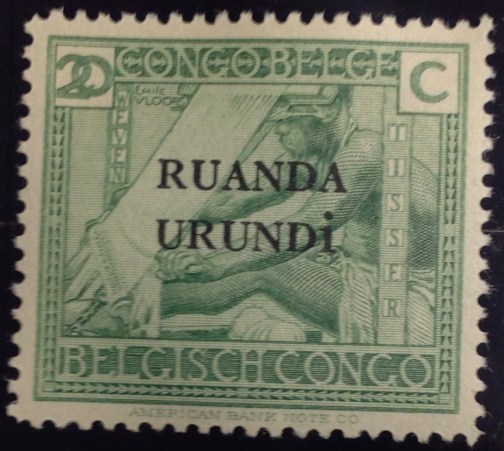
29. The first stamps of Ruanda-Urundi were overprints of a 1920s definitive set from the neighboring Belgian Congo. I suppose it would be a stretch to call them stamps from the Congo, though the name is on them.
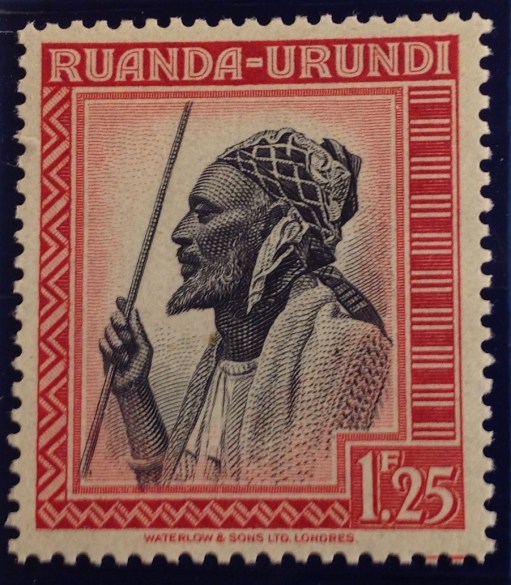
30. Here is a beauty from the first set inscribed with the name Ruanda-Urundi, in the 1940s — a handsome portrait, and a fine example of the engraver’s and colorist’s art.
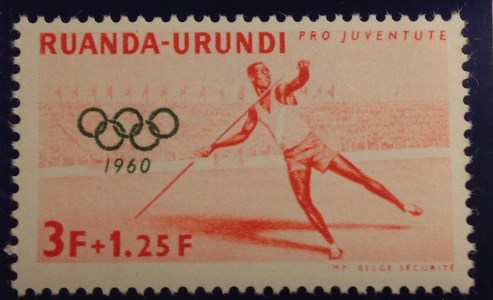
31. This stamp commemorating the Olympic Games came out just as the Congo was preparing for its independence day June 30. The set shares the designs with last issue from the Belgian Congo. Ruanda-Urundi remained tied to Belgium for another year before splitting into the Kingdom of Burundi and the Republic of Rwanda. The extra year didn’t prepare either nation any better for independence than the devolving Congo to the east. The people of all three nations would continue to suffer, trading colonial oppression for corruption, misrule and tribal violence.

32. The first Burundi stamps carried clumsy overprints on leftover Belgian Congo stamps from the 1952-3 flower set.

33. The first Rwanda stamps bore slightly fancier overprints, still using stocks of Belgian Congo stamps, this one from the animal series of 1959.
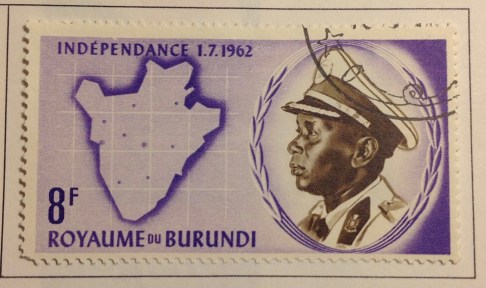
34. Both Rwanda and Burundi soon were issuing stamps of their own design. This one includes a portrait of Burundi’s king, who soon enough would be sent packing.
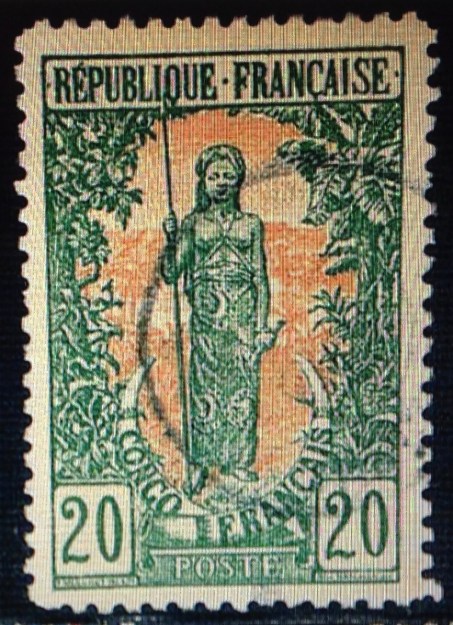
35. Before I bring you more or less up to date, a quick history lesson about other “Congo” stamps. Here’s one from the 1900s inscribed “Congo Francais” — French Congo. Now look at the next image.

36. These two stamps are inscribed “Moyen Congo” — Middle Congo — along with the name above, “Republique Francaise.” Why Congo and Middle Congo? Aren’t they both French territory? What’s the difference? Does it matter? Indeed it does. The original French Congo overlaps with modern-day Gabon, a small nation located along the west coast of Africa, north of the Congo. Middle Congo covered a much larger territory across the Congo river from the Belgian territory.
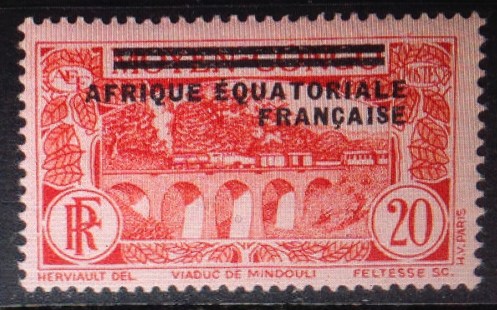
37. Middle Congo eventually took over from French Congo, and the territory issued stamps into the 1930s, when it joined French Equatorial Africa. The first regional issues included this overprint from Middle Congo. Upon reaching independence, a large part of Middle Congo unfortunately was dubbed the republic of the Congo. The fact that there are two Congo republics across the Congo River from each other has created decades of confusion, helping to make this slide show necessary!
38. Finally, one more “Congo” in this tangled philatelic history. The stamp pictured here was issued in 1914, and represents a colonial territory of Portugal that straddles the western “lip” of the then-Belgian Congo that extends to the south Atlantic ocean. This small “Congo” territory gave the Portuguese access to the Congo river delta. Portugal also controlled Angola, directly to the south of Belgian Congo. (see maps). While the Portuguese only used the name “Congo” until 1915, it kept control of the territory as part of Angola until independence in 1975. Today it is the free Angolan province of Cabinda, still straddling the northern border of the Congo. There is an independence movement in this tiny province. There also are stirrings from others in the region who dream of resurrecting the ancient “Kongo” kingdom. This unlikely development would only happen if land is ceded from four countries that mistrust each other — Angola, both Congos and Gabon. A final reflection: I wonder what the indigeneous population thought when they first saw this stamp back i 1914, which depicts a fierce-looking caucasian (actually the harvest goddess Ceres), wielding what could be a machete …
39. Now, to start wrapping things up. Mobutu finally was forced out of the country in the mid-1990s, decamping to his European mansions, where he died soon after, having precious little time to enjoy the estimated $15 billion he st0le from his country. In 1997, in an act of embarrassment, or wishful amnesia, or spite, the powers-that-be changed the country’s name back to Republic of the Congo. This did not portend happier times for the much-abused Congolese people, alas. Even though Mobutu was gone, the country was worse than bankrupt, and misrule continued under Laurent Kabila and then his son, Joseph Kabila. This stamp captures the ethos of the post-Mobutu
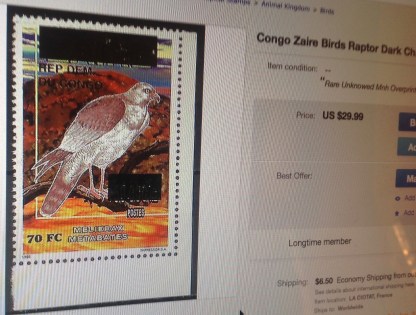
era — “Zaire”: is blotted out with an ugly black rectangle. The country’s name underneath is an almost-indeciperhable “Rep Dem du Congo.” There is a new value, with the old one covered by another black box. A vulture or hawk perches menacingly amid these dark blots. The eBay seller wanted $29.99 for this odd, apparently unlisted stamp, acknowledging that it might be bogus.

40. As it turns out, the Congo had to contend with a number of bogus stamps issued in 1997. These slick, multicolored philatelic items, still carrying the name “Zaire,” commemorate folks who had nothing to do with the Congo, like John Lennon, Frank Sinatra and Elvis. The stamps were officially declared illegal by Congolese postal authorities, who alerted the Philatelic Webmasters Organization. This group collaborates with the Universal Postal Union to call out spurious issues. The postmaster in Kinshasa identified “a certain number of philatelic products still printed with the country’s old name (Zaire).” These stamps would not be admitted for sale or use in the Congo, the note said. You can still find these fake stamps for sale on eBay. Buyer, beware!
41. So we come to the end of this slide show, with an image of an authentic issue of stamps from the modern-day Democratic Republic of the Congo. Pretty stamps, eh? Don’t be fooled. There’s nothing pretty about the way Congo is being run today. I wish I could say otherwise.
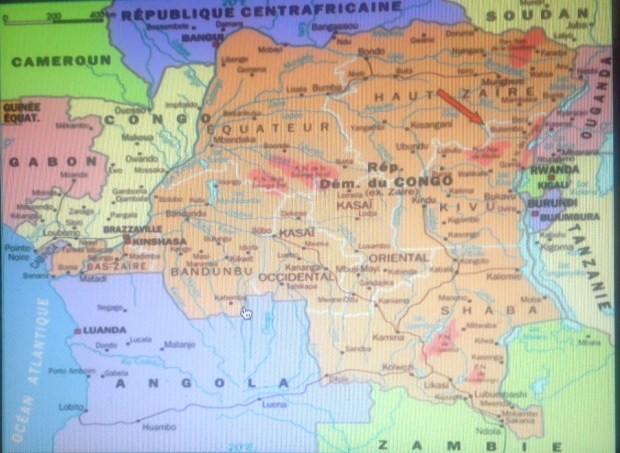
42. The Congo today. Note the name changes of provinces, the location of the Angolan province of Cabinda in the far west, and Rwanda and Burundi in the east.
Bonus: Pietersburg!
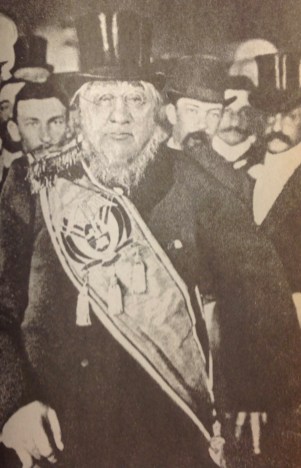
This thrilling selection of stamps arrived in the mail the other day, in a small flat package from South Africa. The stamps are from 1901, during the last days of the South African Republic (ZAR) based in Pietersburg (Transvaal), where tough, stubborn old Paul Kruger concluded his decades-long conflict with the British and dominance of black Africans. Much blood was shed and misery visited on the people before Kruger’s forces were defeated. Kruger’s strong convictions, military and political leadership
Paul Kruger in his prime.
helped to secure the Afrikaner tradition in South Africa’s culture. This wily Cape Colony farm boy should rank with the most adept of southern Africa’s tribal leaders — except for one thing. Unlike the Zulu, Matabele or Xhosa, his tribe was a bickering lot of caucasians: Boers, Dutch settlers, Germans, Huguenots and diverse others, some tracing their African ancestry to the 1600s. (Kruger’s German forebear landed in Capetown in 1713.)
Kruger was old enough to take part as a child in the Boers’ Great Trek inland in the 1830s. He was present at the signing of the Sand Hill Convention with Britain in 1852, and was instrumental in sustaining the Boer-dominated ZAR in ensuing decades. These “Pietersburg” stamps — authorized Boer provisionals — were printed by the local newspaper and issued only between March 20 and April 9, 1901. Kruger had moved his government from Pretoria to Pietersburg to avoid capture by the British. By the time the stamps were placed on sale, the South African Republic was well on its way to defeat by British guns and troops. Kruger narrowly escaped to neighboring Laurenco Marques, Portuguese territory.
The rather undistinguished-looking stamps are listed in the Scott catalogue under Transvaal, the British name for the territory, with a smaller headline announcing, “South African Republic,” and a special subsection for “Pietersburg Issues.” Paul Kruger surely would object to this ranking, since his republic, spanning all but six years between 1869 and 1902, was a sovereign nation. The Scott catalogue explains, rather lamely: “Although issued by an independent state, the stamps of the South African Republic are included in this section (i.e. Transvaal) in accord with established philatelic practice.” Sounds like a British tilt, if you ask me. Philatelic protocol, like history, favors the winners.
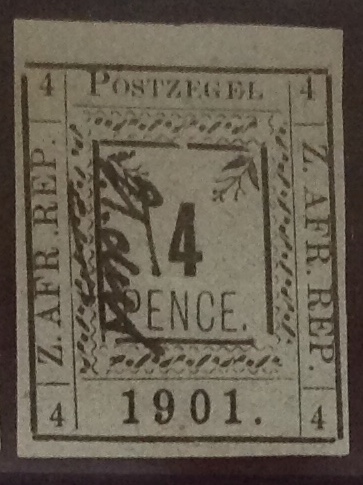
At first glance, the Pietersburg stamps in the group all look alike. Be not deceived! Join me in a quick tour of this particular philatelic weed-lot — a game of Each-of-these-things-is-slightly-but-distinctly-different-from-the-others. Can you spot the differences? Here’s a hint: The four stamps in the top row are the same, but different from the two in the second row, which in turn are different from the three in the third row. Now can you spot the differences?

Stamp from Row 1
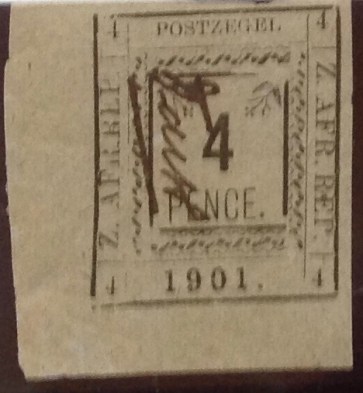
No? OK, look closely at the first-row close-up. Notice the stamp’s elements: the denomination (four pence) in a framed box, above the large date “1901”; on either side the inscription: “Z. AFR. REP.” — an awkward contraction of the country’s name (then again, “ZUID AFRIKAANSCHE REPUBLIEK” is quite a handful of letters to have to strew across any postage stamp); finally, at the top the announcement, “POSTZEGEL” — postage. There is also a handwritten scrawl, but let’s not talk about that just yet.

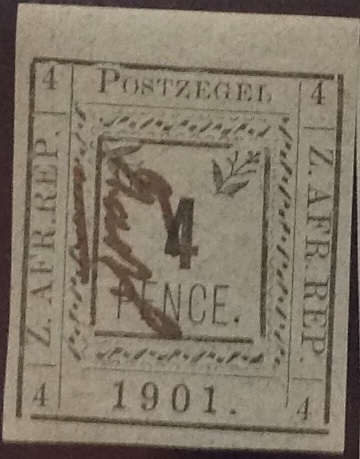
Stamp from Row 2
Now look at the second-row close-up. All the elements are there — but with a subtle change. See it? Look at the number, “1901.” Compare it to the date in the first close-up. Now do you see it? Why, sure! In No. 2, the date is at least one millimeter smaller. It’s a completely different stamp!

Stamp from Row 3
On to Row 3. Again, all elements are present. (Notice the extremely large margin on the blow-up example I have included — a stamp from the side of the plate, I’d guess, probably no extra value.) What is the difference here? Still stumped? All right … Look closely at the word “POSTZEGEL” at the top of the stamp. Compare it to the same word in close-ups No. 1 and No. 2. Notice anything? Sure! In the top two, the “P” is distinctly larger than the other letters. In No. 3, however, all the letters are the same size. It’s a completely different stamp!
Now, quickly, back to the handwritten scrawls, which appear on each stamp. Compare them, and two things are clear: the scrawl is visibly similar on each stamp; and each one is slightly different — unique, probably. To “cancel” or “certify” these for postage, it seems a Boer bureaucrat — or was it Kruger himself? — had to sign each stamp issued in what remained of the South African Republic/Pietersburg during this three-week period in the spring of 1901. Maybe the same person didn’t sign every stamp, but it sure looks like it. Perhaps the inscription means “cancelled” or something else. This is the only set of “hand-cancelled” stamps I’ve seen processed this way. (Yes, there are the rare British Guiana hand-cancels of 1854, and the fabled Bermuda Postmaster stamps of 1848 — but let’s not go there.)
Perhaps because of this singular “cancellation” process, together with relative scarcity, if not rampant demand, these Pietersburg stamps retain considerable value — $30 to $40 apiece in catalogues. I got a bargain online, paying about $40 for the selection of nine stamps that include all three printing varieties. (The catalogue also lists perforated sets, and a few stamps with red scrawls instead of black.)
The Pietersburg stamps occasionally are available online — for a price. Curiously, you can find copies that have been cancelled the traditional way, with a circular date stamp, selling at a discount. Which begs the question: If the stamps already are marked by a hand scrawl, why cancel them again? Was the scrawl not universally recognized? Is it a signature at all? Am I asking too many questions? Yes!

Double cancel? This Pietersburg stamp carries the scrawl as well as a circular date stamp. What gives? (This illustration comes from the Internet, not my collection; I held out for stamps without the taint of “cancelled to order” (CTO)
The Scott Catalogue merits a word at this juncture. It acknowledges that “cancelled” copies of the Pietersburg stamps exist, but warns they may be spurious. The editors opine: “Used copies are not valued, as all seen show evidence of having been cancelled to order.” Ah! Those freighted words: cancelled to order, or CTO. This means postal officials devalued, or “remaindered” their own stamps by cancelling them right in the office. Don’t ask me why, or I’ll have to do more research. But the practice has been widespread in philatelic history. Stamps going back to the Victorian era carry the unmistakable markings of in-house cancellation, an intentional practice which supposedly renders the postal “remainders” worthless. Those stamps tend to bring weaker prices in today’s philatelic marketplace. Over the decades, many nations (though not ours) have produced reams of CTO sets, which I imagine are sold at a discount in shadowy stamp bazaars. The whole CTO thing makes me queasy, so I don’t really care to look into it too deeply. I mean, I want the stamps, but I don’t want to be scammed by worthless paper.
I have been on the lookout for Pietersburg stamps since rediscovering the blank spaces in my British Africa album and wondering about these strange designs and their apparent rarity. After learning the back story, and hearing about the suspect “cancellations,” I have been holding out for copies without the circular date stamps. Now, with his latest find, I seem to have acquired a cache of the real thing: stamps with the unique scrawls (the catalogue calls it “initializing”), no CTOs, all three varieties represented. What a find! …

Paul Kruger near the end of the ZAR.
Back to Pietersburg in 1901. The ZAR stopped issuing its stamps after just three weeks. For Paul Kruger and the Boers, the end was near. The war against the British was lost, though diehard Boer guerrilla fighters held out in the veld. British countermeasures included a scorched-earth policy that produced thousands of destitute women and children — and an early incarnation of concentration camps. The aging “Uncle Paul” made his way by ship to Europe. He refused to return to a southern Africa ruled by the British, and died in Switzerland in 1904, aged 78, survived by many of his 17 children.
As you can tell, I am proud to add these unusual stamps to my collection, and may decide to install the small display shown in the photo at the top of this article as-is among the pages of my growing South Africa collection. The evanescent postal history of the Pietersburg stamps spins off grim and gripping tales of ZAR conflict and resistance. During the first British takeover in Transvaal in 1877, postal authorities overprinted ZAR stamps with the initials “V.R.” — Victoria Regina — then issued a set with the queen’s portrait. When the Boers took charge again in 1884, they overprinted the Victoria series with Afrikaans surcharges before issuing their own stamps. As the British swept into Boer territory again in 1900-1901, they stamped “V.R.I.” on more ZAR sets — though not on those last ones from Pietersburg. (Maybe because of all those worthless CTO sets?)
Kruger’s last stand followed decades of pushing, shoving and shooting between British and Boers — with black Africans caught in the middle. Both sides issued their own stamps or overprints while in power. The Pietersburg story comes from one corner of southern Africa. The philatelic adventures multiply with the varieties of provisional stamps issued in Lydenburg, Wolmaransstad and Rustenburg, and from the “pseudo-siege” and destruction of Schweitzer-Reneke.
Elsewhere, more Philatelic history was being made. From the Cape of Good Hope to Zululand, competition, conflict and conquest — and the stamps reflecting it all — roiled southern Africa between the 1870s and World War I.
Take one more moment to moon over this small, nondescript but dear Pietersburg collection; examine and re-examine the subtle differences and wonder what reasons lay behind the changes (Why a smaller date? Why a smaller “P”?); take note of printing variations, differing paper tones and above all, those enigmatic scrawls. I imagine a florid, nervous man in a sweat-soaked linen uniform and pith helmet, perched nervously on his stool inside the Pietersburg post office in 1901, pen in hand, inkwell at the ready, conscientiously initializing each stamp from the doomed republic as British guns sound in the distance …
ADDENDUM
Transvaal, a South African province until it was partitioned in 1994, covered 110,000 square miles and contained the modern capital city, Pretoria. (South Africa still has three capitals — Pretoria for executive government, Cape Town for parliament, Bloemfontein for the judiciary.) Its first stamps were issued in 1869 by the Boer-led South African Republic (ZAR). In 1877 British forces occupied the state, but the ZAR was restored in 1884, and lasted until the end of the century, when Britain took over for good. That historical overview cloaks an era of violence, bloodshed, intrigue and ruthless politics as conflicting forces tried to prevail in a land where whites held dominion over indigenous black populations. Stamps from the era are emblems of a turbulent time. Some of these stamps are exceedingly rare and command prices in the hundreds, even thousands.
After spending so much time writing about the Pietersburg sets, issued in the last days and hours of the ZAR, I recalled I still lacked a remarkable set of stamps that would make a resonant visual counterpoint to the last Boer issues. In 1877, as the British initially took over, postal authorities began overprinting ZAR stamps with “V.R.” — Victoria Regina. These overprints took different forms, and included for the first time the name, Transvaal. I suspect some collectors have made it their philatelic mission to assemble and study these overprints. (** see footnote, below.) Another set of stamps, issued between 1878 and 1880, feature an engraved profile of Victoria — an elegant portrait of a mature queen in the fourth decade decade of her reign. I decided to go after this small set — though the stamps aren’t cheap, with catalogue prices ranging from a couple of bucks to $70-plus. Oddly, the 1/2 penny stamp, the lowest value, is one of the costliest. Needless to say, I didn’t end up with that one, or the top-value 2 shilling, either. I did manage to snag the

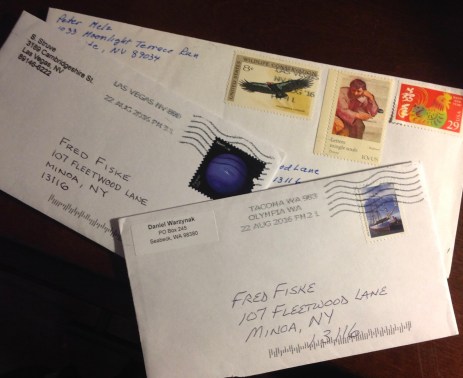
It’s always a thrill when the envelopes arrive!
others, though It took some doing. I ended up buying from three separate dealers, with a total outlay of nearly $60.
As usual, it was a thrill when the letters arrived. Notice the colorful stamps the dealers used on their packets. (The stamp on the middle cover has a scuff. This is a great use for flawed mint U.S. stamps — they are still good for postage!)
After a while I opened the
envelopes. Here is what the contents look like, just as they spilled out. Dealers and experienced collectors know how to protect and ship stamps. It’s not hard. I don’t recall ever receiving a stamp damaged in transit. The only complaint I have is sometimes, a package will include sticky tape in close proximity to a stamp, which to me is a no-no.
Next, I assembled the stamps I ordered, mounting them on cut-down stock pages to admire on my desk before putting them in my album and forgetting about them for a while. In addition to the Victoria set, the envelopes also contained two more Transvaal stamps I ordered — from 1904, with a profile portrait of Edward VII, who by then had succeeded his late mother. For good measure I also acquired three early Mauritius stamps I need. You never can tell what you’ll end up with when you go shopping online …
The main event, however, is the handsome 1878-80 Transvaal Victoria set — five values in all, missing only the 1/2d and the 2 shilling. I admit they are not all in great shape. Some are missing perforations, the centering is not great, and one stamp has a thin spot on the back. Yet I still was willing to pay for the set. I mean, think about it: The stamps are nearly 140 years old. They started out being bought at a ZAR/Transvaal post office counter, stuck to an envelope and sent through the mail, involving carriages, trains and sailing ships, possible all three. So what if a couple of them are what is called “space fillers” — that is, they will never have much value because of their flaws. I go back to the emblematic significance of these stamps. They are artifacts from a long-ago time and place of imperial Britain asserting itself over the Boers. For a while, British rule would be fragile and temporary in a state that continued to be bargained for and fought over — as though it actually belonged to either side.
** Footnote: See, for example: Philatelic Series CD 81, “The South African Provisional War Stamps,” by B.W.H. Poole (1901). Contents: Orange River Colony – First Printing, Varieties Of The First Printing, Second Printing, Varieties Of The Second Printing, Third Printing, Varieties Of The Third Printing, Second Issue, Varieties Of The Second Issue; Transvaal – Varieties Of The First Issue, Second Issue, Varieties Of The Second Issue; Mafeking Siege Issue, Varieties Of The Mafeking Siege Issue; British Local Issues – Lydenburg, Rustenburg, Vryburg, Wolmaransstad, Kuruman; Boer Local Issues – Pietersburg, Vryburg, In Dienst; Other Emissions – Krugersdorp, Schweizer Reneke, Commando Brief. Profusely illustrated with photographs of actual specimens. 56 pages.
Bonus: USA No. 10 or No. 11?
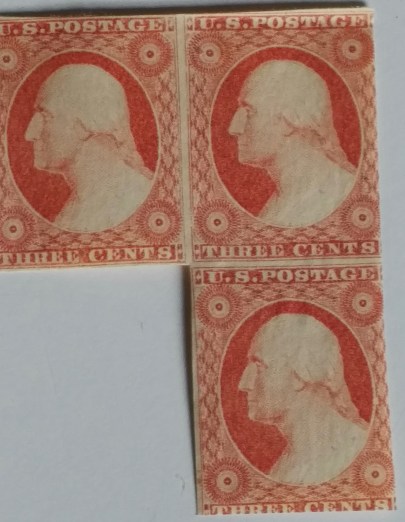
While visiting Daniel, an old friend and Milton Academy high school classmate in Brookline, Mass., June 17-18, 2016, the subject of stamps came up. Daniel went to a coat closet and returned with an old copy book, which he explained was his great-great-grandfather’s journal. He opened the front cover and drew out a glassine envelope containing three
early American stamps — a rare multiple of three of the first three-cent issue (circa 1852), featuring a side profile bust of George Washington. I examined them closely, thrilled to realize they had been sitting in that book for more than 150 years. They were still in pristine condition, as fresh as the day Daniel’s ancestor bought them at a post office for nine cents. Well, he probably bought at least four of them (for 12 cents), cut out one of them, licked the gum on the back and pasted the stamp to a letter, then stored the others for a future use that never arrived..
Daniel told me one of his sources had suggested the stamps might be worth as much at $50,000. I was impressed, though a bit skeptical, and promised to look into the matter. The following is from our subsequent correspondence, which delves into one of the thornier issues in U.S. philatelic lore.
June 21, 2016
Daniel, … I have been searching for more background on your precious stamps, which happily you showed me just before we left on Sunday. Wow! They are beauties. My catalog has them listed as No. 10, with all sorts of prices (some in the thousands), depending on varieties. The value increases with the condition. You have one “gem” (four margins, never-hinged original gum, good centering and color), and two very-fine specimens, also never-hinged. As a multiple of three, the stamps only increase in value. … I shall keep looking for more info, but if you are really curious, have them professionally appraised by a reputable Boston firm. No need to unload them in a hurry, though — stamps like these seem to be holding their value and are a decent investment — particularly considering the original purchase price of nine cents. Meanwhile, I plan to send you shortly some philatelic materials you might use to protect your stamps properly (don’t be nervous — they seem just fine as they are, though to me it seems shockingly informal and casual …) …
Here’s an idea — would you or Maria take a picture of the stamps (through the envelope would be fine)? Then email the image to me. I plan to go to the Syracuse Stamp Club meeting Friday night (a bigger collection of originals you could never hope to see), and I expect I would get some interesting responses in showing around the photo. And I would report back to you …
June 23, 2016 (forwarded correspondence from Daniel)
Ben, I showed Fred Fiske one of my Milton classmates the three cent stamps circa 1852 discovered in my great, great grandfather’s journal (btw also George Buffington’s** step great great grandfather.) Fred is intrigued as were you and as you can see from the email below (ed: i.e., a copy of my note, above), Fred is a member of a secret philatelist society in Syracuse NY. Not to get off track but grandpa reports in his journal he met the Emperor of the Austrian Hungary Empire in Vienna and declares the Hapsburgs the ugliest family he has ever seen, looking like monkeys in fine clothes. … Daniel ** (Ed: George Buffington is also a friend and Milton classmate.)

Does he look like a monkey? Well, sort of …
June 24, 2016
Hi Daniel — Here is the image of a stamp from my collection featuring the last emperor of the Austro-Hungarian empire, Franz Joseph, in 1914, at the outset of World War I. I loved your report from your great-great-grandfather’s visit to the emperor, I guess in the mid-1800s. What were your ancestors up to in those days? Does this next-generation guy still look like a monkey? Sort of, I guess …
By the way, I am embarrassed to say I had the date of the stamp club meeting wrong. The third Friday of the month is not today, but last week! So I will have to wait until the first Friday of next month, July 1, to attend the next stamp club meeting. Meanwhile, however, I have found that a catalogue from 2006 lists your stamp. Scott No. 10, mint, at $2,500. More to come … Best, FMF
p.s. Since we have some time, I would suggest you make another try to photograph your valuable stamps. The shot you sent me was good — clear and sharp — but it cut off the crucial left side of the multiple, which shows that the top left stamp is a gem — four margins, etc. If I had that to show around next Friday, I would be like the bee’s knees …
Best, FMF

Daniel’s second shot of the pristine upper-left-hand stamp in his rare triple clearly shows four full margins on this never-hinged gem. Notice, though, how the color has changed. Is it because of the quality of the photograph? Does it now look a shade more “dull red” than “orange-brown”? See how tricky color can be?
June 26, 2016
Fred, Another shot trying to feature stamp on left. … My great great grandfather who wrote the journal where I found the stamps was Thomas Van Buren. He spent three months traveling through Italy and Austria in 1853, part of the time with his uncle, President Martin Van Buren, and his cousin Martin Jr. They visited the Pope, the Hapsburg emperor and others. I read elsewhere that Martin used to laugh the Europeans assumed he was of noble birth, whereas the family was just poor farmers. Anyway, Grandpa went on to be a California state senator, a NYS assemblyman, a Civil War General and the consul general to Japan from 1872 to 1884. Your old friend Daniel
July 15, 2016
Daniel, … My apologies for not getting back to you about the stamps. Amid the house-moving and the upset rumpus, I have missed a couple of stamp club meetings. I am determined to go on Saturday to the annual Stamp Club Picnic at a member’s house on Cross Lake, which is in Jordan, a small community northwest of Syracuse. The prospect of Stamp Club members cavorting in bathing suits (including me) is a daunting one, likely to frighten children and small animals. Yet I intend to persist, in order to quiz some of the more knowledgeable members about your fine multiple of U.S. No. 10. Best, FMF
July 18, 2016
Hi Daniel — Saturday was beautiful, and so was the year-round vacation home of our host, Dick Nuhn of the Syracuse Stamp Club, on the shore of Cross Lake in northwestern Onondaga County (about 20 miles from here). There was a good turnout of stamp club members for the annual outing, with hamburgers, brats and spiedies, and a table of salads, as well as desserts. Bravo! The lake was charming — a smaller version of Lake George, of Champlain, or something. The Seneca River flows through it, so it’s part of the Erie Canal system, capable of transporting barges and other shipping and pleasure vessels from the Hudson clear to the St. Lawrence Seaway and the Canadian Maritimes …
One of my main purposes — in addition to eating, schmoozing and taking a dip in the refreshing lake waters — was to show around my photos of your three-cent of 1853 multiple on my Macbook. I displayed the stamps before Dick, our host, as well as Mike and Ralph, two early U.S. stamp experts; also Al Swift, who knows a thing or two on the subject, and several others. At one point, Dick took Mike and me into his log house, up a spiral staircase and across a catwalk to a balcony nook with a sweeping view of the lake. This is where he has his stamp collection, which sprawls from one side of the house to the other in vast profusion. Here is some of what they said:
First, Dick looked up Nos. 10 and 11 in a recent Scott catalogue (2006, and prices may have gone up in the last decade). No. 10, described as “orange brown,” catalogued at about $3,200 — this, for a mint (unused) copy which, like the upper left one of your three examples, displays a clear border on all four sides (your other two are cut off just inside one border). Yours, of course, are “never hinged,” which makes them considerably more valuable. Having three together also is worth a premium — a pity you didn’t have the fourth one to make a square block, one of the observers said, which of course would have added even more value.

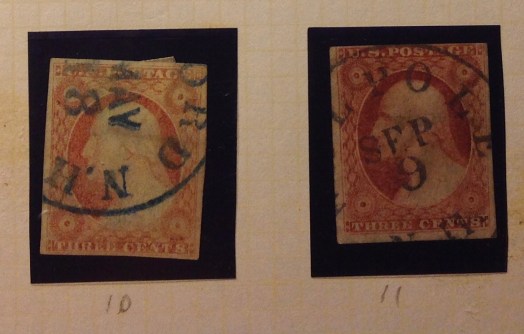
These stamps are from my late father’s collection. I have included them to illustrate the difference between No. 10 (orange brown) and No. 11 (dull red) — at least, in Pa’s estimation…
Now to No. 11, which is identical in every way to No. 10, except for the ink — and the value. No. 11’s color is described as “dull red,” and the catalog value for a good mint copy is about $300 — one-10th the value of No. 10. As an observer noted, there are many shades of each variety, so it can be devilishly hard to discern clear differences between “orange brown” and “dull red.” When stamps are cancelled with a clear date, it’s sometimes easier to distinguish varieties, since an earlier cancellation would rule out the later variety. But in the case of mint stamps, that’s obviously no help. I read elsewhere that the impression on No. 10 may be sharper than No. 11. The impression on your stamps, Daniel, is very crisp, and I still lean toward them being No. 10, the more valuable variety. But I could not get any of my consultants to make a definitive identification.
I think we have stumbled on one of the more enduring challenges in U.S. philately: No. 10 or No. 11? An expertising article I consulted online (“Identifying Scott No. 10 and No. 10A,” at http://www.uspcs.org) notes “(it) probably is the most frequently misidentified 19th century U.S. stamp. The problem of No. 11 and 11a … being advertised as No. 10 or 10a … seems to be chronic … .”
Trying to get to the bottom line with my stamp club buddies was tougher than pulling perforations. First I had to get them to accept, if only in theory, that this was No. 10 (gold) rather than No. 11 (dross). Then there was the matter of three-stamps-not-a-block but still-a-rare-multiple, not to mention mint-never-hinged. Multiply $3,200 by three and you already are up to $9,600 — not bad for a nine-cent investment by your ancestor, Daniel. Add the multiple and never-hinged factors and you get well beyond $10k, toward $20k. “But my friend was advised it might be worth $50k,” I announced. “What do you think?” Mike took another look and allowed, “Maybe.” At least he didn’t rule it out. He also didn’t make an offer. Dick said he once was presented with what the seller said was a cancelled No. 10. “I paid 35 bucks for it, but I’m still not sure if it’s really No. 10.” He showed me his copy, and I displayed for comparison purposes a photo from my father’s collection of what he claimed were No. 10 and No. 11. (By the way, these are all cancelled copies, which are much less valuablle than yours, Daniel.)
So there you have it. They wouldn’t say yes, they wouldn’t say no, just a definite maybe. Mike advised getting the darn thing appraised by an expert, like Mr. Sigismundo (sp?), a stamp expertiser from Central New York. I’ll bet there are several in the Boston area you could locate through the U.S. Philatelic Classics Society … In philatelic solidarity, I remain, FMF
July 19, 2016 (From Dan to Fred) Thanks for learned thoughtful piece. An endless search. More later
http://www.theswedishtiger.com/10-scotts.html (ED: This link is to a site passed along gets so far into the weeds over Nos. 10 and 11 as to drive ardent philatelists to drink, to distraction, discouragement or disconsolation. Is there any end to the depths of this hobby?
Sept. 3, 2016
email from FMF to D. Gerrity (copy to G. Buffington). Subject: two more observations on Nos. 10,11. Forgive the return to a subject that it seemed we might have exhausted some time ago, but here goes:
1) One reason why a multiple of these early U.S. stamps may be more valuable than not, I recently learned, is that in those days, folks mainly took their mail to the post office, unstamped. They bought only the stamps they needed, stuck them to the envelopes and mailed them. That is, they didn’t keep a supply at home. Why bother?
2) It seems the valuable No. 10 stamp went on sale in July, 1851. After May of 1852, nearly all the 3-cent stamps used were the less-valuable No. 11. What just struck me is the following: As I recall, you removed the envelope containing these stamps from a journal you said belonged to your great-etc. grandfather. So might there be a clue in the journal as to when he bought the stamps? If it was before May of 1852, there is a better-than-ever chance it was the valuable No. 10. Are there lots of journal entries? When exactly did he go abroad? (i.e., he couldn’t have bought U.S. stamps while he was traveling!) Does he mention sending a letter to someone? Or buying the stamps? (perhaps that is not the sort of thing one would note in one’s journal, but still …)
Now to let you get on to more pressing matters …
Philatelically yours, FMF
p.s. I hope you and yours are well.
Sept. 3 also, from George Buffington — Dear Fred and Dan:
This sounds like a lot of effort. Can’t you just look at them and tell the difference? Well, I looked on the web and found the helpful thoughts below. Love George (ed: TEXT FOLLOWS)
Don’t look for design differences in the stamp. There aren’t any. The key is the ink color.
Scott #10 is described as orange-brown and Scott #11 is described as dull red. If you haven’t seen these stamps before, they are not too difficult to distinguish.
Scott #10 is very orange appearance in color. Copies of Scott #10 tend to be very bright too. Scott #11 is more red in appearance. If you have copy of Scott #224, then Scott #11 is more like the color of ink used for Scott #224. It’s not a perfect match, but #11 is darker in appearance.
Also, the impressions of Scott #10 are sharper in detail. Scott #10 came from earlier versions of the printing plates before there was much plate wear. Scott #11 came from later printings and the printing plates show some wear. Scott #11 isn’t as crisp appearing.
Using a magnifier, watch for recutting too. Scott #10A and #11A have the inner frame lines recut. Scott #10 and #11 are not recut.
About 5% of the stamp population is Scott #10 or #10A and 95% is Scott #11 or #11A. Watch your copies of Scott #11. You may just run into the more valuable Scott #10.
Scott #10 and #11 have been extensively plated too. The bible is “The 3 cent Stamp of the United States 1851-1857 Issue” by Dr. Carroll Chase. Subsequent work has updated some of Dr. Chase’s information, but his book is still largely complete.
Margins on these stamps are very small. If you see a pair of these stamps, you’ll understand why. There was almost no space between the stamps. Cutting them apart with scissors was not exact. Wide margins on these issues are difficult to find.
Sept. 4
email from FMF to George Buffington:
George, you are as usual an inspiration to me.
First, with your common-sensible response on the Nos. 10, 11 controversy: just look at them and tell the difference.
It reminds me of my old late Mother, as well as Pa, who were happily liberal on political matters, but kind of skeptical when it came to the esoterica of mental health therapy. “Why,” my mother would say, “if you don’t know who you are, get out your Social Security card, hold it up in front of your face and look in the mirror.”
Well, yes. The thing is, philately is different from psychotherapy, for starters. Here are several further considerations, based also on the helpful expertise you supplied in your attachment:
1) The color controversy has long since baffled me. There are so many hues between orange brown and dull red that I have retreated from that line of inquiry, for now at least …
2) I am equally befuddled by references to “plating” — as if the average collector could figure out which PLATE a particular stamp came from.
3) As for “recutting” — what the heck?
4) It turns out even expert stamp collectors are hard to pin down on this one. (I refer to my Bonus posting on Nos., 10 and 11, in which I was unable to get a single member of the Syracuse Stamp Club I interviewed to declare Daniel’s triple No. 10 or No. 11.)
5) The other thing is, it’s lots of fun to delve into all of this. Otherwise, how would I have known about Daniel’s fabled relative (and yours?) and his traveling/stamp-buying habits in the winter of 1852? With the evidence to date, I stick to my booster assessment that his is a rare multiple of No. 10, worth thousands!
Love, FMF
Sept. 4,
follow-up email to George, copy to Daniel. By the way, I checked No. 224, which your attached expertise statement suggests as a useful color guide to distinguish No. 11 from No. 10. It so happens there is a copy in my Pa’s collection, which I am holding. Comparing colors strengthens my conviction that Daniel’s is No. 10. … Love, FMF
Stamp bonus: Welcoming new arrivals

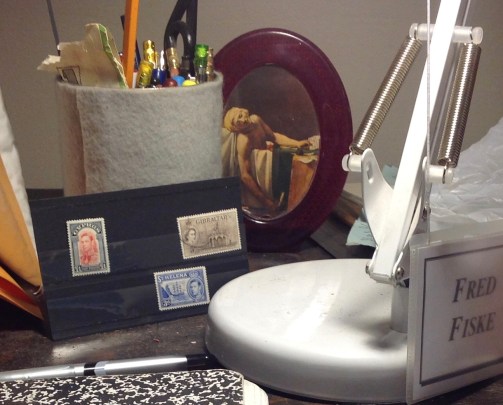
After I decant newly arrived stamps from the mailing envelope, I usually stick them on a small stock page, behind glassine holders on a black background, and display them on my desk so I can admire them for a while before mounting them in my albums.
It’s always exciting for a collector when the next envelope comes in containing stamps purchased for the collection, whether from an auction, a stamp dealer or even the U.S. postal service. When the mail is from a foreign land (and in the era of eBay auctions and global internet sales, this is common), it’s particularly fun to find an envelope in the mail festooned with exotic philately. Stamp dealers tend to use interesting postage on their shipping envelopes. (They are using up some of their extra stock.) Some stamps used for postage turn out to be worth collecting — which helps to ease the pain of the “shipping and handling” charge added to the internet order price.
So it was an added thrill the other day to receive a packet with an array of interesting stamps on the cover — including the $2.90 priority mail stamp from the 1990s that has a catalog value of more than $6, cancelled. (The reason for the extra postage was that the seller, embarrassed because he got my address wrong, re-sent the envelope via express mail; not necessary, but appreciated!)
Inside the envelope were three gorgeous engraved stamps I had ordered from a dealer through his online site. The bill for all three stamps was $50, plus postage and handling, but since there was a 15 percent discount for orders of $50 or more, I felt quite set up. The
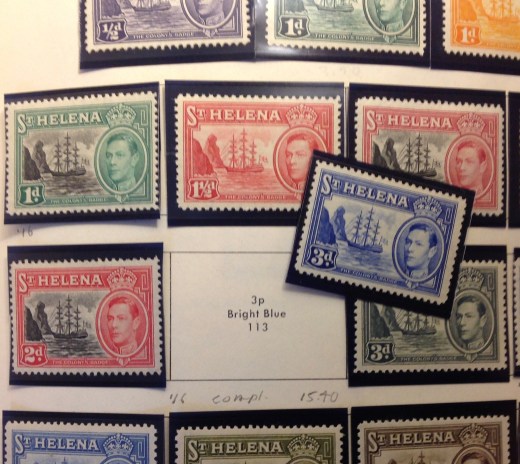
3d. blue from St. Helena, picturing the badge of the colony, completes my long set of the George VI definitives from the 1930s (see illustration).
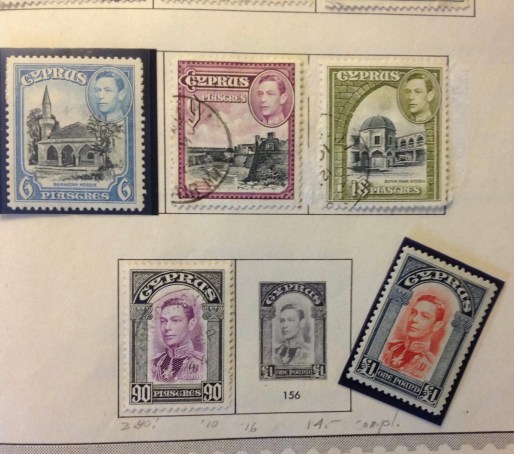
The one-pound stamp from Cyprus completes my George VI set from that country, same era. For a description of the pleasure that awaits in adding these two stamps to complete the sets on the pages of my British Africa and British America albums, please refer to a post in January 2017 on the joys of “filling spaces.”
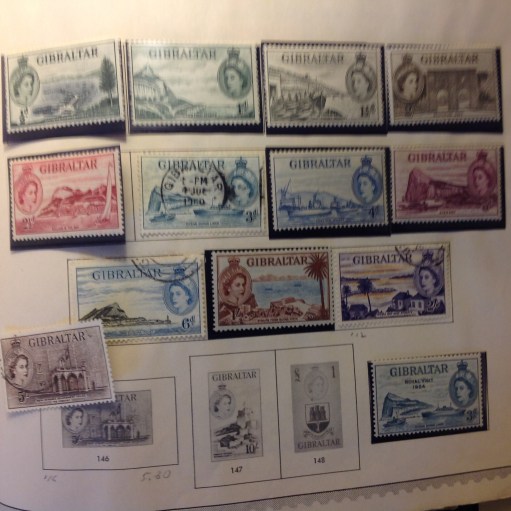
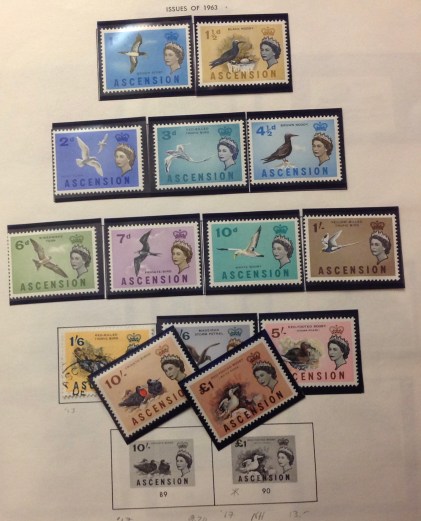
Here is the page in my British Europe album reserved for the Queen Elizabeth set of 1953. Notice the missing spaces for the 10-shilling and L1 stamps. Some day … Also notice how several of the stamps are cancelled and the rest are mint. This is a very controversial practice, a philatelic gamble that I hope pays off (see discussion in text) …
The third stamp from the envelope, the handsome five shilling engraving of the entrance to Government House in Gibraltar, is an incremental addition to my Elizabeth II set from 1953. — I’m still missing the 10 shilling and L1 stamps from the set, which are quite dear. Back in 1961, as a foresighted 13-year-old, I gathered my meager resources and sent a money order to Gibraltar, hoping to purchase most of that early set, which today is selling for $100 or more. As it happened, my letter arrived just months

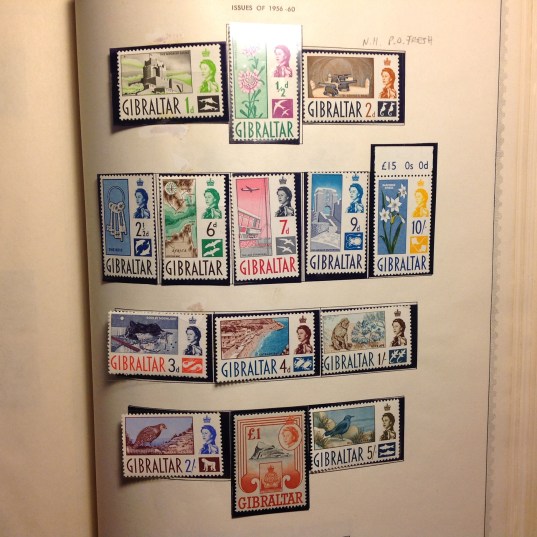
Since I mentioned the garish set from Gibraltar, I figure I ought to include at least a small illustration of that particular set for your viewing. Am I wrong to suggest these stamps are a bit — gaudy? Clashing? Ugly? There are uniform design elements and consistencies, to be sure The L1 stamp is a handsome two-color engraving — but it doesn’t match the rest of the set. On quite a few stamps, the colors don’t go together. starting with the 1/2d, bright green and indigo. Eek. The 7d looks like gray and Pepto Bismol. Urp. The contrasting red-brown and ultramarine on the 2 shilling makes my eyes go numb … Is it just me? Maybe you think this is a beautiful set. Well, I guess you are entitled to your opinion, even if it’s wrong. … (A dissenting opinion: Daughter Molly read the above and responded by email: “I think the supposedly ‘garish’ Gibraltar set looks quite Art Deco. It would be at home lounging in a deck chair on South Beach sipping Mai Tais while planning a night of salsa dancing with the pool boys.”)
after a new and rather garish set of definitives was released, replacing the stamps I had hoped to buy, so I got those instead. The garish set hasn’t done too badly, increasing nicely in catalog value. Still, I miss having a mint, never-hinged, post office-fresh 1953 set.
One other comment about the 1953 Gibraltar set — and the aforementioned Cyprus set from the 1930s as well. Unlike the all-mint set from St. Helena pictured up top, these two other sets contain both mint and postally used stamps. This may seem unremarkable, until you learn that such sets have considerably less market value, and perhaps less collector appeal. Catalogues list prices for sets that are all-mint, or all-used. Mixed mint and used sets are a philatelic mongrel to the traditional collector: neither phish nor phowl.
You may ask: If mixed sets are worth less than all-mint sets, and maybe even some all-used sets, why collect such mishmashes? Why not hold out for the more marketable commodity? Besides, don’t all-mint sets look prettier than sets with some stamps mint, others cancelled?
Good questions, to be sure. The prettiness argument is tough to counter, because it’s true. Mint and used stamps mounted together can look like a jumble — particularly in my albums, where I use black plastic strips to guard my mint stamps and plain stamp hinges to mount my used stamps. Indeed, you may not be convinced by my response in defense of mixed sets that follows. Please believe, however, that it is heart-felt. You see, I have decided to strive for philatelic completeness over philatelic correctness. I abhor those empty spaces in my album pages, and get pleasure from having entire sets assembled — mint, cancelled, even mixed. If I had a choice, I would go for the all-mint set, of which I have many. I also believe that a mixed set — with good mint stamps mingled among the used varieties — generally will be worth more than an all-used set. If I am looking for an elusive stamp to complete my mint set, I might go for a cancelled version. The mint one might be hard to find, or overpriced. Or I’m just too cheap to shell out the bucks. Or impatient. I dunno.
I have accumulated a considerable number of complete sets with mint and used stamps together. For early sets — George V and before — such mixed sets are not as big a deal. Older stamps are harder to find, and complete sets are rather rare. But I love all my mixed sets, old and newer. My basic motive in accumulating these mixed sets is that I am not willing to wait around for the exact stamp I need to pop up at the right price. Life is too short. Complete sets are more interesting than incomplete sets, even if the stamps are mixed. (They all must be in good condition, however!) If the coveted mint stamp appears and is affordable, of course I will pounce on it. If I can only find (or afford) a cancelled copy that fills out my otherwise mostly mint set, I’ll be tempted.
Part of me says: Fred, why are you doing this? Where are your standards? Don’t you realize you are settling for a mixed set, whose value is tainted? Then I also figure: Who knows? Maybe mixed sets won’t always be the pariah of the philatelic world.
There, I said it. I’ll stick to my story that collecting mixed sets is OK. One, you get the pleasure of completeness, now. Two, it’s still a solid investment, and could turn out even better. The future of stamp collecting is so dicey that in a few years the difference between mint and cancelled may grow less significant than the stamps themselves. Then it will be complete sets that collectors of the future will want … that is, if the whole hobby doesn’t turn to dust with the last generation of true stamp collectors …
Just one more point to discuss here. There must be thousands of stamps in my British Africa collection alone, plus thousands more from British America, British Europe, the Congo, my American and European collections, and so on. I have accumulated enough stamps over the decades to fill three shelves of a small bookcase to overflowing with my albums, stockbooks, binders and catalogues. How much is my collection worth? Certainly not its weight in gold. I imagine if instead of my giant, “magpie” collection (from here and there, including this and that), I had focused on buying several choice items, I probably would have been making a better investment. Stamps that already are rare are getting rarer, and their prices are strong and getting stronger. (Even though stamp collecting as a hobby is dying, etc., etc. Go figure.) I did not choose to be that kind of collector — probably because I started young, when it was easiest and most rewarding to accumulate large quantities of cheap stamps. The stamps I acquire now usually are not as cheap. They allow me to fill out sets, some of which I started collecting in my youth. There’s satisfaction in that. Years go by, and the albums grow richer with complete sets — and continue to grow more valuable. It is ever-more-entertaining to leaf through pages of philatelic history, bedecked with more and more orderly rows of these colorful, artistic, revealing postal artifacts …
Bonus! A Vaster Empire …
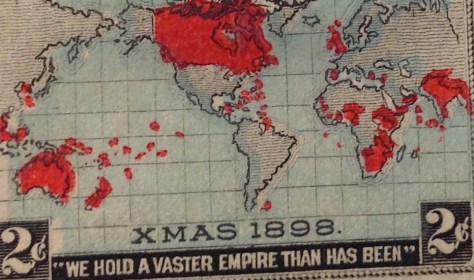
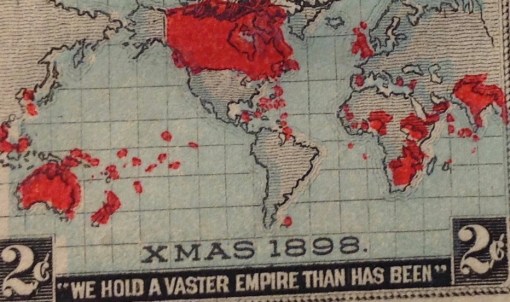
The inscription on a Canadian stamp that includes a map of the world
reads: “We hold a vaster empire than has been.” On the stamp, territory within the British Empire, circa 1898, is colored red. The empire’s reach is impressive, with great swaths covering North America (Canada), India. Australia and a good share of the African continent; plus generous red daubs in the Caribbean, east As
ia and across the Pacific.
To complete the engraving, the artist added one more inscription: “Xmas 1898.” Some collectors consider this the first Christmas stamp, a tradition that has carried on fitfully over the decades, beginning in earnest with yearly issues only in recent years. If you insist that the 1898 issue was indeed the first Christmas stamp, then please answer this question: Why did it take decades for the next one to arrive?

Victoria’s 60 year on the throne: In this double commemoration, a Leeward Island stamp from the jubilee series of the 1890s also carries the unusual “Sexagenary 1897” overprint.
Here’s a story that offers a colorful explanation for the Christmas reference. In philatelic lore, Canadian Postmaster General William Mulock was making the case that the 1898 stamp should be issued Nov. 9, to “honor the prince” — that is, on the birthday of the Prince of Wales, also known as the king in waiting. Hearing the suggestion, the Dowager Queen was said to have asked peevishly: “What prince?” (As it turned out, Edward VII would ascend to the throne upon the death of his dear mater Victoria in early 1901. Was she just cross with Mulock that day, or did she not wish to be reminded of who was biding his time in the wings?) Mulock, sensing his faux pas, quickly came up with an inspired rejoinder: “Why, madam, the Prince of Peace.” This met with Victoria’s approval, and so the first Christmas stamp, such as it was, was born.
There were two other purposes for the stamp. One was to mark the inauguration of the Imperial Penny Postage rate (which apparently was equivalent to 2 cents in Canada, the value on this stamp). The other was to commemorate the remarkable sexagenary (60th year) of Queen Victoria’s rule.
Ten years earlier, the Welsh poet Sir William Morris composed an ode, “A Song of Empire,” to mark Victoria’s 50th Jubilee in 1887. The line quoted on the 1898 stamp came from these verses:
We hold a vaster empire than has been!
Nigh half the race is subject to our Queen!
Nigh half the wide, wise earth is ours in fee!

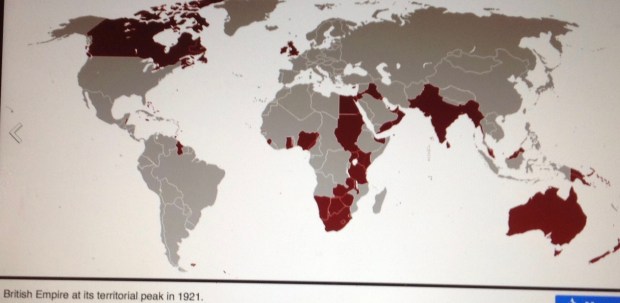
In this map of the world in 1921, as compared to the one from 1898 depicted on the Canadian stamp, you will notice how the British Empire (again, in red) expanded, particularly in North Africa and around India.
The statistical apex of territorial claims in the British Empire actually would not come until 1921. At that time, the empire had influence over 33.7 million square kilometers. Half of the globe’s dry land was “theirs in fee.” The empire’s population of more than 458 million souls constituted one-fifth of the Earth’s people.
The map depicted on that Canadian stamp from 1898 is still impressive. As an aside, notice how Canada happens to be centrally located under the crown. Did Queen Victoria not notice that Postmaster Mulock was making a not-so-subtle political point with his stamp? The inscription begins, “We hold a vaster empire …” That could mean the royal “we,” of course. Or it could suggest a broader imperial covenant that shares responsibility for the empire’s dominion with some of its most loyal subjects — like Canadians, who happen to bestride a transcontinental nation at the center of the world, “wearing” a crown, no less (at least according to this stamp) …
Depending on how you feel about empires in general, the British Empire in particular, you may be as horrified as you are impressed by its vast reach. Look at that little island off the northwest coast of France. England? Posh! That puny principality had the audacity to go out and impose itself on half the world, then claim some sort of ownership, or stewardship, rights and fees and privileges amounting to domination of one sort or another. What presumption! What bloody gall! The white man’s burden? The master race? What dangerous malarky!
Why this quest for global domination? The proclaimed mandate was to spread civilization, freedom, rule of law, Christianity and commerce. The reality was oh, so different. You can argue that the British Empire was the “best” empire (compared with, say, the Belgians, the Portuguese, the Spanish …) If so, it was only the least oppressive of the lot — and that’s just by a slim margin. Don’t get me started on the racism, intolerance, repression, cruelty, rights deprivation, genocidal policies and other flaws of imperialism. I may never stop …
Instead, please entertain another thought about the British Empire, as depicted on that stamp from Xmas 1898. A thought that encompasses the sheer stubborn force of the imperial hand — the hand with which Belgian King Leopold’s men hacked out a path through the Congolese jungle for the first train from Matadi to Leopoldville. The force that sent navigators, swashbucklers, adventurers, soldiers, entrepreneurs, scientists and soon enough, administrators and bureaucrats to every corner of the world. By 1898, the familiar saying that “the sun never sets on the British Empire” was literally true: When the governor general in Ottawa was sound asleep, the viceroy in Delhi was enjoying high tea — and vice-versa.
Imagine a civil service based in Whitehall, the London hub of the Foreign Office, where immaculately groomed mandarins supervised the affairs of empire on six continents (Antarctica came later). Was it possible to set standards for the orderly conduct of public business that could be upheld effectively in places as diverse as Nigeria, North Borneo and the Bahamas? To the extent that it was possible, might it not be considered a remarkable achievement?
As a stamp collector, I have long wrestled with the idea of the British Empire imposing civic order on the world. Not just oppressive domination, but also a sensible way of doing things — predictable, engaging, connected, occasionally even elegant in its protocols. Naturally, I am also talking about philatelic order. That is, the way stability and uniform standards in philately embody the unifying principles of empire.
And so, dear reader, I offer the set of illustrations that follows, rendering that “vast empire” as a series of unified stamp designs replicated across continents and seas.
Pictured here is an example of the stamps that were in circulation in 1897 or thereabouts, issued for use in far-flung precincts of the British Empire, all bearing a likeness of Queen Victoria. As you observe the similarities and subtle differences in the portraits and borders, explored in the next commentary, you can get a sense of how these stamps helped to draw together the British Empire; how they created an identity, a self-image, sustaining a unity of purpose, a commitment to stability and civic order, even pride in being part of this global enterprise. As you contemplate this mosaic of empire reflecting the image of an aging queen, consider these lines from Sir William Morris’s ode:
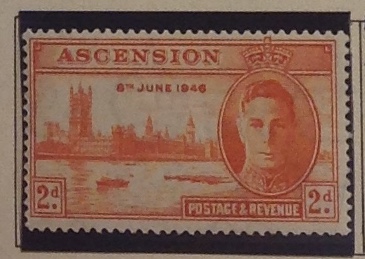
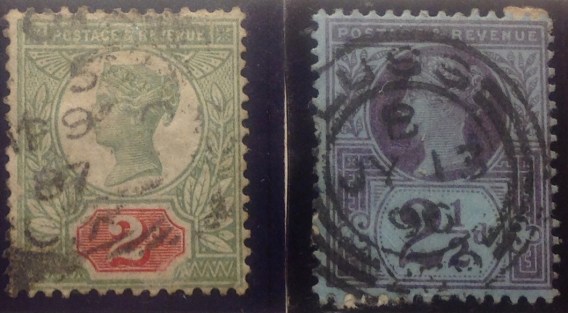
… And where her rule comes all are free
And therefore ’tis, O Queen, that we
Knit fast in bonds of temperate liberty
Rejoice to-day, and make our solemn Jubilee.
Yeah, yeah. I know the British Empire never lived up to these bonnie words by the Welsh poet. The claim that “all are free” under Victoria’s rule falls well short of the truth, along with Livingstone’s claim to be a guileless Christian missionary, Stanley’s pose as a crusading journalist, or Leopold the philanthropist.
Yet if there is a sliver of inspiration to be found in the moral purpose that once helped to fuel the colonial juggernaut; if you can imagine the thrill of exploring, bringing order, building new civic spaces … then that may be enough to draw you on to these iconic images of imperial Britain at its vastest.
A note on the Photo Gallery: Victoria’s Empire
What I have tried to do in the following series of illustrations is to present a fine-grain glimpse of the British Empire by grouping similar designs in portraits of Queen Victoria on stamps printed for use in the Home Country, and those available in the farthest colonial outposts during her long reign. What I already am discovering is that although there are significant similarities between stamps from the same era and with the same general characteristics, there are also subtle differences, It turns out there is not exactly a one-size-fits-all approach by the designers — at least, not during the Victorian era. In the 20th

The two-stamp Peace Issue of 1946 is an example of an “omnibus set” — the same design adopted by virtually every British territory.
century, the British began issuing “omnibus” series — identical designs across dozens of territories to celebrate, for example, King George’s silver jubilee in 1935, the coronation of George VI in 1937, the Peace Issue of 1946, and the Universal Postal Union set of 1949. Omnibus commemorative issues continued into the modern Commonwealth years.
Now I invite you on a leisurely tour of stamp designs during the Victorian era. Let’s start at the very end — the final years. The sexagenary, diamond jubilee, 60th year of her rule (1897), was celebrated in song and circumstance. Special sets of stamps were issued in a few colonies (British Guiana, Canada, Newfoundland). Another set was issued by more than a dozen colonies, similar in size and number to the regular definitive series of earlier decades, only this time with an image more uniform than ever before,
across colonies and continents. The typographed design — a compact miniature profile bust of the queen in a border, placed atop a tablet containing the value — was adopted with slight variations around the world. It’s the first omnibus set, in effect.
This extraordinary postal event illustrates how philately helped to unite the British imperium. Imagine these stamps, so similar in appearance, being purchased in a post office in Ceylon, British Honduras, Gambia or elsewhere, affixed to an envelope, stamped with a local postmark, and sent on its way to another part of the world — like a gossamer thread, stitching together a durable and colorful fabric of empire.
Victoria’s Empire on Stamps
Great Britain was the seat of empire, and GB never had to put its name on its stamps — because it was first, in 1840. (Can you believe it?) This set — the Queen Victoria Jubilee Issue — was released in 1887, with added values in later years. It set the standard for issues in colonies around the world. I include two stamps from the set,with considerable variations — if you can make them out under the heavy cancels. I particularly like the royal purple of the 2 1/2 d.
Notice in the images that follow, how many of these stamps, issued on five continents at roughly the same time, have a similar design (you might try enlarging them on your screen for even closer views of these beauties; then you will be able to appreciate the many subtle and not-so-subtle differences among them). This has to be one of earliest manifestations of globalization. To borrow a concept from columnist Thomas Friedman, the British already were busily “flattening” the world in the 1890s. Below is a gallery of the stamps pictured in the map above, with additions and comments when called for …
British America
Two predominant designs were used in Jubilee stamps from the Americas. These from St. Vincent show one design, with a crimped border around the bust. Notice the hand-written cancels. These tend to lower the value of the stamp — the preferred cancel is a circular date stamp in black ink — but the handwriting is intriguing. What does it mean?
These Jubilee stamps, above, from three Caribbean/Central American colonies are identical in design — though the tablet border and numeral style change for the British Honduras set. Notice, below, a similar looking British Honduras stamp with a circular border of the cameo portrait — one replicated in a number of other colonies. Why the change? Which border is better — crimped or circular? You decide …
Oddball variations, below. The stamp at left, from Jamaica, still has the bust-portrait and the number tablet, but otherwise is very different in design (just wait until you see Natal, a little further on …)
At right you have all the elements of a Victoria jubilees design in a stamp from British Guiana — but no Victoria! Instead, there is the badge of the colony. Why? You’d have to consult the mandarins at Whitehall on that one …
Sidebar: glimpse at the end of an era. Below is one of the final portraits of Queen Victoria engraved on a stamp. Caught in a reflective mood, the queen seems to be staring fixedly into the light — the future? The celestial lumens? It is a remarkable portrait of the ungainly queen. In real life, she could seem as awkward and bad tempered as the famous Lewis Carroll caricature in Alice’s adventures … But on stamps she was never less than regal.
Interesting aside: There was a problem with the first Canadian set (above left), even though it was a bold new design for 1897 and still has a clean, startlingly modern look. The problem: There was no number, just letters and four maple-leaf ornaments engraved in the corners. The second set (right), issued in 1898, took away two of the maple leaves and replaced them with numbers in the lower corners. It seems postal authorities overestimated the literacy of the population. Maybe it was also a French-English thing. Just guessing.
British Africa
By now these Jubilee designs should be getting pretty familiar to you. Oh yes, notice the similarities between the Natal stamp and Jamaica, above. Well, not so similar when you actually compare them … These stamps span the African continent, from the Atlantic nations of Gambia and Sierra Leone, across the vastness of Northern Nigeria, to the south African colonies of Natal and Zululand.
British Asia
Below are a couple more samples, of Jubilee stamps — one from Ceylon/Sri Lanka off the east coast of India, the other from thousands of miles to the east and the Straits Settlements of Singapore and Malaya. Underneath is an Indian stamp from 1899 that is not the same design at all. But it’s a classic late portrait, so I’m including it, just for fun.
Australia and British Oceania
For some reason the omnibus Jubilee design memo did not reach Australia, the Antipodes (I think that means New Zealand) or any of the micronesian colonies, protectorates, condominiums and what-have-you strewn across the south Pacific. Since I’m not a big collector of this area, I only managed to scrounge up a few battered examples of late Victorian philately from down under — including Victoria on Victoria! (Today Australia’s smallest and richest state, Victoria once was a separate colony and issued its own stamps from 1850 to the early 1900s. During that time it produced at least 50 original portraits of Victoria on stamps. Some of them, I must say, are quite primitive! It’s fun to check them out on eBay. Oddly, the last stamps from the colony of Victoria pictured the queen’s son and heir to the throne, the new King Edward VII, ruining the eponymous philatelic fun — but at the same time injecting a gender-bending element: Edward-Victoria!
Same stamp design on five continents. Now let’s play a parlor game of spot-the-similarities among the eight stamps appearing below: 1) All feature the Victoria bust; 2) in a circular border containing the country name and amount; 3) all letters, no numbers … Now, enjoy the variations in these delicate designs — do any of them have the same border flourishes, for example? This harmonious “set” of nine stamps actually comes from five separate continents — including Mauritius, which I include just as an illustration because I don’t have that particular one — yet.
Mid-Victorian design similarities, 1860s-1880s. Another round of spot-the-similarities, anyone? Eight more stamps from earlier in the Victorian era, spanning three continents, are depicted below. They share the iconic portrait of the queen, a round border and a bar below with the value. Look how closely Lagos (Africa) resembles Dominica, Tobago and St. Christopher (Caribbean). Not … quite … the … same, though.
Round three. Try to find any design differences among the 10 beauties pictured below. The new challenge for this page is inspired by Sesame Street, I think. Which of these things belong together, which of these things is not quite the same? Or something like that.
Spoiler: Check the Trinidad stamp, which looks like it should have the standard Victoria portrait, but instead uses the badge of the colony, or “Britannia,” if you will. What gives? What next? A “portrait” of a giraffe on a stamp from Tanganyika?


I kid you not. At first I thought this giraffe set from the British Mandate of Tanganyika was an anti-monarchist spoof. But it’s real enough. The series appeared in 1922. A set with George V’s portrait didn’t follow until 1927. The stamps are gorgeous little engravings, colored with brilliant inks of carmine, green, orange and dark violet that contrast deliciously with the jet-black centers. Still, it’s a shock to see the spot normally reserved for a Royal be usurped by a dopey-looking giraffe. Why, it borders on insubordination! This set allows one to imagine at least some of the mandarins of the Colonial Office had a sense of humor.
Early Victorian stamp design similarities — 1850s-1860s. Most British stamps from Victorian era originated with the cameo portrait of Princess Victoria created by William Wyon in 1834, pictured here. That image appeared on a medal commemorating the new queen’s visit to London in 1837. It also became the basis for the world’s first stamp — the “Penny Black” of 1840 (see below). The stamp’s designer, Sir Rowland Hill, picked the rough sketch by Henry Corbould (I’m still looking for that sketch), and engravers Charles Heath and his son Frederick
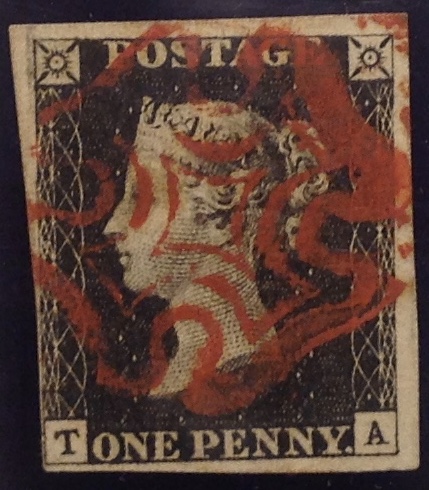
produced the stamp. The image, subject to minor revision over the years, and illustrated by the early stamps pictured below, would remain in continuous use in successive sets issued in Great Britain and the empire until Victoria’s death in 1901.
The Chalon head

It’s hard to believe the portrait at right is of the same woman who was portrayed in those stamps above as a classical bust or an aged dowager. In this painting, she appears young and winsome, swallow-necked and elegant, with a coy, doe-like beauty.
“Chalons” are prized among British Colony stamp collectors because they are generally early and rare — not to mention beautiful engravings. The stamps, some of which are pictured below, appeared starting in the British empire in the early 1850s. The first was Canada’s provinces (1851), then Nova Scotia (1853), Tasmania/Van Diemensland (1855), New Zealand (1855), The Bahamas (1859), Natal (1859) Grenada (1860), New Brunswick and Queensland (1860).

Notice my pencil marks below the stamp, which indicate I purchased it in 2012 for $16.53, and that a catalogue listing in 2009 valued the stamp at $110. Not a bad deal!
In most colonies, the stamps were replaced as Victoria aged. Canada marked Victoria’s sexagenary in 1897 with a startling pair of side-by-side cameos of the queen “then” (the Chalon head of 1837) and “now” (the plump old dowager). The same person? Impossible! In Queensland (now Australia), you could still buy a high-value stamp with a Chalon head at the post office as late as 1912, more than a decade after Victoria’s death. 
Take a second look at the portrait in the Nova Scotia stamp, at right — the green 8 and 1/2-center from 1860 (value: a few bucks at most). On double-take, it’s clearly not based on the Chalon head. My bet is on the Winterhalter portrait of 1859, reproduced below. 
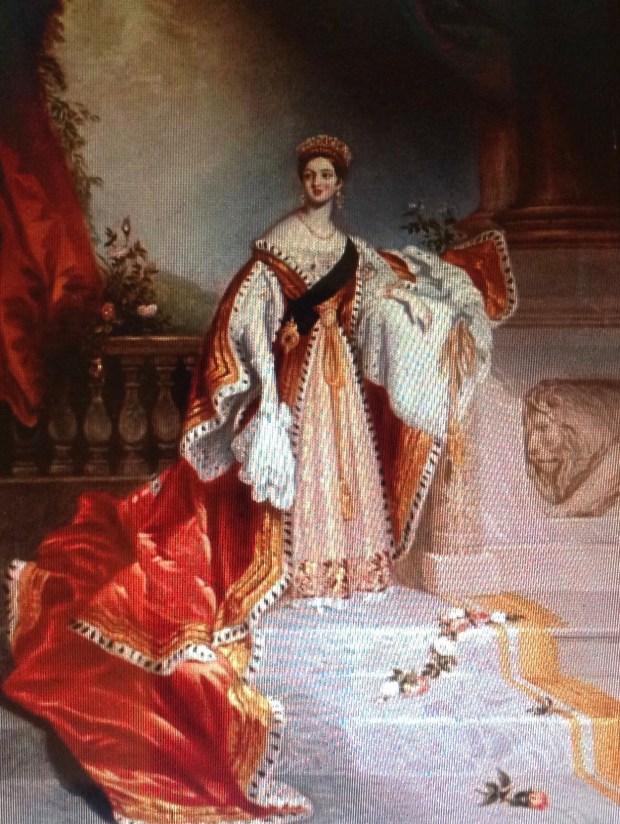
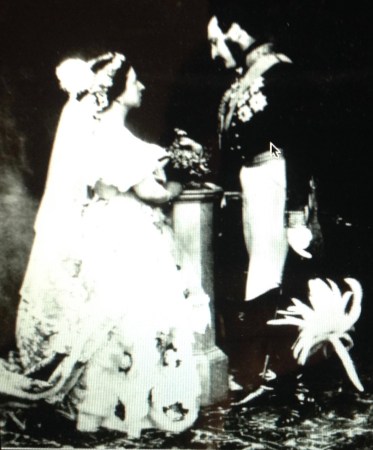
Above is full Chalon portrait of Queen Victoria. It was painted in 1837 by Alfred Edward Chalon, intended as a gift to Victoria’s mother and to mark her first public appearance as queen — for a speech at the House of Lords to prorogue Parliament. The painting became known as the “Coronation portrait,” and engraved images were popular with the public as early as 1838. This painting is the basis of the “Chalon head” portrait used on early Victorian-era stamps, illustrated above.
Reality check: Here is an apparent photo-like record of the marriage of Victoria and Albert in London, Feb. 10, 1840. The close-up below is strikingly immediate, bringing you face to face with an intimate moment more than a century-and-a-half ago. … Queen Victoria looks, well, short and dumpy. She has a big nose and a receding chin. She is, well, homely. Perhaps such realistic depictions don’t do her justice. Or perhaps the engraver’s art is, well, artful. There is no mistaking her resolve in this image as she gazes at her prince. They were by all accounts a happy couple, in love and devoted to each other for the 21 years allotted them before Albert succumbed to stomach ailments and
typhoid fever. They had nine children. Victoria would continue on as queen until her death in 1901, becoming the longest-reigning British monarch in modern history — that is, until her great-great-grandaughter Elizabeth broke her record in 2015.
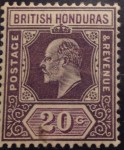
The British Empire’s fourth dimension — through time in stamps
- Same design through five reigns: (from top left) Victoria, 1837-1901; Edward VII, 1901-1910; George V, 1910-1935; George VI, 1936-1952; Elizabeth II, 1952 —
- The stamps pictured above, from around the British Empire, were issued between the 1890s and the 1950s. They span five reigns, from Victoria to Elizabeth, that amount to 179 years — and counting. Across this vast expanse of time and territory, these stamps have held to the same design standard set by the first Victoria Jubilee series. These remarkable threads of continuity — from monarch to monarch, century to century, continent to continent —weave a mesmerizing tapestry of empire, don’t you think?
Onward from the Congo. But where?

Here are the first two stamps of the first set of the “Etat Independent du Congo.” They were issued in 1886, and are worth a few bucks.
Note to readers —
You now have at your disposal my first foray into Congo stamp commentary — “10 Interesting Anecdotes about Congo Stamps” — including Anecdote No. 10, a long and personal memoir of my own experiences in the Congo, between 1962 and 1964, in which my writing seems to have abandoned all restraint. Oh well, at least there are profuse illustrations …

A nice engraving from the first airmail set, in 1920 — though the plane looks a bit like a dragonfly, don’t you think?
What next? My provisional plan was to continue with a page-by-page exposition of my Congo collection, starting with the King Leopold sets from the lawless years of the Congo Free State in the 1880s and 1890s; then through the tedious and oppressive decades of Belgian colonial rule until independence in 1960; then the prism-like philatelic

The long series featuring masks, issued between 1947 and 1950, featured beautiful two-color engravings.
shattering of the fractured secessionist states and beyond. Now, however, I realize that other commentaries may have to come first. Before I go on, however, a parting word or two on the Congo.
My active collecting of Congo stamps

This is from a set issued in 1958, two years before independence, to commemorate 50 years of Belgian rule in the Congo. 1908 was the year King Leopold yielded to pressure and gave up his “independent state.” I guess it’s an event worth celebrating — the evolution of the Congo from a King’s private fiefdom to a vassal colonial state. The kings, left to right, start with Leopold I (don’t know why he’s in there …), then King Leopold II, Albert, Leopold III, and finally the young new King Baudouin.
ended soon after I left Africa in 1964. It was depressing to witness the stagnation and disarray of the Congo during the decades of Mobutu’s brutal, careless dictatorship after 1965. I just didn’t have the heart to collect the bland, crude, haphazard issues that emerged from the Congo, then Zaire, now simply “Congo.” It’s been more than 20 years since Mobutu left, and the Congo is still a basket case of a nation. What gives?
Perhaps this is enough about the Congo for the time being. Look at it this way: If I whetted your appetite for more by sharing my 10 anecdotes, fine. I’ll get back to my Congo collection by and by. I’m sure there is a story on every page. As we divert from our fascinating philatelic hike through the Congo, let me just leave you with a few more images and long captions to round things out.

Does it strike you as a little depressing that an early issue of stamps from the Republique du Congo should celebrate the “reopening of Parliament”? That is, barely a year into independence, the country has had its parliament set up, shut down, then started up again. The overprint is on a stamp featuring President Kasavubu and marking the first anniversary of independence. Some anniversary. The country was still split by secessionist movements, and within years a new dictator would emerge, Joseph Mobutu, who was just as bad for the Congo in his way as old King Leopold II. This stamp purporting to celebrate a real, working, open parliament tacitly admits the failure of democracy thus far. It’s only 1961, and the Congo still has far to fall …

Here is a poignant artifact. In 1964, the Congo issued a set of stamps, along with this souvenir sheet, celebrating the 10th anniversary of the national university, Lovanium. The images of science, a scientist and the badge of the university superimposed on an orderly set of modern buildings gave every reason for hope in the technological future of this young nation. Alas, it was not to be. Today, the Congo is a barely functioning state covering a vast land mass, manifestly incapable of meeting the basic needs of its citizens. I could check and see what has become of Lovanium and its brave hopes, but I don’t care to. You do it. For me, it’s too depressing.

Joseph Mobutu is pictured here in his leopard-skin cap, sign of his African “authenticity.” Can you imagine being immortalized on a stamp — wearing sunglasses? Perhaps it’s to disguise the fact that he has eyes only for the big diamond pictured at right. Mobutu stole a fortune estimated at up to $15 billion from the Congo. Where is all that money today? Good question …

OK, I’m a retired opinion writer, so allow me an editorial comment: This stamp seems a fairly accurate portrait of Joseph Mobutu, the leader of “Zaire” — a royal python strangling his country.

So what do you make of this bird? I think it’s originally a stamp from Zaire, but the name is blacked out like a censor’s box. Underneath is the inscription, “Rep Dem Du Congo” — cryptic at best. The old value also is blocked out by a black square — literally a box at the foot of the falcon, or hawk, or vulture pictured in the stamp. The new value, 70fc, is a mystery to me (“Francs Congolais,” perhaps?) … eBay calls it an “unknown overprint.” I cannot certify either its provenance or legitimacy. … The only other thing I’d say is that this very odd stamp is jarring: Those black boxes and the beady-eyed predator convey a sense of menace, foretelling dark days and disorder.

Here’s the last Congo caption for now, I promise. The stamps above were produced in 1997, as the nation’s name was changed from “Zaire” back to “Congo.” According to the Universal Postal Union, the stamps were “illegal issues.” In a letter to the UPU, M.S. Raman, assistant postal director, declared that the stamps “are fraudulent and are therefore not admitted for philatelic sale by its postal Services.” Below are legitimate stamps from 2000, using the correct (if not exactly accurate) new name for the country: Republique Democratique du Congo.

So after Congo … now what? Earlier, I set out a leisurely alphabetical stroll through my British Africa book. I started with Ascension, got through Basutoland — then got distracted by the Congo thing. The natural progression now would be to get back on track, which means Bechuanaland. Indeed, I find this prospect irresistible. Basutoland and Bechuanaland had considerable philatelic similarities, with interesting differences.

Notice the stylistic similarities between these definitive sets from Bechuanaland Protectorate, above, extending from George V in the 1930s through George VI and finally, to Elizabeth II in the 1950s. Now view the similarities in Basutoland’s series, below — up to a point. Why didn’t Basutoland keep up the tradition and print the same design with Queen Elizabeth? Is it really all about the crocodile?


Can you make out Queen Victoria’s portrait above, facing left, in this 2-shilling stamp from the 1880s? The overprints, below, on Cape of Good Hope stamps, are clear enough — but who decided to run them both ways?
The history told in Bechuanaland stamps dates back far before Basutoland to the Victorian era, when imperial pioneers were still exploring. They established, by negotiation or force, protectorates and colonies, sometimes both on the same land. Bechuanaland is an example of
this, and stamps help tell the story. Bechuanaland (now Botswana) covers a land mass the size of France, is landlocked, bordering South Africa. Historically, its sparse pastoral population, dry climate and arid regions ensured that it would not be at the center of continental dramas and battles for the lucrative spoils of gold, diamond, rubber and the like. To the south, however, colonial history and politics brought bloody clashes and diplomatic rifts that reached Whitehall and Berlin, and reverberated back to Capetown.
South Africa had its barons, burghers, magnates, soldiers, statesmen and adventurers. The interactions between whites and blacks were racially regimented and hierarchal, but political relations
were another matter. From early on, black Africans collaborated, conspired and clashed with whites, the same as would one tribe with another. Particularly vivid are stories of the sometimes nuanced relations between Boer and Zulu leaders in the 1880s and 1890s. The turn of the century brought to full flower the Boer War with the British. The pitched battles were appalling in the loss of life and limb. In comparison, the tangle of philatelic history involved will be a pleasure to try and unravel.

Same country, same people, only now “British Bechuanaland” becomes “Bechuanaland Protectorate.” (In the case of this stamp, these developments are recorded on a half-penny stamp that originally was issued for use in Great Britain.) It seems the colonial masters never settled on one definition of their overseas holdings. Some were more independent, or more protected, or more autonomous or semi-autonomous, than others. There were crown colonies, and protectorates, mandates and trust territories, dependencies and federations … all so that Great Britain could cling to its self-image as a source of influence in “a vaster empire than has been.” Even today, if you made a tour of countries once or still within the “Commonwealth,” I suspect you would still see many signs of continuing British cultural influence.

This is Africa? Although I wasn’t a collector of South African stamps until recently, I remember being struck early by this particular design. South Africa first issued this set in the 1920s, and kept coming up with slight variations over the years until the 1950s. This image of imposing, elegant government buildings struck me as incongruous for an “African” country — which was supposed to be primitive, right? I was a teenager at the time I was making this judgment. It just looked so — European, so — cosmopolitan. How could this be Africa? How indeed? The fact is, no country in sub-Saharan Africa could ever compete with South Africa when it comes to infrastructure. Impressive. But it was still a racist system, inherently unstable and fatally flawed.
Indeed, I don’t see how I can resist a fuller look at South African stamps. My South African collection, though improving, is not much to boast about. My increased interest is relatively recent — I used to consider South African stamps dull, some downright ugly, and with all that English-Afrikaans bilingual clutter!

Until recently, I tended to dismiss South African stamps as rather … homely. Now I’m not so sure. There’s lots of history to explore. Lots to learn …

The Cape of Good Hope stamp above, overprinted with a big red “G,” is from Griqualand West, in 1877. This was a short-lived British crown colony, apart and distant from Griqualand East, which never put out postage stamps. The “:Nieuwe Republiek” stamp below, issued in 1887, is from a breakaway republic of the Boers, which apparently retained sterling currency. Look closely and you should see the embossed coat of arms behind the printing. I paid $12.94 for this stamp in 2012. The Griqualand West stamp (from 1878) cost me $4.95 in 2015.

As I am reading more South African history, I become intrigued with its philatelic artifacts — for example from short-lived colonies and states like Griqualand West and the New Republic.
The striking imagery and symbolism of stamps make them authentic labels of politics and culture. There is much to learn from postal history. Some stories are arresting and cinematically vivid. No doubt it will take some time to get there, but I already look forward to sharing the story behind my stamp from Cape of Good Hope, overprinted in 1899 with the alarming inscription: “Mafeking Besieged.” The bloody tale involves the heroism and ingenuity of Col. (later Lord) Baden-Powell, who inspired the Boy Scouts.

How about this beauty? It’s from 1895, celebrating with images of progress and productivity. The central coat of arms (under a heavy cancel, sorry) represents the doomed “South African Republic” of the Boers.

I purposely didn’t include a stamp in this illustration — only the blank spaces on my page in the British Africa album. That’s because the so-called Pietersburg issues of 1900 are rare and expensive. I could include a photo from eBay, but I prefer to wait. Perhaps by the time I write more expansively about South Africa I will actually have one of the elusive rascals. I already have learned some arcana, to wit: I should insist on a copy with only a handwritten cancellation, as above, and not with a customary postal cancellation, because those copies were cancelled-to-order and worth considerably less … (What does cancelled-to-order mean? That’s another story — don’t get me started …)

Above is my “Mafeking Besieged” stamp, a surcharge and overprint of the familiar Cape of Good Hope stamp. You will see the upper left hand corner is “rounded,” with stunted perforations, thus diminishing its value. The stamp is catalogued at $47,50 or more, and I feel lucky to have acquired it on eBay for just 17-and-a-half pounds.
Why should I venture so soon to South Africa? The alphabet plan offers its delights as well: after Bechuanaland comes British East Africa (1890-1903), then Cameroons (wait, that wasn’t a British colony, was it?), and then … well, then comes Cape of Good Hope — South Africa! — and we’re off to the races!

The Orange Free State was also a Boer Republic — until it wasn’t. Notice how the original design was surcharged once, then again, and overprinted “VRI” to signify the dominion of Queen Victoria over the Boer land.

Here are some stamps from countries I will be skipping over — like British East Africa, a “country” that first ran like a concessionary stand for imperial adventurers, developers, entrepreneurs and looters under the British. (“Light and Liberty”? Don’t make me cry …)
Here is a stamp from German “Kamerun,” occupied by Great Britain after World War I. The French took over much of Cameroon, in west Africa, though British influence remained. As the region was going independent in 1960s, the UK issued a set of stamps — Nigerian definitives, overprinted — for use in the Anglophone trust territories (UKTT) until their final disposition could be decided. The Scott catalogue explains what happened next: “Nos. 66-77 were withdrawn in Northern Cameroons on May 31, 1961, when that territory joined Nigeria and in Southern Cameroons Sept. 30, 1961, when that territory joined the Cameroon Federal Republic.”


Even non-philatelists have heard of the Cape of Good Hope Triangles. Here is one of two in my collection. I inherited them from my father. If he and I are not mistaken it is COGH No. 1, issued in 1853. It’s a pretty nice example of a fairly valuable stamp (catalogue listing: $200, used). It is a beautifully engraved design of a seated “Hope,” worth collecting as a rare art object, don’t you think? Can you imagine, though, trying to use these stamps? Cutting them out from the sheet at all those angles? No wonder triangle stamps never caught on … And no wonder they are hard to find with complete and ample margins. I do hope this is genuine. The catalogue warns that “counterfeits exist.”